Insights
Why geo targeting matters for iGaming affiliates

Geo-targeting in iGaming affiliate marketing is the practice of delivering offers, tracking, and commissions based on a user’s geographic location to improve campaign performance, compliance, and revenue. The industry term is geographic audience segmentation, and it sits at the core of every profitable multi-jurisdiction affiliate operation. Understanding why geo targeting matters for iGaming affiliates is not a theoretical exercise. Campaigns using geo-specific landing pages outperform generic campaigns by 40%–120% in conversion rates, and over 40% of affiliate traffic originates outside primary target markets. Those numbers define the opportunity, and ignoring them costs real money.
Why geo targeting matters for iGaming affiliates: the core case
Location determines everything in iGaming. It determines which operator licences apply, which payment methods players trust, which bonuses are legal to advertise, and what a converted player is actually worth. An affiliate sending UK traffic to an unlicensed operator faces account termination. An affiliate sending Brazilian traffic to a UK-only bonus page wastes every click.
Brands excelling in geo-aware personalisation generate 40% more revenue, and 91% of consumers prefer region-relevant offers. That preference is not a soft metric. It translates directly into click-through rates, registration completions, and first-deposit conversions. When a player in Ontario sees a bonus denominated in Canadian dollars with Interac as a payment option, the friction disappears. When that same player sees a bonus in euros with bank wire only, they leave.

The importance of geo targeting goes beyond personalisation. It is the mechanism that connects traffic volume to actual commission earnings. Without it, affiliates optimise for clicks that never convert, and operators pay commissions on traffic that generates no value. Both sides lose.
How does geo-targeting improve conversion rates and revenue?
Geo-targeting lifts conversions through three mechanisms: offer relevance, language alignment, and payment method matching. Each one removes a reason for a player to abandon the registration flow.
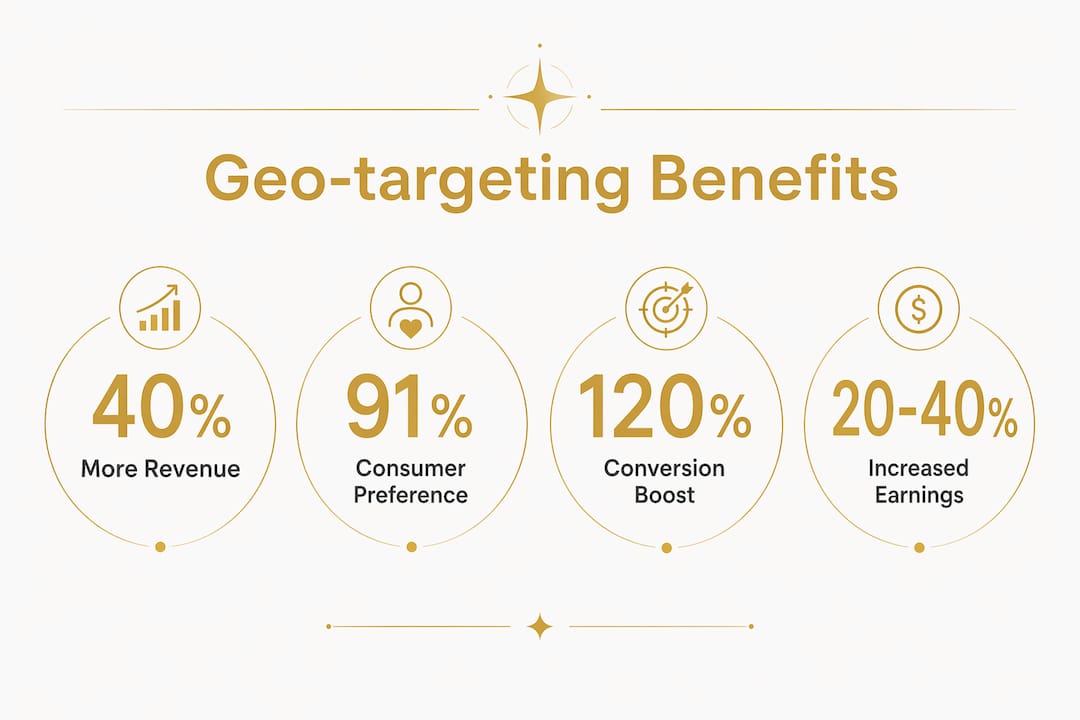
Geo-specific landing pages deliver a 40%–120% conversion rate improvement over generic pages. That range reflects how much variance exists between markets. A well-localised page for a Tier 1 market like Germany or Sweden sits at the higher end. A generic English page served to a Spanish-speaking audience sits at the lower end, or below it entirely.
The revenue impact compounds when affiliates capture traffic they previously ignored. Without geo-routing, over 40% of international traffic goes unmonetised. Recovering even a portion of that traffic through geo-aware smartlinks adds 20%–40% to total affiliate revenue without increasing ad spend. That is pure margin recovery.
Key geo targeting benefits for affiliates in the conversion context:
- Offer matching: Players see bonuses, free spins, or no-deposit offers that are legal and available in their jurisdiction.
- Currency localisation: Displaying amounts in local currency removes cognitive friction at the deposit stage.
- Payment method alignment: Showing Pix in Brazil, UPI in India, or Trustly in Scandinavia directly increases deposit conversion.
- Language and cultural tone: A page written for a German audience reads differently from one written for a Canadian audience, even in English.
Pro Tip: Segment your traffic reports by country before building any new landing page. The data will show you which markets convert at under 1% on your current generic page. Those are your highest-priority localisation targets.
What is the compliance role of geo-targeting in iGaming?
Geo-compliance is an operational requirement, not an optional layer. Tracking conversions only in licensed markets and restricting non-compliant traffic is embedded in affiliate tracking and commission logic for any serious programme. Affiliates who skip this step do not just lose commissions. They risk account suspension, domain blacklisting, and regulatory fines passed down from operators.
The compliance function of geo-targeting works at several levels:
- Traffic filtering: Blocking or redirecting players from jurisdictions where the operator holds no licence.
- Ad restriction enforcement: Preventing bonus ads from appearing in markets where bonus advertising is prohibited, such as the Netherlands or Sweden.
- Responsible gambling alignment: Serving age-verification messaging and problem gambling resources that meet local regulatory standards.
- Conversion qualification: Counting only registrations from licensed markets toward affiliate commission thresholds.
Promoting unauthorised offers risks account and domain blacklisting. That consequence is permanent in many affiliate programmes. A single compliance failure in a regulated market like the UK or Ontario can end an affiliate relationship that took years to build. Geo-targeting is the technical layer that prevents that failure from happening by default.
Pro Tip: Review the promotional content rules for every jurisdiction you actively target before running paid traffic. Bonus advertising restrictions in Sweden, the Netherlands, and Ontario differ significantly from each other.
How does geo-based commission structuring work for affiliates?
Commission structures that ignore geography are a liability. Treating commissions as uniform across jurisdictions leads to margin erosion for operators and lost affiliates when payouts do not reflect the actual value of traffic. A flat 25% revenue share applied equally to a UK player and a Tier 3 market player produces wildly different outcomes for both parties.
Earnings per click vary drastically by geography. Tier 1 markets like the UK, Germany, and Canada produce EPC values above $0.50. Tier 3 markets produce EPC values between $0.05 and $0.10. That tenfold difference means a flat CPA deal that works in Canada destroys margin when applied to traffic from lower-value markets.
Geo-based commission engines solve this by aligning deal structures with market context, fraud signals, and player lifetime value by jurisdiction. The table below shows how commission logic shifts across market tiers:
| Market tier | Typical player LTV | Preferred commission model | Key risk factor |
|---|---|---|---|
| Tier 1 (UK, Canada, Germany) | High | Revenue share or hybrid | Regulatory compliance cost |
| Tier 2 (Poland, Brazil, Mexico) | Medium | CPA or hybrid | Payment method variance |
| Tier 3 (emerging markets) | Low | CPA with geo cap | Fraud and chargeback risk |
Pro Tip: Ask your affiliate manager for a geo-breakdown of your traffic’s player LTV before renegotiating commission rates. Operators with geo-aware reporting can show you exactly which markets are profitable and which are eroding your share.
Geo-based reporting also enables affiliates to identify underperforming markets and reallocate budget. If your Canadian traffic converts at three times the rate of your US traffic on the same offer, the data tells you where to spend more. That kind of affiliate programme management decision is impossible without location-level data.
How to implement geo-targeting effectively in iGaming campaigns
Technical implementation determines whether geo-targeting delivers its theoretical benefits or creates new problems. The most common mistake is using IP-based redirects without proper SEO architecture. Improper geo-redirects harm search rankings. Search engines cannot index location-specific content when they are redirected away from it on every crawl.
A sound technical setup follows this sequence:
- Use hreflang tags and subdirectory structures. Assign each market its own URL path (e.g., /ca/, /uk/, /de/) and tag each with the correct hreflang attribute. This tells search engines which version to serve to which audience without blocking crawlers.
- Deploy geo-aware smartlinks. Smartlinks detect a visitor’s location and route them to the highest-converting offer available in their market. Without geo-routing, standard affiliate links lose commissions on 20%–40% of international traffic due to errors or untracked visits.
- Match payment methods to local billing culture. EPC variance makes offer-billing alignment critical. A player in Brazil who reaches a deposit page with no Pix option will not convert, regardless of how good the bonus is.
- Avoid cloaking. Serving different content to search engine crawlers than to users is a manual penalty trigger. Geo-targeting must be transparent and consistent across both.
- Test redirect chains. Every additional redirect in a geo-routing chain adds latency and increases the chance of a broken link. Keep the chain to one hop where possible.
The content localisation layer sits on top of the technical layer. Localisation means more than translation. It means using local bonus terminology, referencing local payment methods, and writing in the register that resonates with that market’s players.
How does geo-targeting integrate with broader affiliate marketing tactics?
Geo-targeting and iGaming audience segmentation work together. Location is one segmentation variable, but it becomes more powerful when combined with device type, traffic source, and player intent signals. An affiliate running paid social in Canada and organic search in Germany needs different creative, different offers, and different tracking parameters for each.
Practical integration points for affiliates include:
- Dayparting by time zone: Scheduling ad delivery to match peak gambling hours in each target market improves cost per acquisition without changing the offer.
- Creative localisation: Using imagery, colour schemes, and bonus framing that align with cultural expectations in each market. A welcome bonus framed around hockey resonates in Canada. The same framing falls flat in Brazil.
- Underserved market identification: Geo data reveals markets where competition is low and player acquisition costs are below average. These are the markets worth building content for before competitors do.
- Brand safety enforcement: Aligning every ad and landing page with the affiliate brand safety standards of each jurisdiction protects both the affiliate and the operator from regulatory exposure.
Geo-targeting evolves from a tactical feature into a business intelligence discipline when affiliates connect location signals to business outcomes. The affiliates who treat it that way consistently outperform those who treat it as a simple redirect rule.
Key takeaways
Geo-targeting is the single most important variable connecting traffic volume to actual affiliate revenue in regulated iGaming markets.
| Point | Details |
|---|---|
| Conversion rate impact | Geo-specific landing pages outperform generic ones by 40%–120% in conversion rates. |
| Revenue recovery | Geo-aware smartlinks recover commissions on 20%–40% of international traffic that standard links miss. |
| Compliance is non-negotiable | Promoting offers in unlicensed markets risks account suspension and domain blacklisting. |
| Commission tiers by market | Tier 1 EPC exceeds $0.50 while Tier 3 EPC sits at $0.05–$0.10, making flat commission models unprofitable. |
| Technical setup matters | Hreflang tags and subdirectory structures protect SEO while enabling location-specific content delivery. |
My honest view on geo-targeting as a core affiliate skill
I have watched affiliates build six-figure traffic operations that earn almost nothing because they never bothered to segment by location. They optimise for total clicks, celebrate high session counts, and then wonder why their EPC is terrible. The answer is almost always geo. They are sending Tier 3 traffic to Tier 1 offers, or worse, sending traffic to markets where the operator is not even licensed.
Geo-targeting stopped being an optional tactic years ago. It is now the foundation of unit economics in iGaming affiliate marketing. If you do not know your EPC by country, you do not know your business. If you do not have geo-aware compliance filters in your tracking setup, you are one regulatory audit away from losing everything you built.
The affiliates who treat geo data as business intelligence, not just a routing rule, are the ones building durable operations. They find underserved markets before the competition does. They negotiate commission structures that reflect actual player value by jurisdiction. They build content that ranks in local search results because their technical setup is correct. That is the competitive edge, and it is available to anyone willing to do the work.
— Lucky
Geo-targeted iGaming affiliate resources at Myluckyuniverse
Myluckyuniverse publishes editorial-grade iGaming affiliate content built for the way affiliates actually work in 2026. The platform covers geo-compliance, commission structuring, content localisation, and audience segmentation with the depth that working affiliates need.

Whether you are building your first geo-targeted campaign or renegotiating commission tiers across multiple jurisdictions, Myluckyuniverse provides the structured, source-transparent guidance to do it correctly. The iGaming content strategy guides and compliant ad copy resources are built specifically for affiliates operating in regulated markets. Visit Myluckyuniverse to put location intelligence at the centre of your affiliate operation.
FAQ
What is geo-targeting in iGaming affiliate marketing?
Geo-targeting in iGaming affiliate marketing is the practice of delivering location-specific offers, tracking, and commissions based on a user’s geographic location. It aligns campaign content with local regulations, payment methods, and player expectations to improve conversion rates and compliance.
How much can geo-targeting increase affiliate revenue?
Affiliates using geo-aware smartlinks and localised landing pages can increase total revenue by 20%–40% by recovering commissions on international traffic that standard links miss. Geo-specific pages also outperform generic pages by 40%–120% in conversion rates.
Why is geo-compliance required for iGaming affiliates?
Geo-compliance is required because promoting gambling offers in unlicensed markets exposes affiliates to account suspension and domain blacklisting. Operators in regulated markets like the UK, Ontario, and Sweden require affiliates to restrict traffic to licensed jurisdictions as a condition of their programme agreements.
How does geo-targeting affect affiliate commission structures?
Geo-targeting reveals that player lifetime value and earnings per click vary significantly by market. Tier 1 markets produce EPC values above $0.50 while Tier 3 markets produce $0.05–$0.10, making flat commission models unprofitable and geo-based tiered structures the correct approach.
What technical setup does geo-targeting require for SEO?
Effective geo-targeting for SEO requires hreflang tags and subdirectory URL structures rather than IP-based redirects. Improper redirects prevent search engines from indexing location-specific content, which harms organic rankings in each target market.