Insights
How iGaming SEO differs from traditional SEO in 2026

iGaming SEO is the practice of optimising online gambling and betting websites using strategies that combine regulatory compliance, jurisdictional licensing, and content approaches distinct from traditional SEO. Understanding how iGaming SEO differs from traditional methods is not optional for digital marketers in this space. The gap between the two disciplines is wide. Competing for top iGaming keywords requires a monthly SEO budget 3 to 4 times higher than traditional industries, with costs ranging from $40,000 to $50,000 monthly versus $10,000 to $15,000 in standard sectors. That budget gap reflects a fundamentally different operating environment, one shaped by regulators, licensing bodies, and Google’s EEAT framework in equal measure.
How iGaming SEO differs from traditional SEO: regulatory and compliance factors
Compliance is not a legal checkbox in iGaming SEO. It is a direct ranking signal. Failure to display mandatory compliance elements like 18+ banners causes both regulatory and SEO penalties. Google treats missing trust signals the same way it treats thin content: as a reason to suppress rankings.
The compliance requirements that shape iGaming SEO strategies include:
- Licensing display: Operators must show active licence numbers from bodies like the UK Gambling Commission, Malta Gaming Authority, or Gibraltar Regulatory Authority on every page. Missing or outdated licence information triggers manual review.
- Responsible gambling links: Footers must link to organisations like GamCare or BeGambleAware. These links function as trust signals, not just legal requirements.
- Jurisdiction-specific restrictions: A site licensed in the UK cannot rank for Canadian or Australian queries without separate geo-targeted content and compliance structures. Search engines segment authority by geographic licensing, so rankings do not transfer across borders.
- Inducement language rules: Promotional copy cannot use phrases that encourage irresponsible gambling. Regulators and Google both penalise content that crosses this line.
Pro Tip: Run a compliance audit before any technical SEO audit. A site with perfect Core Web Vitals but missing licence display will still face manual penalties. Fix compliance first.
The practical consequence for SEO professionals is that every page template must be reviewed by both an SEO specialist and a compliance officer before publication. This dual-review process slows production but prevents penalties that can remove a domain from search results entirely.
How does iGaming content strategy differ from traditional SEO content?
Traditional SEO content rewards depth and topical authority. iGaming content demands all of that, plus named authorship, legal accuracy, and strict language controls. The two disciplines share the same foundation but operate under entirely different constraints.
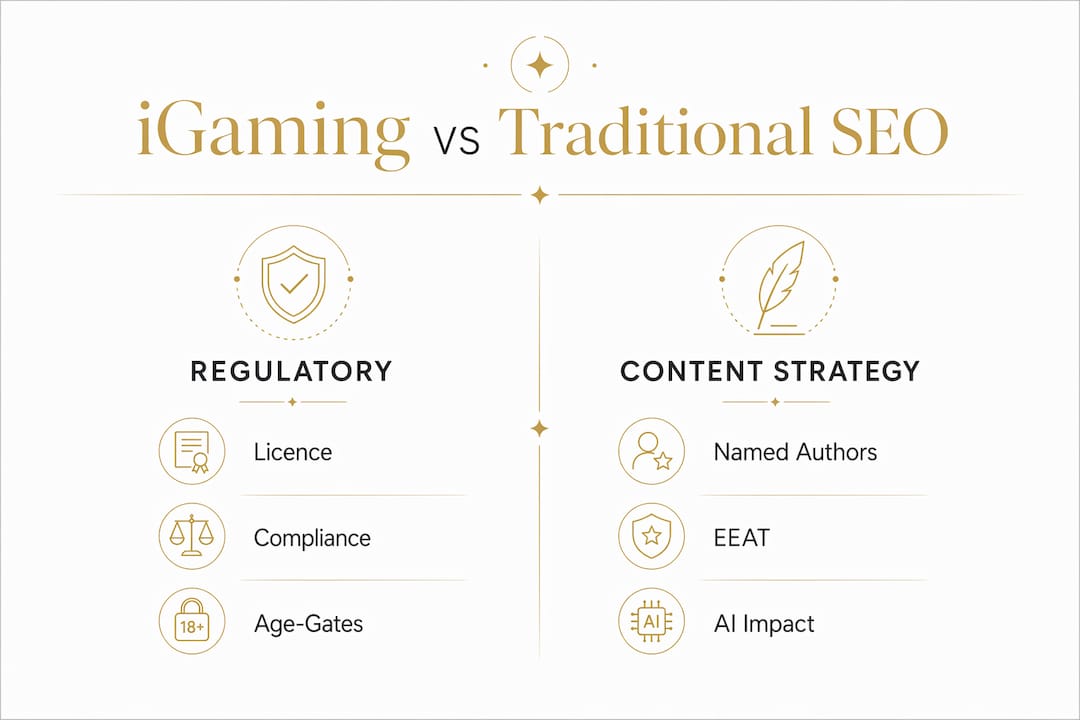
Named human authors with verifiable iGaming experience are the top ranking factor in this sector, outranking domain authority and backlinks. That finding inverts the conventional SEO wisdom that links drive rankings above all else. In iGaming, a review written by a credentialed gambling expert with a public profile outperforms the same content published anonymously on a high-authority domain.
The content workflow for iGaming SEO professionals looks different from traditional practice in four specific ways:
- Author credentialing: Every review, guide, or news article must carry a named byline linked to a verifiable author profile. The profile should list the author’s gambling industry experience, published work, and professional affiliations. This is not optional for EEAT compliance.
- Content freshness requirements: Operators must update at least 30% of evergreen content quarterly to maintain rankings. Stale bonus information or outdated game libraries trigger traffic loss. Traditional industries rarely face this level of mandatory refresh.
- Long-tail keyword targeting: High-volume terms like “online casino” are dominated by established operators with decade-long domain histories. Newer sites build authority through informational long-tail queries: “how does RTP work in slots,” “what is a wagering requirement,” or “best live dealer games for Canadian players.”
- Disclaimer integration: Promotional language must include responsible gambling disclaimers. These cannot be buried in footers. Regulators expect them adjacent to any claim about bonuses or winning potential.
The iGaming content strategy that performs in 2026 treats EEAT as architecture, not an afterthought. Every content decision, from topic selection to author assignment to update scheduling, flows from that framework.
Notably, iGaming content triggers AI overviews in only 1.4% of queries, the lowest rate among major search categories. That means traditional organic rankings remain the primary traffic driver in this sector, making on-page SEO and content quality more critical here than in almost any other industry.
What technical SEO requirements are unique to iGaming sites?
Technical SEO in iGaming carries compliance obligations that standard industries never encounter. The most consequential is the age-gate overlay. Every iGaming site must verify user age before granting access, but a poorly configured age gate blocks Googlebot along with underage users.

Age-gate overlays must permit Googlebot crawling while effectively blocking non-compliant users. The technical solution requires conditional rendering: serve the full page to verified crawlers using user-agent detection, while presenting the age verification screen to unverified human visitors. Getting this wrong means Google cannot index the site’s content, regardless of how well-written or compliant it is.
Mobile performance carries equal weight. LCP must stay under 2.5 seconds on mobile for slot demo pages and content-heavy sections. Slot demo pages are particularly demanding because they load game assets alongside editorial content. Sites that fail this threshold lose rankings to faster competitors, especially on mobile-first index evaluations.
Pro Tip: Use Google Search Console’s URL Inspection tool to test how Googlebot renders age-gated pages. If the tool returns a blocked or incomplete render, your age-gate configuration is suppressing indexation.
Crawl budget management also differs from traditional sites. iGaming platforms often host thousands of game pages, many with near-identical metadata. Canonical tags, noindex directives on thin game-description pages, and XML sitemaps segmented by content type all become necessary at scale.
What makes link building in iGaming uniquely difficult?
Link building in iGaming is where the gap between traditional and sector-specific SEO becomes most visible. Traditional SEO rewards volume and domain authority. iGaming SEO punishes both if they are pursued without precision.
The anchor text distribution required to avoid penalties is specific: 60% branded anchors, 25% partial match, and 15% exact match. Exact-match commercial anchor text above 15% triggers automated suppression. That threshold is far stricter than what most traditional SEO practitioners are accustomed to managing.
Key differences in iGaming link building include:
- Geographic authority limits: A link from a UK gambling publication carries authority for UK-targeted pages only. It does not transfer to Canadian or Australian rankings. Links and content authority do not cross jurisdictions, so link acquisition must be planned market by market.
- Editorial placement over volume: A single placement in a regulated gambling media outlet outperforms dozens of links from general-interest blogs. Quality editorial placements signal sector relevance to Google’s algorithms.
- Partnership-based acquisition: Affiliate networks, responsible gambling organisations, and industry associations provide link opportunities that general outreach cannot replicate. These relationships take time to build but produce durable, penalty-resistant authority.
- Disavow file maintenance: iGaming sites attract a disproportionate volume of low-quality link spam. Regular disavow file updates are not optional maintenance. They are a core part of the iGaming link building process.
The shift from volume to quality is not a preference. It is a structural requirement of the iGaming environment. Sites that import traditional aggressive link-building tactics into iGaming consistently face algorithmic suppression within two to three algorithm update cycles.
Key takeaways
iGaming SEO requires compliance-integrated strategies, named author credentialing, and jurisdiction-specific link building that traditional SEO never demands.
| Point | Details |
|---|---|
| Compliance is a ranking signal | Missing licence displays and 18+ banners cause both regulatory and SEO penalties. |
| Named authorship outranks backlinks | Verified iGaming authors are the top ranking factor, above domain authority. |
| Content must refresh quarterly | Update at least 30% of evergreen content every quarter to prevent traffic loss. |
| Anchor text ratios are strict | Keep exact-match anchors at or below 15% to avoid automated suppression. |
| Authority is jurisdiction-specific | Links and rankings do not transfer across geographic licensing boundaries. |
What I have learned navigating iGaming SEO in 2026
The biggest mistake I see SEO professionals make when moving into iGaming is treating compliance as someone else’s problem. They hand it off to legal, focus on keywords and links, and then wonder why their rankings plateau or collapse after a core update.
Compliance and SEO are the same job in this sector. When I audit an iGaming site, I check licence display and responsible gambling links before I look at a single title tag. The editorial standards that underpin EEAT are not separate from SEO. They are the mechanism through which SEO works.
The other misconception worth addressing is that iGaming SEO is simply harder traditional SEO. It is not harder. It is different. The rules are stricter, the budgets are larger, and the penalties are more severe. But the underlying logic is the same: build genuine authority, serve real user intent, and maintain technical health. The difference is that in iGaming, “genuine authority” includes a compliance officer’s sign-off on every page.
Professionals who thrive in this space treat regulatory updates the same way they treat algorithm updates: as signals to adapt, not obstacles to work around.
— Lucky
Myluckyuniverse: built for iGaming SEO professionals
Navigating the compliance requirements, content standards, and link-building constraints of iGaming SEO is a full-time discipline. Myluckyuniverse operates at the intersection of AI-native content and iGaming media, with over 20 years of industry experience informing every editorial and technical decision.

The Myluckyuniverse blog covers the full range of iGaming SEO strategies, from AI-optimised casino content to content localisation for specific gambling markets. For SEO professionals who need structured, compliance-aware guidance rather than generic digital marketing advice, Myluckyuniverse provides the depth and sector specificity this industry demands. The platform’s casinoexpert.ai brand applies the same editorial rigour to its own content that it recommends to operators and marketers.
FAQ
What is iGaming SEO?
iGaming SEO is the practice of optimising online gambling and betting websites using strategies that integrate regulatory compliance, jurisdictional licensing, and sector-specific content and link-building approaches. It differs from traditional SEO primarily in its compliance obligations and the weight given to named author credibility.
Why does iGaming SEO cost more than traditional SEO?
Competing for top iGaming keywords requires a monthly budget of $40,000 to $50,000, compared to $10,000 to $15,000 in standard industries. The higher cost reflects greater competition, compliance overhead, and the need for credentialed authors and jurisdiction-specific content.
How does EEAT apply differently in iGaming?
In iGaming, named human authors with verifiable gambling industry experience are the top ranking factor, outranking domain authority and backlinks. Traditional SEO treats EEAT as one signal among many; iGaming SEO treats it as the primary ranking mechanism.
What anchor text ratio should iGaming link builders use?
The recommended distribution is 60% branded anchors, 25% partial match, and 15% exact match. Exact-match commercial anchors above 15% trigger automated suppression from Google’s algorithms.
Do iGaming rankings transfer between countries?
No. Search engines segment authority and rankings by geographic licensing. A site ranking well for UK queries will not automatically rank for Canadian or Australian queries. Each market requires its own geo-targeted content and locally relevant link acquisition.