Insights
Optimise casino content for AI search in 2026

If your casino content traffic has been sliding despite solid keyword rankings, you are not imagining things. The shift to AI-driven search has changed what gets cited, summarised, and surfaced. To optimize casino content for AI search today means rethinking the entire production process, not just tweaking meta tags. AI engines like ChatGPT, Perplexity, and Google’s AI Overviews pull from content that demonstrates genuine expertise, structured clarity, and verifiable experience. This guide walks you through exactly what to do, in the right order, to make your casino content the source AI wants to quote.
Table of Contents
- Key takeaways
- How to optimise casino content for AI search: the foundation
- Creating casino content that AI actually cites
- Technical execution for better AI visibility
- Monitoring AI search performance
- Mistakes that will stall your AI content strategy
- My honest take after years in iGaming content
- How Myluckyuniverse can help you get there
- FAQ
Key takeaways
| Point | Details |
|---|---|
| Technical foundations first | Crawlability, indexability, and page experience must be solid before any AI optimisation pays off. |
| Authenticity beats volume | A few deeply researched, screenshot-backed reviews consistently outperform large libraries of thin content. |
| Fix the iframe LCP problem | Deferring slot iframe loading with click-to-play can cut page load time by more than half. |
| Track AI visibility, not just rankings | Start with Bing Webmaster Tools AI Performance, the only free first-party report on Copilot citations, then layer third-party trackers for ChatGPT and Perplexity. |
| Grounding queries are not keywords | The phrases AI systems use to retrieve your content are sentence-length and carry no measurable search volume. Read them monthly and write headings that answer them verbatim. |
| Human oversight is non-negotiable | AI drafts need expert review with original testing data before publication to meet E-E-A-T standards. |
How to optimise casino content for AI search: the foundation
Before you write a single word of optimised copy, the technical bones of your casino site need to be sound. AI search engines do not reward clever content sitting on a slow, poorly structured site.
What Google actually requires in 2026
Google’s current guidance is clear on one point most iGaming marketers misread: foundational SEO remains primary. That means crawlability, indexability, page experience, and structured data. Google explicitly advises against AI-specific workarounds like content chunking or llms.txt files, stating they do not improve AI visibility and may actually violate policies. Stop chasing shortcuts that do not exist.
Here is what your technical baseline must include before you think about content:
- Crawlability and indexability: Every key review page, guide, and bonus page must be reachable by crawlers with clean internal linking and no soft 404s.
- Page experience signals: Core Web Vitals still matter. LCP, INP, and CLS scores directly affect whether your content gets picked up.
- E-E-A-T signals on every page: Named authors with verifiable credentials, original screenshots, hands-on testing dates, and a transparent editorial process.
- Compliance elements: Licence hyperlinks, age-gate overlays, and responsible gambling disclosures are not optional. Missing them flags your domain as untrustworthy.
- Schema markup: Use Article or Review schema. Avoid self-assigned star ratings. Google actively penalises self-assigned review schema in casino content, preferring verified user ratings or clean article schema instead.
| Element | Required | Common mistake |
|---|---|---|
| Named author with bio | Yes | Anonymous “editorial team” bylines |
| Original gameplay screenshots | Yes | Stock images or vendor-supplied graphics |
| Licence hyperlink | Yes | Mentioning licence number without linking |
| Article schema | Yes | Self-assigned star ratings in schema |
| Hands-on testing date | Yes | No date or only a publication year |
Pro Tip: Run a crawl audit specifically looking for orphaned pages and duplicate licence disclosure text. These two issues alone account for a significant portion of lost crawl budget on large iGaming sites.
Creating casino content that AI actually cites
Once the technical foundation is solid, the content itself needs to earn its place in AI-generated summaries. That requires a different approach from traditional search engine optimisation for casinos built around keyword density and backlink acquisition.
Non-commodity content with personal experience gets cited more by AI. That sentence should reframe your entire editorial process. Here is a practical framework for producing it:
- Conduct genuine hands-on testing. Log in, make a real deposit, play through the bonus, and document everything with screenshots. High-quality casino reviews now require 6 to 12 original screenshots and step-by-step deposit walkthroughs. This is the floor, not a differentiator.
- Write from a specific, verifiable point of view. “We tested the cashier on a Monday evening and withdrawal processed in 4 hours” is citable. “Withdrawals are generally fast” is not.
- Structure content for semantic extraction. Use clear H2 and H3 headings that answer discrete questions. AI models pull structured answers from content with obvious semantic hierarchy, not walls of descriptive prose.
- Disclose RTP figures with sources. Link directly to the game developer’s published paytable or a verified third-party audit. Unverified RTP claims are a fast way to lose credibility with both readers and AI systems.
- Keep paragraphs short and purposeful. Three to four sentences per paragraph, one idea per paragraph. AI feature extraction favours content that is easy to parse at the sentence level.
- Build internal links with intent. Internal link density of 3 to 5 contextual links per 1,000 words with varied anchor text supports topical authority. Link your slot reviews to your RTP explanation guide and your bonus review to your terms glossary.
Pro Tip: When writing bonus review sections, include a dedicated subsection titled something like “What the fine print actually says” and summarise the wagering requirements in plain language. AI search tools specifically surface content that decodes complexity for users.
The AI shift in iGaming SEO is moving the discipline away from link-building volume toward content that reads like it was written by someone who genuinely knows the product. If your current content could have been produced by someone who has never visited the casino, it will not perform.
Technical execution for better AI visibility
Content quality alone will not get you ranked if the technical layer is working against you. Casino sites face a specific set of performance challenges that most general SEO guides never address.
The slot iframe LCP problem
Slot game preview iframes are one of the worst LCP offenders in iGaming. Pages that load an embedded game demo directly on page load have LCP scores that routinely exceed 5 seconds. The fix is straightforward: implement click-to-play iframe deferral, which improved one casino site’s LCP from 5.8 seconds to 1.9 seconds with indexing recovering within weeks.

The same principle applies to lobby pages with multiple game tiles. Lazy-load non-visible tiles and only render previews for games above the fold on initial load.
Here is a comparison of the two approaches:
| Approach | Average LCP | Crawl efficiency | AI indexing speed |
|---|---|---|---|
| Eager iframe loading | 5+ seconds | Poor | Slow |
| Click-to-play / lazy-load | Under 2 seconds | Strong | Fast |
Additional technical priorities worth addressing:
- Server-side rendering for dynamic data: Live odds, jackpot totals, and real-time bonus availability must be rendered server-side rather than loaded via client-side JavaScript only. AI crawlers often cannot execute JavaScript reliably.
- Content freshness signals: Update evergreen review pages at minimum quarterly. Add a visible “last reviewed” date with the reviewer’s name. Stale content without freshness signals loses priority in AI summaries quickly.
- Crawl budget management: Audit and remove or canonicalise paginated filter pages, duplicate bonus landing pages, and boilerplate geo-redirect pages. Each one dilutes your crawl budget.
- Avoid duplicate bonus text: Licence-mandated bonus terms often get duplicated across dozens of pages. Use canonical tags and rewrite the editorial framing so each page has unique descriptive content around the same terms.
Monitoring AI search performance
Producing excellent content means nothing if you cannot see whether AI systems are actually picking it up. Traditional organic rank tracking gives you an incomplete picture of AI-driven visibility.
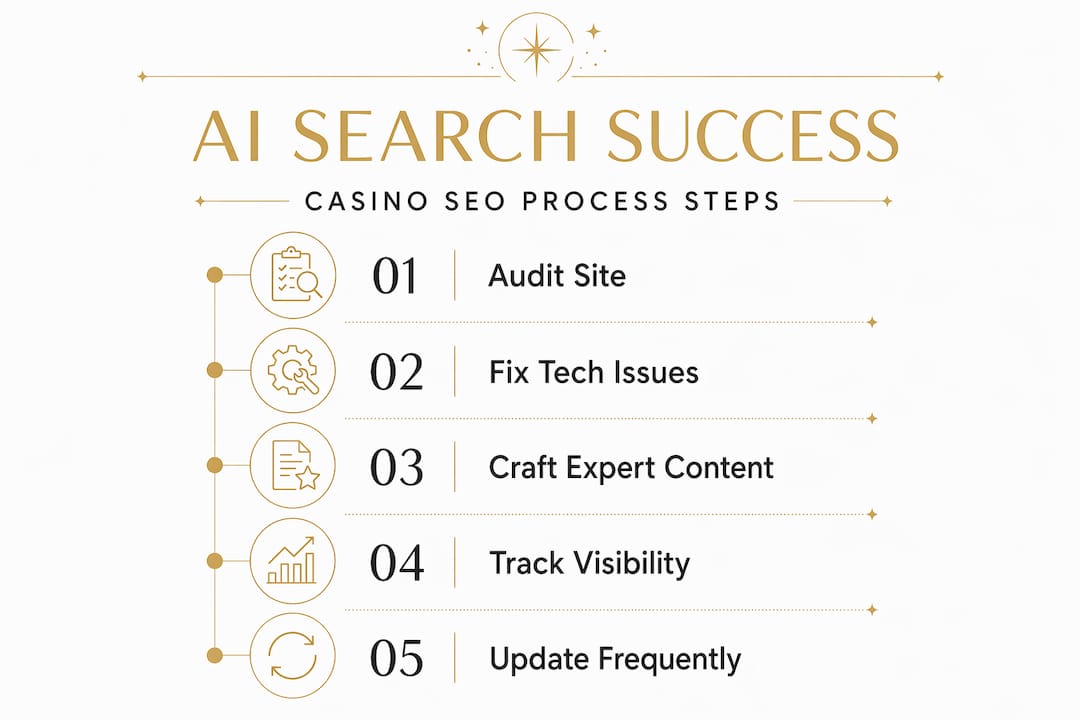
Start with first-party citation data, not third-party estimates
Since 10 February 2026, Bing Webmaster Tools has carried AI Performance in public preview, a free first-party report showing when your pages are cited as sources inside Microsoft Copilot, AI-generated summaries in Bing, and selected partner integrations. Microsoft describes it as “an early step toward Generative Engine Optimization (GEO) tooling”. For casino and iGaming publishers this matters because it is the only citation dataset that comes from the AI platform itself rather than from a vendor sending test prompts on your behalf.
The report publishes five measures:
- Total citations: how many times your pages appeared as sources in AI answers during the window.
- Average cited pages: unique pages cited per day, which tells you whether citations are concentrated on one asset or spread across the library.
- Grounding queries: the phrases the AI actually used when retrieving content it went on to cite.
- Page-level citation activity: citation counts per URL.
- Visibility trends over time: the citation timeline for the property.
The interface also reports a citation share percentage against each grounding query. Microsoft’s announcement does not define how it is calculated, so treat it as a relative signal between your own queries rather than an absolute benchmark. Microsoft is explicit that none of these figures indicate ranking, authority, or placement within an answer. They tell you retrieval happened, not that you won the answer.
Grounding queries are not keywords
This is the finding that should change how you brief content. A grounding query is what the model constructed in order to go looking for sources. It is not what a person typed. These strings are long, declarative, and largely invisible to volume-based keyword tools.
We pulled the rolling 90-day AI Performance report for this property on 21 September 2026. It returned ten grounding queries across 28 cited pages. The highest-share phrases were sentence-length retrieval strings, not head terms:
| Grounding query | Citations | Citation share |
|---|---|---|
| casino affiliate not relevant | 25 | 37.31% |
| build full iGaming ecosystem multiple brands | 27 | 26.73% |
| trusted gaming casino CRM software player lifetime value segmentation | 27 | 12.68% |
| top casino CRM tools player loyalty tier segmentation | 11 | 5.56% |
Two things follow from that table. First, an eight-word string like “trusted gaming casino CRM software player lifetime value segmentation” carries no meaningful search volume and would never survive a keyword export, yet it produced 27 citations. Sizing AI opportunity on search volume systematically misses this traffic. Second, two near-identical CRM phrasings returned citation shares a factor of two apart, which means the structure of the page answering each one matters more than the topic it sits under.
The practical instruction: read your grounding queries monthly and write H2s that answer them close to verbatim. That is a different exercise from keyword research and it produces different briefs.
Where third-party trackers still earn their place
Bing’s report covers Microsoft surfaces only. It does not see ChatGPT, Perplexity, or Google’s AI Overviews, so it replaces nothing — it anchors everything else with ground truth.
| What you need | Bing AI Performance | Third-party AI trackers |
|---|---|---|
| Copilot and Bing citations | First-party, measured | Estimated from sampled prompts |
| ChatGPT, Perplexity, AI Overviews | Not covered | Covered |
| The phrases the model actually retrieved on | Yes, as grounding queries | No, they test prompts you supply |
| Cost | Free with a verified property | Subscription |
| Freshness | Sampled and refined as data processes | Depends on probe frequency |
AI visibility tracking tools like Ahrefs and Akii monitor brand mentions and inclusion in AI-generated summaries, reporting visibility scores on a 0 to 100 scale alongside query fan-out awareness. That visibility score tells you how often your content appears across a defined set of AI-relevant queries, which is a fundamentally different signal from a position 3 ranking — but it is inferred, where Bing’s citation count is observed.
Here is what to track and how:
- First-party citation counts: Verify the property in Bing Webmaster Tools and review AI Performance monthly. Cited-page counts and grounding queries are measured, not modelled.
- Brand mention monitoring: Set up alerts for your casino brand name and key product names across AI platforms. A brand appearing in an AI summary is qualitatively different from a backlink.
- AI visibility scores: Review these weekly for your top 20 money pages. A declining score on a recently published page often signals a structural content issue, not a ranking penalty.
- Query fan-out gaps: These tools identify related queries your content is not appearing in despite strong core rankings. Each gap is a content brief waiting to be written.
- Low-performance page identification: Sort pages by AI visibility score and prioritise the bottom 20% for content refreshes before publishing anything new.
Pro Tip: Cross-reference your AI visibility score drops with your content publishing calendar. If a page’s score dropped after a recent update, the edit likely removed something the AI was using as a citation trigger. Review the change and restore the specific language or data point.
For a deeper look at how AI visibility works in iGaming, the mechanics of answer engine optimisation are worth understanding before you invest heavily in tracking infrastructure.
Mistakes that will stall your AI content strategy
Several patterns keep showing up across casino sites that are underperforming in AI search. Most of them stem from carrying over assumptions from 2022-era search engine optimisation for casinos into a fundamentally different environment.
Content mistakes to stop immediately:
- Publishing thin bonus pages that repeat the operator’s own terms without editorial analysis
- Using scaled AI-generated content without hands-on expert review. Automated content scaling is penalised directly by Google’s current policies
- Ignoring freshness. Evergreen content without a visible quarterly review date loses AI citation priority
- Over-optimising for keyword density at the expense of natural, readable prose that actually answers the reader’s question
Structural errors that compound over time:
- No clear author identity on review pages
- Missing or incorrectly implemented schema for iGaming content, particularly self-assigned star ratings in review markup
- Duplicate pages for geo-targeted bonus offers without unique content on each
“GEO is less about controlling AI and more about semantic clarity and brand trust readiness, focusing on making content easily citable by generative tools.” SEO.Casino
That framing is worth keeping on your monitor. You are not trying to trick AI systems. You are making your content structurally easy to trust and cite. The best practices for casino content in 2026 all point in the same direction: genuine expertise, clearly structured, consistently updated.
My honest take after years in iGaming content
I have watched iGaming content teams pour resources into publishing velocity and come away with almost nothing to show for it in AI search. In my experience, the teams getting genuine traction right now are publishing less, not more.
What I have learned is that AI systems are remarkably good at detecting the difference between a review written by someone who actually played the games and a review assembled from competitor pages. The tells are subtle but consistent: vague time references, missing specifics on withdrawal processing, and bonus terms explained without any editorial opinion on whether they are actually fair.
The content that gets cited tends to share a few qualities. It has a named person behind it. It includes data points you cannot find anywhere else, like a specific withdrawal time recorded on a specific date. And it takes a position. “This casino’s live dealer interface is genuinely better than most” is citable. “This casino offers live dealer games” is not.
What I find most interesting about the current moment is that the AI-driven casino marketing conversation keeps circling back to something that was always true: people trust people, not pages. The difference now is that AI systems are finally surfacing that trust signal at scale. If your content has been written to game a ranking algorithm rather than to genuinely inform a player, 2026 is the year that gap becomes very visible, very quickly.
— Lucky
How Myluckyuniverse can help you get there

At Myluckyuniverse, we have spent over two decades at the intersection of iGaming and digital media, and we built our entire platform around the AI-native content model that most casino sites are now scrambling to adopt. Our blog covers the practical mechanics of AI credibility scoring for iGaming and walks through real implementation examples, not theory. If you are looking to audit your current casino content against AI visibility standards, understand where your schema implementation is falling short, or build an editorial framework that holds up under Google’s 2026 E-E-A-T requirements, Myluckyuniverse is where to start. We do not publish generic SEO advice. Every piece is grounded in hands-on iGaming experience and built for the AI search environment your content lives in right now.
FAQ
What does it mean to optimise casino content for AI search?
It means producing structured, expert-led content that AI platforms like Google’s AI Overviews, ChatGPT, and Perplexity can extract, verify, and cite. This goes beyond keyword placement to include original screenshots, named authors, schema markup, and regular content updates.
Do AI-specific workarounds like llms.txt actually help casino SEO?
No. Google’s official guidance explicitly advises against AI-specific workarounds, stating they do not improve AI visibility and may violate search policies. Standard technical SEO remains the primary driver of AI search inclusion.
How often should casino review pages be updated for AI visibility?
Quarterly updates are the current minimum standard. Each update should include a visible “last reviewed” date, the reviewer’s name, and any changed data points such as withdrawal times, bonus terms, or licensing status.
What is a grounding query, and how is it different from a keyword?
A grounding query is the phrase an AI system generated for itself in order to retrieve source material, reported in Bing Webmaster Tools’ AI Performance dashboard. Keywords are what people type; grounding queries are what the model constructs. They are typically sentence-length, carry no measurable search volume, and will not appear in any keyword research export.
Can I see Copilot citations for my casino site for free?
Yes. Bing Webmaster Tools’ AI Performance report has been in public preview since 10 February 2026 and is free with a verified property. It reports total citations, average cited pages per day, page-level citation counts, grounding queries, and a citation timeline across Microsoft Copilot, Bing AI summaries, and partner integrations.
What AI visibility tracking tools work best for iGaming sites?
Use both layers. Bing Webmaster Tools AI Performance gives you free, first-party citation counts and grounding queries for Microsoft Copilot surfaces. Tools like Ahrefs and Akii extend coverage to ChatGPT, Perplexity, and Google AI Overviews with visibility scores on a 0 to 100 scale, but those scores are inferred from sampled prompts rather than measured.
Why is the slot iframe LCP problem so damaging for casino SEO?
Embedding slot game iframes on page load routinely pushes LCP above 5 seconds, which signals poor page experience to both Google and AI crawlers. Implementing click-to-play or lazy-load deferral can cut LCP to under 2 seconds and restore indexing speed within weeks.