Insights
Schema markup: boost your iGaming AI search visibility

Structured data has become one of the most misunderstood tools in the iGaming marketer’s kit. Many teams assume that adding schema markup to a casino review page or bonus landing page is a fast track to appearing in Google’s AI Overviews, but that assumption is costing real visibility. The truth is more nuanced, more technical, and frankly more interesting. This guide unpacks exactly what schema markup does and does not do in AI-driven search, why iGaming content carries unique risks, and how to build a schema strategy that actually moves the needle in 2026.
Table of Contents
- Schema markup: demystifying its role in AI search
- Benefits of schema markup for iGaming SEO
- Common pitfalls and edge cases: iGaming schema mistakes
- Schema in AI search: limitations and best practices
- Why schema nuances matter more in iGaming
- Upgrading your AI search strategy with Lucky Universe
- Frequently asked questions
Key Takeaways
| Point | Details |
|---|---|
| Schema enables AI context | Structured data helps Google’s AI correctly interpret iGaming pages for search features. |
| Semantic accuracy is critical | Schema must closely match visible content; mismatches undermine compliance and eligibility. |
| No guaranteed citations | Schema aids supporting links, but Google uses snippet and indexing criteria, not just markup. |
| Update for compliance | Frequent content changes require prompt schema updates in iGaming for ongoing eligibility. |
| Best practices boost visibility | Applying schema best practices maximises AI search results and gives iGaming marketers a competitive edge. |
Schema markup: demystifying its role in AI search
Schema markup, also called structured data, is a standardised vocabulary of tags you embed in your HTML to help search engines understand the meaning of your content, not just its words. Think of it as a translation layer. Your page might say “Welcome bonus: 100% up to $500,” but without structured data, Google’s crawler has to guess whether that’s a product offer, a promotional event, or editorial commentary. Schema removes that guesswork.
Google’s AI Overviews and AI Mode use this contextual layer to decide which pages are worth surfacing as supporting links. The keyword there is “supporting.” Schema helps Google’s AI interpret content and can be used as part of eligibility for AI Overviews, but eligibility is not the same as guaranteed placement. That distinction matters enormously for iGaming teams allocating SEO resources.
Here is where many marketers get tripped up. They conflate two separate outcomes: rich snippet eligibility (the visual enhancements in standard search results like star ratings and review counts) and AI supporting link eligibility (appearing as a cited source within an AI Overview). Schema can influence both, but through different mechanisms and with different success rates.
Common schema misconceptions for iGaming marketers:
- Schema alone will push a page into AI Overviews
- Any valid schema type will improve rankings universally
- Adding more schema types to one page always helps
- Schema replaces the need for high-quality editorial content
- Outdated schema is harmless as long as it is technically valid
“Structured data helps Google understand the content of your pages and can be used as part of determining eligibility for AI features like AI Overviews and AI Mode supporting links.” — Google Search Central
The real function of schema is interpretive assistance, not a ranking lever. It tells Google’s systems what your content means so those systems can decide whether it fits a user’s query. For iGaming, where content categories include operator reviews, bonus comparisons, responsible gambling resources, and jurisdictional guides, that interpretive clarity is genuinely valuable, but only when it is accurate.
Benefits of schema markup for iGaming SEO
With a foundation set, we can now look at the specific advantages for iGaming marketers. The benefits are real, but they are conditional on implementation quality.
| Schema type | iGaming content use case | Primary benefit |
|---|---|---|
| Review / AggregateRating | Casino and sportsbook reviews | Star ratings in SERPs, AI trust signals |
| FAQPage | Bonus terms, wagering requirements | Featured snippet eligibility, AI Q&A sourcing |
| Article / NewsArticle | Editorial guides, regulatory updates | Freshness signals, AI Overview sourcing |
| BreadcrumbList | Site navigation for large portals | Improved crawl clarity, SERP breadcrumb display |
| Offer | Bonus landing pages | Structured promotion data for AI interpretation |
| Organization | Brand pages, about sections | Entity recognition, knowledge panel support |
Each schema type serves a distinct purpose. A casino review site that uses AggregateRating schema correctly gives Google’s AI a clear signal that the page represents a collective assessment, which makes it more likely to be cited when a user asks an AI Overview “what is the best online casino in Canada.” That is a meaningful competitive edge.

Improved visibility in AI-driven search results comes from combining accurate schema with high-quality, source-transparent content. Schema is the signal; content quality is the substance. Both need to be present.
Steps to boost iGaming snippet eligibility with schema:
- Audit your highest-traffic pages and identify which schema types are missing or incomplete
- Match every schema property to its corresponding visible text on the page, word for word where possible
- Validate all structured data using Google’s Rich Results Test before deployment
- Submit updated sitemaps after schema changes to accelerate re-indexing
- Monitor Google Search Console’s “Enhancements” tab weekly for schema errors and warnings
- Review schema accuracy after every bonus update, odds change, or regulatory amendment
Pro Tip: Matching schema properties to visible text is not just good practice for AI trust signals. It is also a compliance requirement in many jurisdictions. If your schema says a bonus is “100% up to $500” but the visible page has been updated to “$200,” that mismatch can trigger both a Google policy flag and a regulatory issue. Treat schema updates as part of your compliance workflow, not a separate technical task.
The AI features structured data guidance from Google explicitly notes that schema helps AI interpret iGaming content and match visible text for eligibility in AI Overviews and AI Mode. That matching requirement is the critical detail most teams overlook.
Common pitfalls and edge cases: iGaming schema mistakes
These benefits come with some risks. Let us examine the common pitfalls and how iGaming teams can avoid them.
| Scenario | Proper schema approach | Problematic schema approach |
|---|---|---|
| Bonus offer updated mid-campaign | Update Offer schema to reflect new amount immediately | Leave old schema live; creates semantic mismatch |
| Jurisdictional disclaimer added | Include disclaimer in schema description field | Omit disclaimer from schema; visible text and schema diverge |
| Review score updated after re-evaluation | Refresh AggregateRating with new ratingValue | Keep outdated rating; misleads AI and users |
| Responsible gambling page | Use Article schema with clear topical signals | Use generic WebPage schema; loses topical context |
| Odds displayed dynamically | Use server-side rendering so schema reflects live odds | Static schema with stale odds; factual mismatch |
The comparison above illustrates a pattern: the problematic approach almost always involves a gap between what the schema says and what the user actually sees. Google’s documentation is direct on this point. Schema that is technically valid but semantically thin or mismatched to the visible text can reduce usefulness and may violate structured data policies. For iGaming, where compliance text, odds, bonuses, and jurisdictional disclaimers change frequently, this risk is amplified significantly.
Frequent schema mistakes in iGaming:
- Using Review schema on pages that are actually affiliate landing pages with no genuine editorial assessment
- Applying FAQPage schema to questions that are not answered on the visible page
- Marking up bonus offers with Offer schema but omitting required terms and conditions
- Using Organisation schema with outdated contact details or incorrect licence numbers
- Deploying schema in JavaScript that Google’s crawler cannot reliably render
- Failing to remove deprecated schema types after Google updates its guidelines
Pro Tip: Build a schema change log as part of your content management workflow. Every time a compliance officer updates a disclaimer, a bonus amount changes, or a new jurisdiction is added to a page, that change should trigger an automatic schema review ticket. Teams that treat schema as a “set and forget” technical element are the ones most likely to accumulate invisible compliance risks over time.
The iGaming industry operates under constant regulatory scrutiny. A schema mismatch on a responsible gambling page or a bonus terms page is not just an SEO problem. It can attract attention from advertising standards bodies in the UK, Malta, Ontario, and other regulated markets. The technical and the legal are intertwined here in ways they simply are not in most other verticals.
Schema in AI search: limitations and best practices
After learning the pitfalls, it is crucial to set expectations and outline actionable guidelines for iGaming teams.
“Schema markup is one of the most powerful tools in modern SEO, and when applied correctly to structured content like casino reviews or bonus comparisons, it dramatically increases the likelihood of appearing in AI-generated answer features.” — Schema proponent perspective, widely held in the SEO community
That view is not wrong, but it is incomplete. The critical nuance is that schema is not a direct citation guarantee. Google frames AI supporting links around indexing quality and snippet eligibility, with structured data functioning as an aid rather than an entitlement. The difference between “aid” and “entitlement” is where many iGaming SEO strategies go off track.
Schema best practices for iGaming SEO:
- Prioritise semantic accuracy over volume. It is better to have three perfectly accurate schema types than ten loosely applied ones. Each schema property you mark up is a claim you are making to Google’s AI. Make only claims you can substantiate with visible page content.
- Align schema updates with your editorial calendar. Every content update, bonus change, or regulatory revision should include a schema review as a mandatory step. Build this into your CMS workflow rather than relying on manual audits.
- Use structured data to reinforce E-E-A-T signals. Experience, Expertise, Authoritativeness, and Trustworthiness are the framework Google uses to evaluate content quality. Schema that correctly identifies authors, organisations, licences, and review methodologies directly supports these signals.
- Test in staging before deploying to production. Schema errors can cause rich result eligibility to be revoked entirely. Always validate changes in a staging environment using Google’s Rich Results Test tool.
- Monitor AI Overview appearances actively. Use tools that track whether your pages are being cited in AI Overviews. If a page drops out of AI supporting links after a schema change, that is diagnostic information worth acting on quickly.
- Document your schema rationale. For regulated markets, being able to demonstrate that your schema accurately reflects your content is a form of compliance documentation. Keep records of what schema you deployed, when, and why.
The limitation that schema cannot overcome is content quality. If a page is thin, lacks genuine editorial depth, or fails to address user intent, no amount of structured data will rescue its AI search performance. Schema amplifies good content. It cannot substitute for it.
Why schema nuances matter more in iGaming
Most industries can afford to treat schema as a set-and-forget technical layer. iGaming cannot. This is the uncomfortable truth that separates operators and affiliates who maintain strong AI search visibility from those who wonder why their technically valid pages keep getting overlooked.
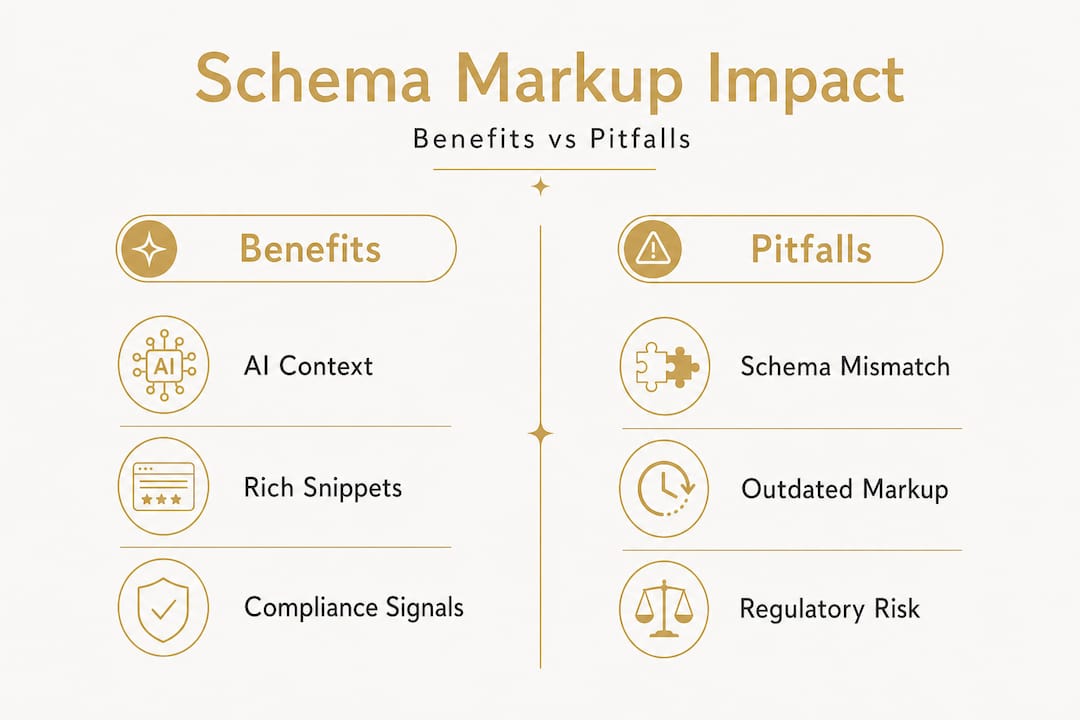
Consider the volatility alone. A sports betting page might display odds that change every few minutes. A casino bonus page might be updated three times in a single promotional week. A responsible gambling section might need to add new jurisdictional language when a new market opens. In each of these cases, the schema on the page has a very short shelf life before it becomes a liability rather than an asset.
We have seen this pattern repeatedly across iGaming properties. A team invests significant effort in a schema implementation, validates everything correctly, and sees strong AI search performance for several weeks. Then a compliance update goes live, the visible text changes, and the schema is not updated to match. Within weeks, the page loses its AI supporting link appearances. The team assumes the algorithm changed. In reality, they created a semantic mismatch that Google’s AI correctly identified as unreliable.
“Schema that is technically valid but semantically thin or mismatched to visible text can reduce usefulness and may violate structured data policies; for iGaming this is especially risky where compliance text, odds, bonuses, and jurisdictional disclaimers change frequently.” — Google Search Central
The deeper issue is that iGaming schema mistakes carry dual consequences. On the SEO side, mismatched schema reduces AI search eligibility. On the compliance side, it can constitute misleading advertising in regulated jurisdictions. That dual exposure means the cost of getting schema wrong in iGaming is materially higher than in, say, a travel or retail context.
Pro Tip: Schedule a full schema audit every quarter at minimum, and immediately after any significant regulatory change in your key markets. Use a structured checklist that maps every schema property to its corresponding visible text element. Teams that build this audit into their quarterly SEO review as a competitive intelligence exercise, rather than a reactive fix, consistently outperform those that do not.
The iGaming operators and affiliates who will dominate AI search in 2026 and beyond are those who treat schema as a living document, not a one-time technical implementation. That mindset shift is the real competitive advantage.
Upgrading your AI search strategy with Lucky Universe
Schema accuracy is one piece of a much larger AI search puzzle, and keeping every piece aligned while managing a dynamic iGaming content portfolio is genuinely complex.

Lucky Universe is built specifically for this challenge. As an AI-native iGaming media platform with over 20 years of industry experience, Lucky Universe creates structured, editorial-grade content that is designed from the ground up to perform in AI-driven search environments. The platform’s approach to schema, compliance alignment, and answer-engine optimisation reflects the same best practices outlined in this guide, applied at scale across a growing portfolio of iGaming properties. If you are looking to sharpen your AI search strategy, explore how Lucky Universe’s technology and editorial standards can support your next move.
Frequently asked questions
What is schema markup and why is it important for AI search in iGaming?
Schema markup is structured data embedded in your HTML that helps Google’s AI interpret iGaming content, improving eligibility for AI Overviews and supporting links in AI Mode results.
Does using schema guarantee that iGaming pages appear as AI supporting links?
No. Schema aids eligibility, but AI supporting links are determined by indexing quality and snippet relevance, meaning structured data is an aid rather than an entitlement to placement.
How often should schema markup be updated for iGaming sites?
Schema should be reviewed and updated every time compliance text, bonus amounts, or odds change, since schema mismatch to visible text is a documented risk for iGaming pages in regulated markets.
Can semantic errors in schema markup affect AI search performance?
Yes. Technically valid but semantically mismatched schema can violate Google’s structured data policies and reduce a page’s usefulness score, directly impacting AI search eligibility.