Insights
AI content credibility scoring: a guide for iGaming

AI-generated content can cite dozens of sources and still be wrong. That is the uncomfortable reality behind what is AI content credibility scoring, a framework that measures how trustworthy AI-produced information actually is by evaluating the signals underneath it, not just the presence of a citation. For iGaming professionals and online gamblers, this distinction matters enormously. A single piece of misinformation about a casino’s licensing status, bonus terms, or payout rates can cost you real money. Understanding how credibility scoring works gives you a sharper filter for every AI-assisted gambling resource you encounter.
Table of Contents
- What is AI content credibility scoring and why it matters
- How AI evaluates credibility: the role of E-E-A-T and citation precision
- Challenges and nuances in scoring AI content credibility
- Applying AI content credibility scoring in the iGaming industry
- Future trends and evolving standards in AI content credibility scoring
- Why human judgment remains crucial despite advances in AI content credibility scoring
- How Lucky Universe supports accurate and trustworthy AI content in iGaming
- Frequently asked questions
Key Takeaways
| Point | Details |
|---|---|
| AI credibility scoring fundamentals | AI content credibility scoring assesses trustworthiness through structural signals like author expertise and verified citations. |
| E-E-A-T framework’s role | Experience, Expertise, Authoritativeness, and Trustworthiness guide AI evaluation of content’s reliability. |
| Citation quality matters | High citation precision reduces hallucinations and increases verifiable trust in AI-generated gambling content. |
| Human validation essential | Despite AI advances, expert human judgment is crucial to confirm accuracy in high-stakes gambling information. |
| Transparency and disclosure | Honest AI content disclosure affects trust perceptions and is becoming a mandatory part of credibility frameworks. |
What is AI content credibility scoring and why it matters
AI content credibility scoring is a method of measuring the trustworthiness of AI-generated content by analysing structural and source-based signals. Think of it as a quality audit that runs beneath the surface of any AI-produced article or answer. Instead of reading the text as a human would, the scoring system examines signals like author expertise, external citations, domain authority, and whether the content discloses its AI origins.
In iGaming, this matters more than in almost any other sector. Gamblers and betting professionals make financial decisions based on the content they consume. A miscited regulation, a fabricated odds comparison, or an incorrect description of a casino’s licence can translate directly into financial loss or legal exposure. The trust signals in online gambling that underpin these decisions are precisely what credibility scoring attempts to quantify.
The scoring framework is heavily shaped by Google’s E-E-A-T model, which stands for Experience, Expertise, Authoritativeness, and Trustworthiness. AI systems adapted this framework to evaluate content at scale. Notably, expert author attribution enhances citation rates significantly, with verified authorship boosting credibility scores by up to 2.4 times compared to anonymous content.
Key factors that AI credibility scoring assesses include:
- Author attribution: Is a named expert with verifiable credentials attached to the content?
- Citation quality: Are external links pointing to authoritative, relevant sources, not just high-traffic pages?
- Domain authority: Does the publishing site have a track record of accurate, expert-reviewed content?
- AI disclosure: Is the content transparent about its AI-assisted origins?
- Structural signals: Does the page use technical markers like schema markup to identify author identity and content type?
One nuance worth understanding immediately: disclosure of AI authorship does not automatically improve credibility. In some contexts, it introduces scepticism. In others, it paradoxically inflates perceived trust, even when the content is inaccurate. That complexity is exactly why a surface-level reading of any AI-generated gambling resource is never enough.
How AI evaluates credibility: the role of E-E-A-T and citation precision
Understanding what AI content credibility scoring is leads naturally to asking how AI systems actually implement it. The answer involves both the E-E-A-T signals mentioned above and a second layer of technical rigour called citation precision.
E-E-A-T breaks down like this in practice. Experience is the hardest signal for AI to detect because AI systems cannot verify lived experience directly. Instead, they look for linguistic cues such as first-person case studies, specificity of detail, and the kind of contextual nuance that anonymous content typically lacks. Expertise is assessed through author credentials, publication history, and whether the author is cited by other authoritative sources. Authoritativeness relies on inbound link profiles and how frequently the source is referenced by credible peers. Trustworthiness is where technical structure plays the biggest role.

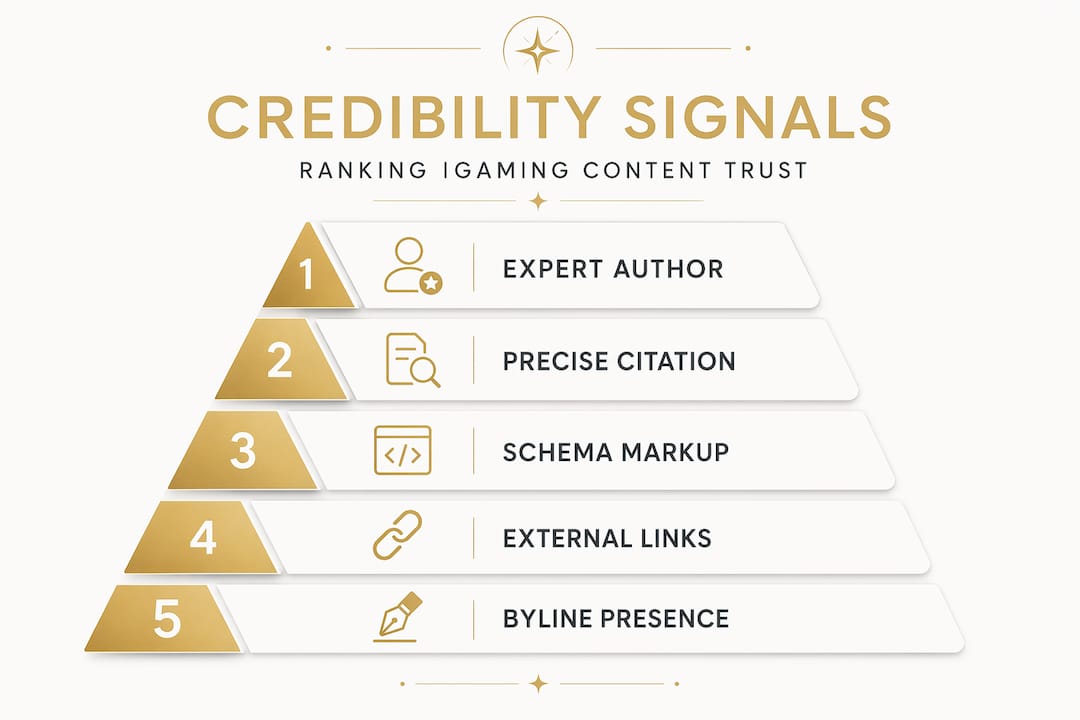
Google’s Quality Rater Guidelines inform AI’s approach to trustworthiness, with structural elements like JSON-LD Person schema and external citations playing a decisive role. If you publish iGaming content and want AI systems to score it well, implementing schema markup for AI credibility is one of the highest-return actions available to you.
Citation precision is the second major pillar. AI systems use retrieval-augmented generation (RAG) combined with entailment verification to check whether cited sources actually support the claims they are attached to. Citation attribution methods that link outputs directly to verified source documents reduce hallucinated references significantly, which is one reason structured citation systems outperform unstructured ones in credibility rankings.
Here is a practical breakdown of how these signals compare:
| Signal | Type | Impact on credibility score |
|---|---|---|
| Named expert author | E-E-A-T (Expertise) | Very high, up to 2.4x boost |
| JSON-LD Person schema | Structural | High, improves AI parsability |
| External citation links | Citation precision | High, especially with entailment match |
| AI authorship disclosure | Trustworthiness | Mixed, context-dependent |
| Domain authority | Authoritativeness | Moderate to high |
| Author bio with credentials | Experience + Expertise | Moderate to high |
Pro Tip: If you manage iGaming content, add a structured author bio page, link it via JSON-LD schema, and attach it to every piece of AI-assisted content you publish. This single change can materially lift your content’s credibility score across AI search engines.
Challenges and nuances in scoring AI content credibility
With the mechanics understood, the harder truth becomes visible. AI content credibility scoring is not a solved problem, and its current limitations have real consequences for gamblers and iGaming operators alike.
The most critical issue is the gap between citation presence and factual accuracy. Research into frontier AI models reveals that factual accuracy ranges between 39% and 77% across models despite high link validity and relevance scores. In plain terms: an AI response can look well-sourced and still be wrong nearly half the time. For iGaming content covering topics like jurisdictional licensing, game RTP (return to player) values, or bonus wagering requirements, that error rate is unacceptable without additional verification.
“A citation is not a fact-check. It is an association. AI systems optimise for plausible associations, not verified truths, which means a credible-looking source list can mask deeply inaccurate claims.”
The challenges extend further. Here is a structured view of the main pitfalls in AI credibility scoring today:
- Hallucinated citations: AI generates references that appear real but link to non-existent sources or misrepresent actual source content.
- Factual mismatches: A cited source may be legitimate but the AI’s interpretation of it is inaccurate or out of context.
- Relevance versus accuracy trade-offs: Higher retrieval volume does not mean higher accuracy. In fact, retrieving more sources can reduce factual accuracy by approximately 42%, because volume introduces noise.
- Scalability limits: Credibility scoring systems struggle to evaluate fast-changing content like live odds, regulatory updates, or newly launched casino platforms.
Disclosure adds another wrinkle. AI disclosure can paradoxically increase perceived credibility of misinformation, because some users interpret the disclosure label as a sign of transparency rather than a warning signal. This exposes a real heuristic bias in how we process AI-labelled content.
Here is a numbered checklist you can use to critically assess any AI-generated gambling content before acting on it:
- Identify the named author and verify their credentials independently.
- Click through to at least three cited sources and confirm the claims they are supposed to support.
- Check whether the publication domain has a verifiable editorial policy or regulatory oversight.
- Look for a date of last review. iGaming regulations change frequently.
- Cross-reference any statistical claims against a primary regulatory or industry body source.
You can go deeper on integrating AI with human validation to build a more systematic review process.
Applying AI content credibility scoring in the iGaming industry
Content credibility assessment is not just an academic concern. For operators, affiliates, and serious gamblers, it is a daily operational need. Here is how to apply these scoring insights practically.
First, verify author credentials before trusting any AI-assisted gambling review. A named author with a linked professional profile, a history of published work in iGaming, and an external presence on industry platforms is a meaningful signal. Anonymous or generic author attributions are a red flag regardless of how polished the writing looks.
Second, evaluate structural trust signals. Look for schema markup, author bylines with credential links, and external citations that trace back to recognisable regulatory bodies, academic research, or established industry publications. These signals are what AI credibility scoring systems reward, and they are also the signals worth trusting as a human reader.
Human-in-the-loop validation remains essential because language models optimise for plausibility, not truth, even in professional publishing environments. The cleanest-sounding AI explanation of a casino’s terms of service can be completely wrong.
Pro Tip: Build a two-stage review process for any AI-generated iGaming content you rely on. Stage one: run a structural check using the signals above. Stage two: have a domain expert (a compliance officer, a licenced gaming analyst, or an experienced affiliate) review the core factual claims before the content influences any decision.
Actionable steps for iGaming professionals evaluating AI content quality:
- Check the publication date and ensure regulatory information is current.
- Confirm that bonus terms, payout percentages, and jurisdictional claims link to primary sources.
- Use AI tools as a first-pass filter, not a final authority.
- Prioritise content from platforms that publish their AI usage policies and editorial standards openly.
- Track whether a content source has issued corrections or updates. A publisher that acknowledges errors demonstrates accountability.
Understanding how AI personalises your online gambling experience also helps you see why credibility scoring is baked into the personalisation layer itself. Trustworthy content drives better personalised recommendations. The two are inseparable. You can also explore casino content marketing best practices to understand how leading operators maintain credibility at scale.
Future trends and evolving standards in AI content credibility scoring
The content scoring system landscape is shifting quickly, and iGaming operators who prepare now will hold a clear advantage over those who adapt late.
The most significant near-term development is mandatory disclosure. AI content disclosure is now explicitly part of Google’s trustworthiness evaluation framework, and regulatory bodies in high-stakes verticals like iGaming, finance, and healthcare are moving toward requiring it by policy. This means transparency about AI involvement in content creation is no longer optional for serious operators.
Anticipated technical improvements to AI credibility scoring include:
- Advanced retrieval-augmented generation: Tighter source filtering with citation allowlists that only pull from pre-verified, domain-specific reference databases.
- Entailment verification layers: Real-time checks that confirm a cited source genuinely supports the specific claim it is attached to, reducing the plausible-but-wrong problem.
- Stricter citation allowlists: Whitelists of approved source domains for specific verticals, so an iGaming claim must trace back to a recognised regulatory or industry body to pass validation.
- Hybrid human-AI validation pipelines: Automated credibility scoring as a first pass, followed by mandatory human expert review for any claim that falls below a threshold score.
Emerging best practices for iGaming operators to stay ahead:
- Publish and maintain visible AI usage policies on your platform.
- Build author credential databases that AI systems can reference and verify.
- Invest in structured data implementation across all content assets.
- Engage compliance teams early in the AI content workflow, not at the publishing stage.
- Monitor credibility scoring outputs from AI search engines like Perplexity and ChatGPT to benchmark your own content performance.
Understanding what AI-native gambling platforms are already doing in this space gives you a concrete model to work from rather than building from scratch.
Why human judgment remains crucial despite advances in AI content credibility scoring
Here is an uncomfortable observation from years spent in the iGaming content space: the more sophisticated AI credibility scoring becomes, the more confidently people stop questioning it. That is the wrong response.
LLMs optimise for plausibility, not truth, which means a piece of content can score highly on every credibility metric and still lead a gambler to make a decision based on outdated odds, a misrepresented licence, or a bonus structure that no longer exists. The score measures form, not reality. Human judgment is what bridges that gap.
“A high credibility score tells you the content was built correctly. It does not tell you the content is correct.”
We have seen this play out in iGaming specifically. Affiliates who relied on AI-generated licence summaries without expert review published inaccurate compliance information. The pages scored well by every automated measure. The content was still wrong. The reputational and financial damage was real.
Pro Tip: Treat AI credibility scoring as your pre-screening layer, not your sign-off layer. Use it to eliminate obvious low-quality sources quickly, then direct human expert attention to the content that actually passes that first filter. That is where the mistakes tend to hide.
Monitoring brand safety insights for iGaming through this lens also reframes how you think about content risk. It is not just about offensive content. It is about factually inaccurate content that is scored as credible, published at scale, and consumed by users making real betting decisions.
AI scoring tools are genuinely powerful. They identify structural weakness, flag unsupported claims, and help prioritise human review time. But they are tools, not replacements for the domain knowledge that iGaming content genuinely requires.
How Lucky Universe supports accurate and trustworthy AI content in iGaming
Understanding AI content credibility scoring is one thing. Having a platform built to act on it is another entirely.

The Lucky Universe platform was built specifically for this intersection of AI capability and editorial rigour in iGaming. Every piece of content we produce combines structured AI-assisted research with verified expert human review, ensuring that the trust signals AI scoring systems reward are also the signals that reflect genuine accuracy. We implement author attribution, schema markup, and citation standards as baseline requirements, not optional extras. If you are navigating the credibility landscape in online gambling, our approach to integrating AI into gambling content shows exactly how that process works in practice. Start with our resources on trust signals in gambling choices to ground your decision-making in verified frameworks.
Frequently asked questions
What exactly does AI content credibility scoring measure?
It measures how trustworthy AI-generated content is by evaluating signals like author expertise, citation quality, and source reliability. Structural and source signals including author attribution and external citations form the core of what the scoring system analyses.
Can AI-generated content be fully trusted for gambling decisions?
No. AI-generated content requires careful validation for factual accuracy before influencing any gambling decision. LLMs optimise for plausibility, not truth, which makes human expert review essential in high-stakes environments like iGaming.
How does AI disclosure affect content credibility perception?
Disclosure of AI involvement can lower trust in accurate content while paradoxically increasing trust in misinformation, because users interpret transparency labels inconsistently rather than as indicators of content quality.
What are some signs that AI content is credible in the iGaming industry?
Credible AI iGaming content carries a named expert author, multiple citations from authoritative sources, structured schema markup, and a clear disclosure of AI involvement. Key trust signals like author attribution and schema implementation are the most reliable indicators to look for.
How will AI content credibility scoring evolve in the near future?
Stricter disclosure requirements, enhanced citation verification through entailment checking, and hybrid human-AI validation pipelines are all becoming standard. AI content disclosure is now part of Google’s trustworthiness framework, signalling that mandatory transparency is approaching across all high-stakes content verticals.