Insights
Affiliate brand safety for iGaming: What's really at stake

Most iGaming affiliates assume brand safety is simply about ticking compliance boxes and staying out of legal trouble. That assumption is expensive. In practice, brand safety in iGaming affiliate marketing covers everything from responsible gambling messaging and geo-fencing to fraud prevention, attribution abuse, and the long-term trust that determines whether an operator keeps its market licence. Affiliates who treat brand safety as a minimum threshold miss the larger opportunity: building the kind of reputation that attracts premium programmes and long-term commercial relationships.
Table of Contents
- What does affiliate brand safety mean in iGaming?
- Key pillars of iGaming affiliate brand safety
- The risk landscape: Fraud, attribution abuse, and compliance failures
- How operators and affiliate programs enforce brand safety in practice
- What most iGaming affiliates get wrong about brand safety
- How Lucky Universe supports safer affiliate marketing
- Frequently asked questions
Key Takeaways
| Point | Details |
|---|---|
| Brand safety is dual-layered | Effective iGaming affiliate brand safety addresses both regulatory compliance and market trust. |
| Compliance pillars | Disclosures, responsible gambling messaging, age gating, and geo-fencing are foundational controls for safe affiliate programs. |
| Main risks | Affiliate fraud, attribution abuse, and brand misuse can harm operators even without breaking explicit rules. |
| Operational enforcement | Successful programs use clear guidelines, active monitoring, and rapid enforcement protocols. |
| Go beyond checklists | True leaders view brand safety as a trust driver, not just a legal necessity. |
What does affiliate brand safety mean in iGaming?
Brand safety is the practice of controlling how, where, and by whom your brand is represented online. In iGaming specifically, the stakes are unusually high because advertising is regulated at the jurisdiction level, players are a protected audience, and a single noncompliant promotion can attract regulator scrutiny that harms the entire programme.
For operators, brand safety means preventing affiliates from running illegal, irresponsible, or deceptive promotions under the operator’s name. For affiliates, it means understanding exactly what conduct is permitted, what disclosures are required, and what behaviours will get you removed from a programme permanently.
As affiliate compliance guidance in 2026 makes clear, iGaming affiliate brand safety means “controlling what affiliates do and say so the operator’s brand is not associated with illegal, misleading, or harmful promotions and so campaigns meet advertising and responsible gambling requirements.”
Brand safety in iGaming is not a legal formality. It is the operating system that keeps an entire affiliate ecosystem compliant, trustworthy, and commercially viable over time.
The risks that follow a brand safety failure fall into two categories. First, there are regulatory consequences: fines, mandatory withdrawal of noncompliant advertising, suspension of market licences, and in serious cases, permanent exclusion from regulated markets. Second, there are reputational consequences: player trust erodes, media coverage turns negative, and the brand becomes associated with the very harms that responsible gambling frameworks are designed to prevent.
Key areas where brand safety breakdowns occur include:
- Affiliates promoting gambling offers to audiences in markets where the operator has no licence
- Promotional content that omits required responsible gambling messaging
- Creative that targets or appeals to minors
- Misleading bonus claims or terms that are not clearly disclosed
- Affiliates using the operator’s brand name in unauthorised ways, including paid search bidding
Key pillars of iGaming affiliate brand safety
Brand safety does not happen by accident. It is operationalised through specific controls that every serious programme must have in place. Core compliance mechanisms include clear affiliate and advertising disclosures such as “#ad” labels, responsible gambling messaging and age gating, and geo-fencing so offers are only shown where they are legal.
Here are the five foundational pillars that structure a robust brand safety framework:
- Advertising disclosures. Every piece of affiliate content must clearly identify itself as promotional. This is a legal requirement in most regulated markets and a non-negotiable editorial standard.
- Responsible gambling messaging. Affiliates must include RG resources, helpline signposting, and spending warnings. The exact requirements vary by jurisdiction, but the principle is universal.
- Age gating. Affiliate landing pages and promotional placements must not be accessible to underage audiences, and creative must not appeal to minors in tone, imagery, or theme.
- Geo-fencing. Offers and bonus codes must only be served to users in markets where the operator holds a valid licence. Serving traffic from unlicensed markets is a regulatory offence.
- Brand use restrictions. Affiliates are prohibited from misusing brand names, purchasing brand-related domains, using trademarked imagery without authorisation, or bidding on brand terms in search advertising without explicit approval.
| Pillar | What it prevents | Who is primarily responsible |
|---|---|---|
| Advertising disclosure | Deceptive promotion | Affiliate |
| RG messaging | Harm to vulnerable players | Affiliate and operator |
| Age gating | Exposure of minors | Affiliate and operator |
| Geo-fencing | Unlicensed market activity | Operator tech stack |
| Brand use restrictions | Reputation and trademark abuse | Operator legal and compliance |
Pro Tip: Operators should include explicit geo-fencing requirements and brand use rules in every affiliate agreement, not just in a general terms document. Affiliates who cannot find these rules cannot be expected to follow them consistently.
The risk landscape: Fraud, attribution abuse, and compliance failures
Beyond content compliance, iGaming affiliate programmes face a separate and equally serious threat: fraud. Affiliate fraud in iGaming covers fake traffic, misleading claims, and brand hijacking, all of which can damage trust in the operator’s brand even when the operator’s own marketing is fully compliant.

Brand hijacking through paid search bidding is one of the most common and costly abuses. An affiliate purchases search ads using the operator’s brand terms, intercepts organic traffic, and collects affiliate commissions on players who would have arrived naturally. The operator pays for traffic it already owned. Worse, the affiliate’s landing page may not meet brand safety standards, meaning the player’s first experience with the brand is substandard.
Fake traffic and attribution manipulation are more technically sophisticated. Affiliates inject fraudulent sessions, manipulate tracking cookies, or use bot traffic to simulate player registrations. The operator pays commissions without receiving genuine players. Revenue is eroded, attribution data is corrupted, and decisions made on that data lead programmes in the wrong direction.
The regulatory dimension adds another layer of complexity. Gambling advertising regulation makes affiliates broadly responsible for applying the same or equivalent social responsibility standards as the operator’s own marketing. This means an affiliate cannot claim ignorance of the rules simply because they are not the operator. Regulators in markets like the UK, Sweden, and the Netherlands treat affiliate noncompliance as operator noncompliance.
- Brand hijacking through paid search brand bidding is a daily occurrence in competitive iGaming markets
- Cookie stuffing and session hijacking inflate affiliate commissions without delivering real players
- Noncompliant creative that omits RG messaging or targets restricted audiences can trigger regulator investigations
- Unauthorised geo-targeting exposes operators to immediate licence risk in regulated markets
- Misleading bonus promotion creates player disputes that damage both brand reputation and regulator relationships
The financial penalties alone make investment in brand safety monitoring a straightforward business case. Market licence revocation can mean losing access to an entire regulated territory, an outcome that no commission saving from lax affiliate oversight can justify.
How operators and affiliate programs enforce brand safety in practice
Knowing what can go wrong is one thing. Knowing how to prevent it systematically is another. Affiliate programme marketing guidelines from established operators typically include restrictions on channels such as direct marketing, requirements to include responsible gambling messaging in all creative, and explicit limits on unauthorised brand use including domain purchasing and unauthorised imagery.
Effective enforcement works through several interconnected mechanisms:
- Affiliate agreements. Every affiliate should sign a contract that specifies permitted channels, creative standards, disclosure requirements, traffic reporting obligations, and consequences for violations. Ambiguity in agreements creates loopholes that cost money and credibility.
- Creative approval workflows. High-risk affiliates or new partners should submit landing pages and marketing materials for review before they go live. Catching a noncompliant execution before it reaches users is far cheaper than responding to a regulator inquiry after the fact.
- Active monitoring. Spot checking, mystery shopping, and automated compliance technology are all used by serious programmes. Monitoring should cover not just the affiliate’s primary site but any placement where the operator’s brand or offers appear.
- Clear escalation paths. Violations should trigger a defined response: a first warning with remediation requirement, then clawback of commissions from noncompliant periods, then suspension, then termination. This sequence protects the operator legally while giving affiliates a fair opportunity to correct their behaviour.
- Regular audits. Scheduled compliance reviews of active affiliates catch drift and keep partners aligned with evolving regulatory requirements. A partner who was compliant twelve months ago may not be today if the regulations have changed.
Pro Tip: Invest in compliance technology that can monitor affiliate placements automatically at scale. Manual spot checking alone cannot keep pace with sophisticated fraud or the volume of content that active affiliates produce. Automated tools give you a baseline audit trail that manual processes cannot provide.
The trend across regulated iGaming markets is clear: programme sophistication is increasing, and regulators expect operators to demonstrate active oversight of their affiliate networks, not just reactive enforcement after complaints arise.
Beyond the basics: Content risk vs. distribution risk
Most brand safety discussions focus on content, making sure the creative is compliant, the disclosures are present, and the messaging meets RG standards. But there is an equally important and frequently overlooked dimension: distribution risk.
Brand safety in affiliate marketing must account for both content risk, which includes misleading creative, missing disclosures, and lack of age gating, and distribution risk, which covers where traffic is coming from, what geos are targeted, and whether affiliates are using restricted channels.
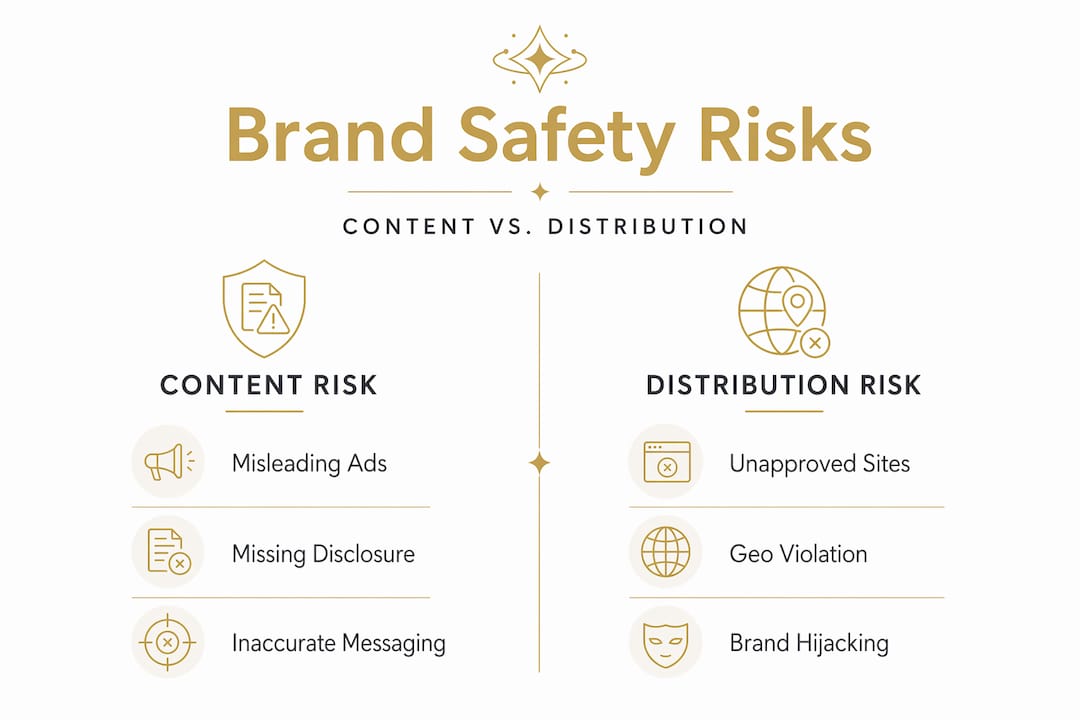
The distinction matters in practice. An affiliate can produce a perfectly compliant landing page with all required disclosures and RG messaging, then distribute that page through a channel that is restricted under the programme agreement, or target a geo where the operator has no licence. The content passes review. The distribution creates a liability.
Distribution risk issues that operators frequently overlook include:
- Native advertising placements on content networks where gambling advertising is prohibited
- Social media amplification through audiences that include users in restricted geos
- Email marketing to lists that have not been properly age verified or consent captured
- Push notification campaigns that bypass geo-fencing controls
- Paid social ads that target lookalike audiences based on parameters that include under-18 users
Both dimensions, content and distribution, must be actively monitored for brand safety to function as intended. A compliance programme that only checks creative is operating with a significant blind spot.
What most iGaming affiliates get wrong about brand safety
Here is an uncomfortable truth that two decades in iGaming media has reinforced: most affiliate programmes treat brand safety as an insurance policy rather than a commercial strategy. They design their controls to minimise the risk of regulatory action, which is necessary, but they stop there.
The programmes that consistently outperform are the ones that have understood something more valuable: brand safety is a trust infrastructure. When an affiliate promotes responsibly, discloses clearly, and respects the operator’s brand standards, players arrive with better expectations, lower dispute rates, and higher lifetime value. The brand safety framework is not just keeping regulators satisfied; it is actively shaping the quality of every player that enters through an affiliate door.
Affiliate fraud and brand safety failures overlap at a specific point that many operators miss: affiliate misconduct can directly harm operator brand trust even when the operator’s compliance controls do not directly prevent every affiliate action. That gap between what an operator controls and what an affiliate actually does is where brand trust is lost.
Smart affiliates have figured out that the inverse is also true. Demonstrating proactive compliance, submitting creative for pre-approval before being asked, maintaining clean traffic sources, and reporting anomalies rather than hoping they go unnoticed makes you the kind of partner that operators want to protect and grow with. Brand safety becomes a differentiator, not a burden.
The checklist mentality is dangerous because it creates a false sense of security. Regulations evolve. Affiliate tactics evolve faster. What was a minor grey area two years ago may be a regulatory priority today. Programmes that rely on written policies without active monitoring and ongoing relationship management will always be one step behind.
How Lucky Universe supports safer affiliate marketing
Brand safety in iGaming requires more than good intentions. It demands transparent systems, proactive compliance infrastructure, and media partnerships built on genuine editorial standards.

At Lucky Universe, we have built our platform with these exact requirements at its foundation. Our AI-native approach means that the content we produce and distribute is structured, source-transparent, and optimised for accuracy, not just traffic volume. Operators working with us get access to compliance-aware content partnerships and a media environment designed to meet the standards that regulated iGaming markets demand. Affiliates benefit from clear guidelines, supported onboarding, and a publishing framework that makes demonstrating compliance straightforward. If you are building an affiliate programme that takes brand safety seriously, or if you are an affiliate ready to operate at the standard that premium programmes require, Lucky Universe is where that work starts.
Frequently asked questions
What is the main goal of affiliate brand safety in iGaming?
The main goal is to ensure that affiliates promote brands legally and responsibly, protecting operators from regulatory risks and reputational harm. As compliance guidance defines it, brand safety means controlling what affiliates do and say so the operator’s brand is not associated with illegal, misleading, or harmful promotions.
How do operators prevent affiliate fraud and attribution abuse?
Operators use affiliate guidelines, monitoring technology, and clear traffic reporting to detect and stop fake traffic or brand hijacking schemes. Common fraud tactics include affiliates bidding on brand terms in search ads and schemes where partners manipulate tracking or attribution to earn commissions without delivering legitimate players.
Which compliance controls are essential for iGaming affiliate programs?
Disclosure, responsible gambling messaging, age gating, geo-fencing, and rules against unauthorised brand use are the foundational controls every programme needs. These mechanisms work together to ensure offers are served legally, responsibly, and transparently.
What penalties can result from affiliate brand safety breaches?
Regulator penalties include loss of market access, fines, and requirements to withdraw noncompliant advertising. Beyond regulatory action, brand trust damage from a serious affiliate breach can be permanent and commercially far more costly than any individual fine.