Insights
How to integrate AI into gambling content for smarter betting

Online gambling is a maze of conflicting odds, promotional noise, and split-second decisions that can cost you real money. The gap between a disciplined bettor and an impulsive one is often just better information, and AI is rapidly becoming the tool that closes that gap. Whether you’re building content for a gambling platform or simply trying to sharpen your own betting strategy, understanding how to integrate AI responsibly and effectively is no longer optional. This guide walks you through every stage, from the foundational concepts to validation and iteration.
Table of Contents
- Understanding AI’s role in gambling content
- Requirements and tools to integrate AI
- Step-by-step guide to integrating AI
- Common mistakes and troubleshooting
- How to validate outcomes and iterate
- What most guides miss about AI in gambling
- Take your next step with Lucky Universe
- Frequently asked questions
Key Takeaways
| Point | Details |
|---|---|
| Avoid accuracy traps | High prediction accuracy doesn’t guarantee profitable bets or positive outcomes. |
| Prioritise transparency | AI-powered systems in gambling must clearly explain decisions and offer human oversight options. |
| Check legal requirements | Always ensure compliance with rules like GDPR when using AI-driven decisioning tools. |
| Benchmark real value | Test your AI against real winnings and odds, not just statistical results. |
Understanding AI’s role in gambling content
Before you integrate anything, you need a clear picture of what AI actually does in the gambling space. There is a critical distinction that most articles gloss over: AI assisting content is not the same as AI altering game mechanics.

AI-assisted content means using machine learning models and language tools to surface better information for players, such as risk flags, historical patterns, or personalised betting summaries. AI-altered game mechanics means changing the actual odds, house edge, or payout structures based on player data. These are entirely different things, and confusing them leads to both bad decisions and legal exposure.
Here is a quick comparison to make that distinction concrete:
| Application type | What it does | Who benefits | Transparency needed |
|---|---|---|---|
| Content personalisation | Tailors information and alerts to user behaviour | Player and operator | High |
| Risk prediction | Flags problem gambling patterns | Player and regulator | High |
| Odds optimisation | Adjusts odds dynamically | Operator only | Very high |
| Recommendation engine | Suggests games or bets | Operator primarily | Medium |
| Decision-support tools | Helps players evaluate value | Player | High |
Key things AI can legitimately do for gambling content include:
- Surfacing responsible gambling alerts based on session behaviour
- Generating personalised summaries of betting history
- Flagging high-risk patterns like loss chasing or rapid deposit cycles
- Presenting odds comparisons in plain language
- Structuring editorial content to answer specific player questions
What AI should not do without full disclosure is silently influence a player’s choices through opaque recommendation systems. Research shows that AI-driven personalisation can influence gambler behaviour and user engagement, but causal claims are limited without proper measurement. That caveat matters enormously. Engagement is not the same as benefit.
Requirements and tools to integrate AI
Now that the types of AI usage are clear, let’s look at what you need to get started and what tools make integration easier.
Getting AI into your gambling content workflow does not require a data science degree, but it does require some baseline preparation. Here is what you need:
Data infrastructure: You need structured, clean data. This means account histories, session logs, deposit and withdrawal patterns, and game interaction data. Without quality data, even the best model produces unreliable outputs.
Platform access: Several platforms make AI integration accessible for gambling content teams. These include:
| Tool or platform | Primary use case | Skill level required |
|---|---|---|
| OpenAI API (GPT-4o) | Content generation, risk summaries | Low to medium |
| Google Vertex AI | Custom model training and deployment | Medium to high |
| AWS SageMaker | End-to-end ML pipelines | High |
| Hugging Face | Open-source model fine-tuning | Medium |
| Tableau with AI extensions | Visualising betting trends | Low |
Legal and compliance knowledge: This is where many teams stumble. Operators using AI must plan for transparency obligations around automated decisions and provide meaningful information about the logic, significance, and consequences of those decisions, particularly under GDPR for automated decisioning. In practical terms, this means players must be told when AI is influencing what they see, and they must have a way to request human review.
Additional requirements to keep in mind:
- Document your model’s logic and update that documentation when the model changes
- Provide opt-out mechanisms for AI-driven personalisation
- Conduct regular bias audits, especially if your model was trained on skewed historical data
- Ensure your data retention policies align with applicable privacy legislation
Pro Tip: Even if you are not legally required to provide a human review option in your jurisdiction, building one into your system from the start protects you when regulations tighten, and they always do.
Step-by-step guide to integrating AI
With tools and requirements covered, it’s time to get practical. Here is how to actually integrate AI into your gambling content.
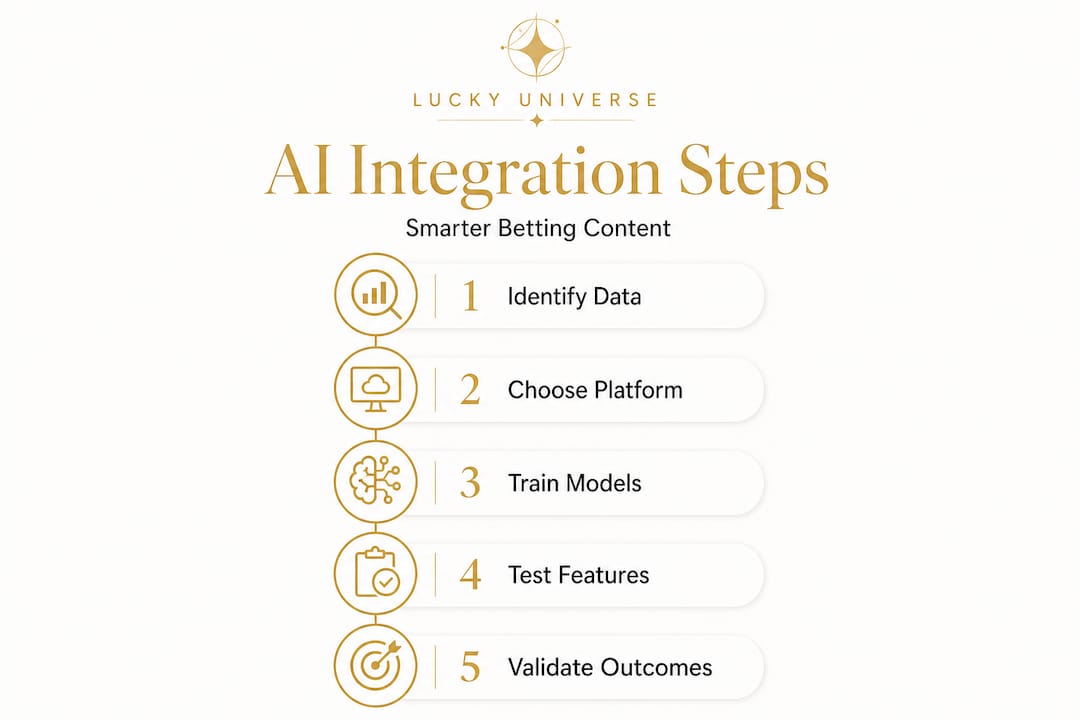
Step 1: Identify your data sources. Start with what you already have. Behavioural tracking data, account histories, session timestamps, and deposit patterns are your raw material. Map every data point to a potential use case. For example, rapid session restarts after a loss might feed a loss-chasing detection model.
Step 2: Choose your AI platform and model type. Match the tool to the task. For content generation and summarisation, large language models like GPT-4o work well. For predictive risk scoring, you need a classification model trained on labelled behavioural data. Do not use a hammer when you need a scalpel.
Step 3: Train models using temporally stable data. This is where most teams make their first serious error. Training a model on a single snapshot of data produces a system that performs well in testing but degrades quickly in production. Use data across multiple time windows to ensure your model handles seasonal variation, promotional periods, and changing player demographics.
Step 4: Test and evaluate your features. Before deploying anything, run your model against a holdout dataset. Key predictors to evaluate include loss chasing frequency, net balance trend over 30 and 90 days, session length variance, and deposit acceleration. Behavioural tracking methods using AI and machine learning can predict problem gambling risk and identify key predictors, supporting an evidence-based case for responsible gambling decision-support content.
Step 5: Deploy decision-support features. These are the player-facing outputs: risk alerts, session summaries, betting value calculators, and personalised responsible gambling nudges. Design these to inform, not to coerce. The goal is empowerment.
Step 6: Build feedback loops. Every deployment should include a mechanism for capturing whether the AI’s output was useful. Did the player act on a risk alert? Did a value suggestion lead to a better outcome? This data feeds your next iteration.
“Model performance is not a launch metric. It is an ongoing responsibility. A system that worked well six months ago may be silently failing today if no one is watching the calibration drift.”
Pro Tip: Always benchmark your models against real profitability outcomes, not just prediction accuracy. A model that is 80% accurate at predicting a win but consistently recommends bets with negative expected value is worse than useless. It is actively harmful.
Common mistakes and troubleshooting
No integration is flawless. Here is how to sidestep the most common errors and address them if they arise.
Mistake 1: Equating accuracy with profitability. This is the most dangerous misconception in AI-assisted betting. A model can be highly accurate at predicting outcomes and still generate losses if it does not account for bookmaker margins and value realisation. Research into value bet modelling confirms that even with strong prediction accuracy, profitability depends on calibration and bookmaker margin. Your content should teach bettors to evaluate expected value against odds, not just follow model outputs blindly.
Mistake 2: Using truncated data windows. Models trained on short data windows miss long-term behavioural patterns. A player who only deposits during football season looks very different from a year-round bettor, and a model that only sees three months of data will misclassify them consistently.
Mistake 3: Ignoring model drift. Markets change. Player behaviour shifts. A model trained before a major regulatory change or a platform redesign may perform very differently afterward. Build monitoring dashboards that track prediction confidence and output distribution over time.
Mistake 4: Non-transparent automated decisions. If your platform uses AI to restrict accounts, limit withdrawals, or flag players without explanation, you are exposed to both regulatory action and player trust erosion. Every automated decision must be explainable.
Common warning signs that your integration needs attention:
- Prediction accuracy drops more than 5% month over month
- Player complaints about irrelevant or intrusive AI suggestions increase
- Responsible gambling alerts are being ignored at high rates
- Model outputs cluster around a narrow range, suggesting overfitting
Pro Tip: Schedule a monthly model health review. Check calibration, review flagged edge cases, and compare model predictions against actual outcomes. Treat it like a financial audit, not an afterthought.
How to validate outcomes and iterate
Once you’ve integrated AI and navigated potential pitfalls, the next step is ongoing validation and improvement of your system.
Validation is not a one-time event. It is a continuous process that determines whether your AI integration is actually serving players or just generating impressive-looking dashboards.
Here is how to measure what matters:
- Prediction hit rate: How often does your model correctly identify the outcome it was designed to predict? Track this weekly, not quarterly.
- Calibration score: Are your model’s confidence levels accurate? A model that says it is 90% confident should be right about 90% of the time.
- User action rate: What percentage of players act on AI-generated suggestions or alerts? Low action rates often signal that outputs are confusing or poorly timed.
- Outcome tracking: For betting decision-support tools, track whether following AI suggestions leads to better net outcomes over a 30, 60, and 90 day window.
- Responsible gambling impact: Are players who receive AI-generated risk alerts showing reduced loss-chasing behaviour? This is the metric that matters most for platform integrity.
Temporal stability and robust performance are key in model evaluation, using features like loss chasing and net balance trend across multiple data truncations. This means your evaluation framework should test the model at different time horizons, not just on the most recent data.
| Validation metric | Target benchmark | Review frequency |
|---|---|---|
| Prediction hit rate | Above 70% | Weekly |
| Calibration score | Within 5% of confidence | Monthly |
| User action rate | Above 25% | Monthly |
| Net outcome improvement | Positive over 90 days | Quarterly |
| Responsible gambling impact | Measurable reduction in risk flags | Quarterly |
Iteration should follow a structured cycle: measure, analyse, adjust, redeploy. Do not make changes to a model based on a single bad week. Look for consistent trends before recalibrating. And always document what changed, why, and what the result was. That documentation becomes your institutional knowledge.
What most guides miss about AI in gambling
Most guides on AI in gambling focus on the technology and skip the philosophy. That is a mistake, and it is one we see repeatedly in the iGaming industry.
The real question is not “how accurate is your model?” It is “does your model serve the player?” Those are not the same question. A model optimised for operator revenue can be technically sophisticated and genuinely harmful at the same time. Predictive accuracy can mislead if it is not matched to real value for the person on the other side of the screen.
We have spent over 20 years watching the gambling industry evolve, and the pattern is consistent: tools built without player-centred design eventually create backlash, regulatory crackdowns, or both. The operators who build lasting trust are the ones who treat AI as a transparency tool, not a manipulation tool.
Here is the uncomfortable truth: most AI integrations in gambling are designed to increase time-on-site and deposit frequency. Very few are designed to help players make genuinely better decisions. The gap between those two goals is where player harm lives.
If you are building AI-driven gambling content, ask yourself one question before deploying any feature: does this make the player more informed or less? If the answer is less, even subtly, reconsider the design. Transparency and human review should not be compliance checkboxes. They should be core features that you would be proud to highlight in your marketing.
The most powerful AI application in gambling is not a prediction engine. It is a system that helps players understand their own behaviour clearly enough to make choices they will not regret.
Take your next step with Lucky Universe
If this guide has shown you anything, it is that integrating AI into gambling content is as much about responsibility as it is about technology. Getting it right requires the right platform, the right data practices, and the right editorial standards.

Lucky Universe is built specifically for this intersection of AI innovation and iGaming integrity. As an AI-native media platform with over 20 years of industry experience, we produce structured, transparent, editorial-grade content that empowers players and supports operators who want to do things right. Whether you are looking to understand how AI is reshaping the industry or seeking a partner that holds itself to the highest standards of responsible gambling innovation, Lucky Universe is where that conversation starts. Explore our platform and see how we are redefining what gambling content can be.
Frequently asked questions
Can AI actually improve my gambling outcomes?
AI can support smarter decisions by predicting risk and behaviour patterns, but profitability depends on model calibration and betting value, not just prediction accuracy.
Is personalisation in AI gambling always benefitting the player?
Personalisation can boost engagement, but AI-driven personalisation has limitations in making causal claims, meaning benefits or risks are not always clear and may not guarantee better outcomes for the player.
What legal requirements apply to AI in gambling?
Operators using AI must provide clear explanations for AI-driven decisions and offer options for human review to comply with transparency standards like GDPR.
How should I evaluate AI decision-support tools?
Focus on both prediction accuracy and real profitability, assessing value against odds and monitoring model performance consistently over time rather than relying on a single accuracy metric.