Insights
How AI personalizes your online gambling experience

Most bettors assume their online gambling experience is shaped by luck and browsing habits alone. The reality is far more calculated. Behind every bet suggestion, promotional offer, and odds display sits a sophisticated layer of AI-driven content delivery that uses recommender systems, collaborative filtering, hybrid models, and reinforcement learning to tailor what you see in real time. Understanding how this works is not just interesting; it is the difference between being guided by the platform and making genuinely informed decisions for yourself.
Table of Contents
- What does AI-powered content personalization mean in online gambling?
- Behind the curtain: How does AI deliver real-time personalised content?
- Personalised recommendations and bet offers: How they shape decisions
- Overcoming hurdles: Cold starts, fairness, and safer content
- The uncomfortable truth about AI personalisation in gambling
- Leverage the power of personalised AI for smarter, safer betting
- Frequently asked questions
Key Takeaways
| Point | Details |
|---|---|
| Real-time personalization | AI delivers tailored bet suggestions and offers in milliseconds for a more engaging gambling experience. |
| Boosted engagement and value | Personalization drives higher retention and player value, but can shape risky behaviours without safeguards. |
| Technology behind the magic | Systems use recommender models, feature stores, and vector databases to personalize your content stream. |
| Risks and responsibility | AI can nudge risky behaviour—understanding and seeking ethical design is crucial for safer betting. |
| Cold start solutions | Smart platforms handle new users with hybrid models and popular bets until they learn your preferences. |
What does AI-powered content personalization mean in online gambling?
Personalization in online gambling is not a simple matter of showing you football odds because you once clicked on a match. It is a continuous, adaptive process where AI analyses your play style, bet history, session timing, stake sizes, and even how long you hover over certain markets before deciding what to show you next.
The core mechanisms powering this are recommender systems. These systems fall into three broad categories:
- Collaborative filtering: Finds users who behave similarly to you and surfaces bets or games those users engaged with
- Content-based filtering: Analyses the attributes of bets you have already placed and finds similar options
- Hybrid models: Combine both approaches for greater accuracy, especially useful when one method lacks enough data
- Reinforcement learning (RL): A type of machine learning where the system learns by trial and reward, continuously optimising which content to show based on your responses over time
The AI-powered gambling content that results from these systems feels intuitive because it is designed to be. You log in and immediately see a pre-match accumulator featuring your favourite teams, a live in-play market for a sport you regularly bet on, and a bonus offer calibrated to your average stake. None of that is coincidental.
“AI delivers personalised bet recommendations, offers, and content via real-time platforms, addressing cold starts for events like the World Cup.” Future Anthem
One particularly clever challenge AI solves is the cold start problem, which refers to the difficulty of personalising content when there is little or no data about a user or event. When you create a brand new account, the platform has nothing to go on. When a new tournament launches, there is no historical betting data to draw from. AI handles this by falling back on popular bets, demographic signals, and metadata about the event itself until enough individual data accumulates. The casinoexpert.ai AI platform is built with exactly this kind of structured, transparent intelligence in mind.
Behind the curtain: How does AI deliver real-time personalised content?

Understanding what AI personalisation is gets you halfway there. The more revealing question is how platforms execute it at a speed that feels instant to you as a bettor.
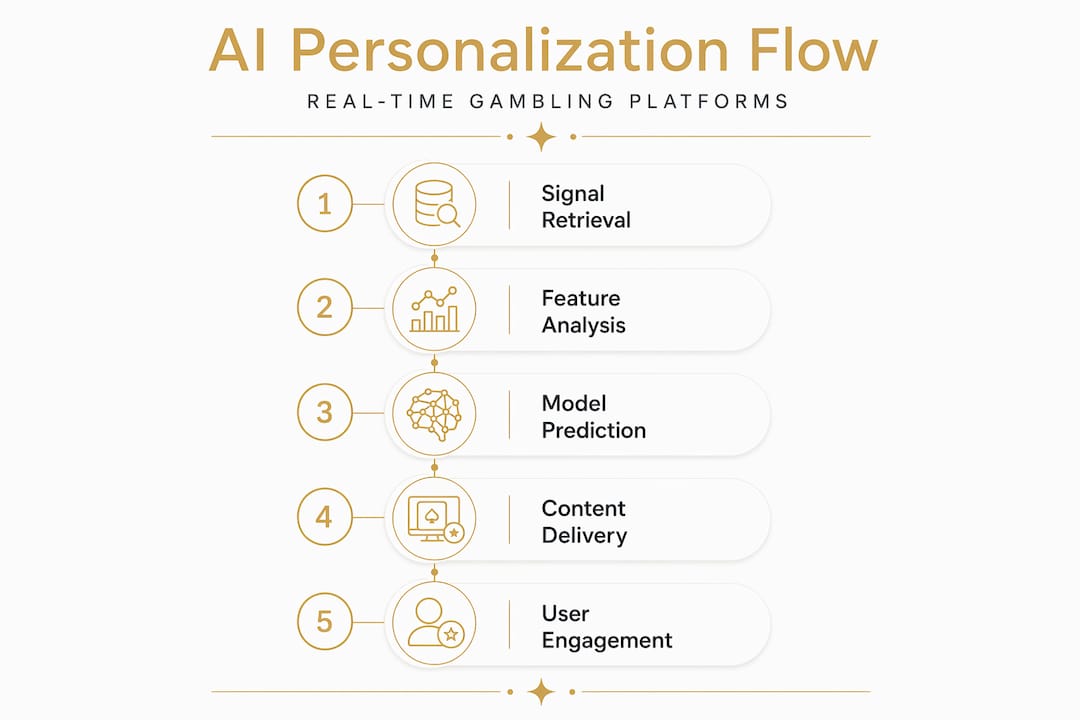
The process relies on a layered technical architecture. At the foundation sit feature stores, which are databases that hold pre-computed user and event attributes. These are split into fast signals (your last three bets, current session activity) and slow signals (your six-month betting history, preferred sports). When you navigate to a page, the system pulls both signal types together and feeds them into a ranking model.
Here is a simplified breakdown of what happens in the milliseconds between your page load and the content you see:
| Stage | Process | Approximate time |
|---|---|---|
| Signal retrieval | Fast and slow feature lookup from store | 5 to 10ms |
| Model inference | Ranking model scores candidate bets | 20 to 100ms |
| Edge cache delivery | Pre-ranked content served from nearest server | Under 5ms |
| Rendering | Page assembles personalised layout | 10 to 20ms |
This temporal decoupling separates the heavy computational work (model inference) from the lightweight delivery step, which is why personalisation feels seamless even during peak traffic. Vector databases also play a role here, storing numerical representations of user preferences so that similarity searches across millions of profiles happen in fractions of a second.
The results of this architecture are measurable. Operators using AI personalisation at this level report significant performance uplift: revenue increases of 10 to 15%, retention and turnover improvements of up to 35%, a 34% higher average bet amount, and 22% higher overall player value. Those are not marginal gains. They represent a fundamental shift in how platforms grow their business.
Pro Tip: If you are a live bettor, you are in the best position to benefit from sub-100ms recommendations. AI systems prioritise in-play markets because the data signals are richest and most immediate. Checking in-play suggestions within the first 30 seconds of a session often surfaces the most accurately personalised options before the model updates to a broader audience pool.
Platforms that invest in AI search visibility techniques are also building the structured data frameworks that make this kind of real-time personalisation more accurate and discoverable.
Personalised recommendations and bet offers: How they shape decisions
Speed and intelligence are impressive, but the real story is what these systems do to your actual betting behaviour. Let us walk through a realistic user journey.
You log in on a Saturday morning. The homepage immediately shows you a five-fold accumulator featuring three teams you have bet on in the past month, a boosted odds offer on a match starting in 90 minutes, and a free bet reload tied to your most recent deposit amount. You did not search for any of this. The platform built it for you, and it took less than 200ms.
The numbered sequence of influence looks like this:
- Attention capture: Personalised content appears above the fold, reducing the effort needed to find relevant bets
- Anchoring: Boosted odds create a reference point that makes the standard price feel less attractive
- Urgency signals: Time-limited offers tied to upcoming events trigger faster decisions
- Social proof: “X bettors placed this today” labels leverage collaborative filtering data visibly
- Reward loops: Personalised free bets tied to your history reinforce return visits
The benefits for bettors who use this wisely are real. Faster navigation to relevant markets saves time. Tailored offers can deliver genuine value when they align with bets you would have placed anyway. AI-surfaced odds analysis can highlight edges you might have missed. Making smarter gambling choices becomes more accessible when the right information is already in front of you.
However, the risks are equally real and worth taking seriously.
| Benefit | Risk |
|---|---|
| Faster access to relevant markets | Filter bubbles limit your exposure to new bet types |
| Tailored offers matching your stake level | Incentives timed to loss periods increase vulnerability |
| Odds analysis surfaced automatically | Nudges towards higher-risk, higher-margin bets |
| Reduced friction in the betting journey | Reduced awareness of how decisions are being shaped |
| Personalised content improves engagement | Ethical concerns over manipulation of at-risk users |
Research published in peer-reviewed literature makes the tension explicit: AI boosts engagement and retention but carries documented risks around addiction via timed incentives during loss periods, filter bubbles that narrow a bettor’s perspective, and ethical questions about manipulation. This is not a theoretical concern. It is an active area of regulatory scrutiny in multiple jurisdictions.
Staying informed about best marketing practices 2026 helps you recognise when platforms are operating responsibly and when they are pushing the boundaries of ethical design.
Overcoming hurdles: Cold starts, fairness, and safer content
Knowing the benefits and risks of AI personalisation, it is worth understanding where the technology still struggles and what responsible operators are doing about it.
The cold start problem is the most well-known limitation. When you are a new bettor, the platform has no individual data to personalise from. The same issue arises when a new sport, league, or game launches without historical engagement data. Without a solution, new users would receive generic, irrelevant content that fails to engage them.
Modern platforms address the cold start problem through several layered approaches:
- Popular content fallback: Surfacing the most widely bet markets until individual preferences emerge
- Metadata-driven seeding: Using event attributes (sport type, competition tier, team popularity) to make educated guesses
- Hybrid model switching: Shifting weight from collaborative filtering to content-based filtering when user data is sparse
- Reinforcement learning augmentation: Deploying RL agents to explore new user preferences through controlled variation rather than waiting passively for data
- Meta-features: Incorporating device type, location, time of day, and referral source as proxy signals for preference
Beyond cold starts, fairness and ethical design are emerging as the defining challenges for the industry. Filter bubbles, where AI only shows you what you already like, can trap bettors in narrow markets and prevent them from discovering better-value options elsewhere. More seriously, systems optimised purely for engagement can learn to exploit vulnerability, sending personalised offers precisely when a bettor is most emotionally reactive after a losing streak.
Responsible operators are beginning to integrate safeguards directly into their personalisation pipelines. These include cooling-off triggers that suppress offers after significant losses, transparency dashboards that show users why they are seeing specific recommendations, and opt-out controls that let bettors shape their own content experience.
Pro Tip: When evaluating a new platform, look specifically for transparency features and user controls in the personalisation settings. A platform that lets you see why you are receiving certain offers and allows you to adjust them is demonstrating ethical AI design. Platforms that hide this information entirely are worth approaching with extra caution. The AI integration tips at Lucky Universe cover what responsible implementation actually looks like in practice.
The uncomfortable truth about AI personalisation in gambling
Here is what most articles about AI in gambling will not tell you directly: the personalisation system is not built for your benefit. It is built for the operator’s benefit, and those two things only overlap some of the time.
When a platform reports a 34% higher average bet amount as a result of AI personalisation, that is not a neutral statistic. It means the system successfully nudged bettors into placing larger wagers than they would have chosen independently. The reinforcement learning models powering these systems are explicitly optimised for long-term player value, which in operator language means sustained engagement and turnover without burning users out too quickly. That is a sophisticated goal, and it is not the same as helping you win.
This does not mean AI personalisation is without value for bettors. It genuinely can surface better odds, highlight markets you would have missed, and make the research process faster. The tailored bet suggestions and odds analysis that AI enables can create real informational edges when you know how to use them. The key word is when you know how to use them.
The bettors who come out ahead are the ones who treat AI recommendations as a starting point for their own analysis, not a conclusion. They notice when offers arrive suspiciously soon after a losing session. They actively seek out markets the algorithm does not push at them. They use AI tools for their own research rather than only consuming the research the platform has pre-packaged for them.
At Lucky Universe, we have spent over 20 years watching the iGaming industry evolve, and the honest assessment is this: AI personalisation is the most powerful force shaping online gambling today, and most bettors are on the receiving end of it without fully realising it. The Lucky Universe insights we publish are built around the principle that informed bettors make better decisions, and that starts with understanding the systems that are actively trying to shape your behaviour.
Demanding transparency, using responsible platforms, and applying your own analytical layer on top of AI recommendations are not optional extras. They are the foundation of sustainable, enjoyable betting.
Leverage the power of personalised AI for smarter, safer betting
You now understand the mechanics, the benefits, and the genuine risks of AI personalisation in online gambling. The next step is putting that knowledge to work with a platform that is actually on your side.
At Lucky Universe, our entire editorial approach is built around transparent, structured, AI-native content that gives you the analytical edge rather than engineering your behaviour for operator gain. From in-depth platform reviews to responsible betting frameworks, our Lucky Universe methodology is designed to help you make genuinely informed decisions. Whether you are evaluating a new sportsbook or trying to understand why a particular offer landed in your inbox, our resources give you the context to act wisely. Explore our growing catalogue of iGaming insights and start betting with clarity, not just instinct.
Frequently asked questions
How does AI determine which bets or offers I see?
AI analyses your behaviour, play history, and preferences to recommend bets and offers using recommender systems that combine your individual data with patterns from similar users through collaborative filtering, content-based filtering, and hybrid models.
Are AI-powered recommendations always safe or fair?
Not always. While personalisation improves engagement, documented risks include manipulation through timed incentives during losses, filter bubbles that narrow your betting perspective, and ethical concerns that responsible platforms are only beginning to address through transparency tools and user controls.
What happens if I’m new and AI has no data about me?
Platforms solve the cold start problem by using popular bets, event metadata, and hybrid models as proxy signals until your own data accumulates, so your early experience is based on broad trends rather than genuine personalisation.
Can personalisation actually increase my betting success?
It can help by surfacing relevant markets and tailored odds analysis faster, but genuine success still depends on your own strategy, discipline, and willingness to look beyond what the algorithm places in front of you.