Insights
How trust signals shape smarter online gambling choices

Most online gamblers spend their energy chasing welcome bonuses and free spins, but the players who consistently enjoy safer, more rewarding experiences are paying attention to something else entirely. Trust signals, the layered cues embedded across every reputable gambling platform, quietly shape your decisions long before you make a deposit or request a withdrawal. Understanding how these signals work, which ones actually matter, and when to look for them can mean the difference between a frustrating experience and a genuinely enjoyable one.
Table of Contents
- What are trust signals in digital media?
- Core types of trust signals: A side-by-side look
- How trust is measured: From badges to algorithms
- When trust really matters: Player behaviour at critical moments
- Why most gamblers misread trust signals (and what to do instead)
- How Lucky Universe helps you spot genuine trust signals
- Frequently asked questions
Key Takeaways
| Point | Details |
|---|---|
| Types of trust signals | Trust signals in digital media include visual, institutional, and behavioural cues that together help players feel safer online. |
| Trust changes at critical moments | Gamblers rely more on operational behaviours like withdrawal processing during high-risk points, not just promotions. |
| Dynamic trust scoring | Both humans and advanced AI systems evaluate trust using layered processes, not just one-time badges or seals. |
| Practical application | Spotting true trustworthiness means prioritising ongoing, consistent player experience and platform transparency. |
What are trust signals in digital media?
Trust signals are not just padlock icons or “licensed and regulated” banners. They are a layered system of visual, institutional, and behavioural cues that work together to reduce your uncertainty when you are deciding whether to play on a platform. As digital media trust signals research confirms, these signals combine visible UI cues, institutional and third-party validations, and behavioural proof from ongoing interactions to reduce risk perception across the entire player journey.
Think of it this way: a casino’s homepage is not just a marketing brochure. Every design choice, every seal, every loading speed, and every piece of content is communicating something about how seriously that platform takes your trust. Players who understand this read gambling sites the way experienced travellers read hotels, spotting quality and reliability in details others overlook.
There are three core categories worth knowing:
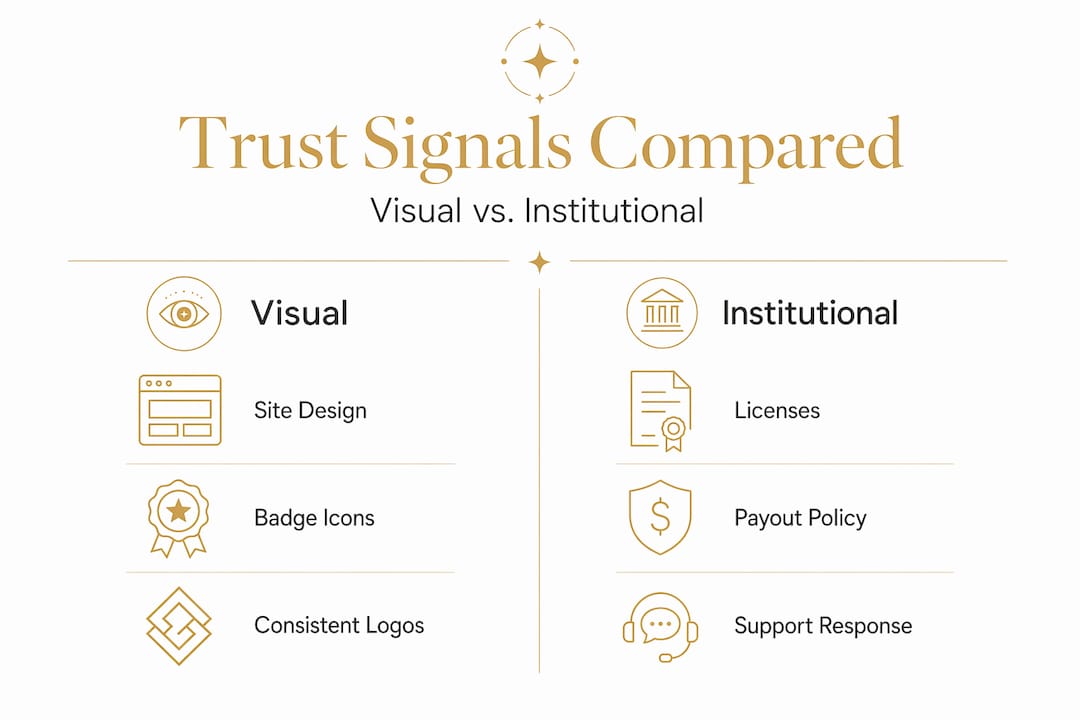
- Visual trust signals: These include consistent branding, professional design, clear navigation, and the absence of cluttered or misleading layouts. A site that looks polished and loads quickly is signalling investment in user experience.
- Institutional trust signals: These are third-party validations such as licensing logos from regulators like the Malta Gaming Authority or the UK Gambling Commission, independent audit seals from eCOGRA or iTech Labs, and payment provider badges.
- Behavioural trust signals: These are the hardest to fake and the most meaningful. They include how quickly a platform responds to support queries, how consistently withdrawals are processed, and how transparently the platform communicates policy changes.
“Trust is not a single badge you earn once. It is a continuous signal that players read across every touchpoint of their experience.” This framing, drawn from current digital trust research, captures exactly why a licence alone is never enough.
Good casino content best practices reflect this layered approach, ensuring that platforms communicate trust through both what they say and how they behave. If you want a deeper look at how this plays out across the industry, the broader gambling insights available from experienced iGaming media are worth exploring.
Core types of trust signals: A side-by-side look
Understanding each kind of signal helps you quickly spot which platforms truly deserve your trust. The table below breaks down the three main types, what they look like in practice, and how easy they are to spot.
| Signal type | What it looks like | How noticeable | What it proves |
|---|---|---|---|
| Visual | Clean layout, consistent branding, fast load times | Immediately obvious | Platform investment in UX |
| Institutional | Regulatory seals, audit badges, payment logos | Visible but requires verification | Third-party accountability |
| Behavioural | Withdrawal speed, support consistency, policy transparency | Subtle, revealed over time | Actual operational reliability |
As trust-signal research confirms, these categories include visual cues like logos, icons, and layout consistency; institutional signals like regulatory seals, certifications, and partner badges; and behavioural signals like predictability, consistent feedback, and reliable actions over time. The key insight is that each type answers a different player concern.
Visual signals answer: “Does this platform take itself seriously?” Institutional signals answer: “Is someone holding this platform accountable?” Behavioural signals answer: “Will this platform actually follow through?”

Pro Tip: Do not just look for a licence badge. Click on it. Legitimate licences link directly to the regulator’s database where you can verify the casino’s status in real time. A badge that goes nowhere is a red flag, not a reassurance.
The rise of AI-native casino experiences has added a fourth layer to this picture. Platforms that structure their content for AI-driven discovery tend to be more transparent by design, because AI systems reward clarity, sourcing, and consistency. This means that players using AI tools to research casinos are increasingly exposed to higher-quality, more trustworthy information by default.
How trust is measured: From badges to algorithms
Now that you can identify trust signals, let’s look at how both people and AI systems actually measure and monitor them. This is where the picture gets genuinely interesting, especially if you use AI tools to research gambling options.
For human players, trust measurement tends to be intuitive and sequential. You notice the design, check the licence, read a few reviews, and then test the platform with a small deposit. But this process is vulnerable to manipulation. Fake reviews, purchased seals, and polished design can all mislead a player who is not looking carefully.
AI systems take a fundamentally different approach. In AI answer-generation pipelines, trust is operationalised as a scoring process across retrieval, citation and weighting, and claim confidence, rather than a single static badge. This means that when you ask an AI tool about a casino’s trustworthiness, the system is weighing dozens of signals simultaneously, not just checking whether a licence exists.
Here is how that process typically works for AI-driven trust assessment:
- Retrieval: The AI gathers information from multiple sources, including regulatory databases, review platforms, news articles, and the casino’s own published content.
- Citation weighting: Sources are ranked by authority. A review from an established iGaming media outlet carries more weight than an anonymous forum post.
- Claim confidence scoring: The AI assesses how consistently claims about the casino appear across sources. If multiple independent sources confirm fast withdrawals, that claim scores high. If claims conflict, confidence drops.
- Output calibration: The final answer reflects the aggregate trust score, not just the most prominent claim.
| Assessment layer | Human approach | AI approach |
|---|---|---|
| Visual signals | Immediate gut reaction | Pattern recognition across layout data |
| Institutional signals | Badge check, sometimes verified | Cross-referenced against regulatory databases |
| Behavioural signals | Personal experience over time | Aggregated from multiple user and review sources |
| Claim confidence | Influenced by recency bias | Weighted by source authority and consistency |
This matters for you as a player because AI for smarter betting is not just a trend. It is becoming a practical tool for filtering out unreliable platforms before you ever make a deposit. Platforms that invest in AI search visibility through structured, transparent content are also, by extension, investing in the kind of operational transparency that makes them more trustworthy in practice.
The takeaway is clear: trust is no longer just a feeling. It is a measurable, multi-layered score that both humans and machines are constantly calculating.
When trust really matters: Player behaviour at critical moments
Knowing how platforms measure trust is one side; understanding when and why you feel that trust is equally critical. Research is clear on this point: trust signals are not equally important at every stage of your gambling journey.
During the signup phase, most players are drawn to visual and institutional signals. The site looks professional, the bonus seems generous, and the licence badge is visible. These signals do their job by getting you through the door. But the real test comes later.
“As risk increases, especially around cashout and verification, players shift their attention from headline promotions to operational behaviours like processing speed and consistency.” This finding from player trust research reflects what experienced gamblers already know intuitively.
The moments when trust matters most include:
- First withdrawal: How quickly does the casino process it? Do they ask for unexpected documentation? Is the amount correct?
- Identity verification (KYC): Is the process clear and proportionate? Are you asked for reasonable documents, or does the platform use verification as a delay tactic?
- Dispute resolution: If something goes wrong, how does the platform respond? Is there a clear escalation path? Do they communicate transparently?
- Bonus wagering completion: When you have met the requirements, does the platform release funds promptly and without friction?
- Account closure requests: Reputable platforms make this straightforward. Platforms with poor trust signals often complicate or delay closures.
Pro Tip: Before you deposit significant funds, test the support channel with a simple question. Note how long it takes to respond, whether the answer is accurate, and whether the agent is helpful or evasive. This single test reveals more about a platform’s behavioural trust signals than any badge on their homepage.
The player trust in iGaming landscape has shifted significantly in recent years. Players are more informed, more connected through community forums, and more likely to share negative experiences publicly. This social accountability layer has become a trust signal in its own right. A casino with thousands of verified positive withdrawal experiences across community platforms is demonstrating behavioural trust at scale.
Why most gamblers misread trust signals (and what to do instead)
Here is the uncomfortable truth that most gambling guides will not tell you: the trust signals that feel most reassuring are often the least reliable. A beautifully designed homepage with a prominent MGA seal can be produced by a platform that delays withdrawals for weeks. A modest-looking site with a less prominent licence badge might process your funds within hours and respond to support queries in minutes.
After more than 20 years of watching how players interact with gambling platforms, we have noticed a consistent pattern. Players who get burned are usually the ones who stopped evaluating trust after the signup page. They saw the badge, felt reassured, and stopped looking. Players who consistently have positive experiences are the ones who treat every interaction as a data point.
The “behaviour first” mindset is the shift that actually protects you. Instead of asking “does this casino have a licence?” ask “does this casino behave consistently across every interaction I have had with it?” These are very different questions, and only the second one gives you reliable information.
Here is a practical checklist to apply before depositing or cashing out:
Before depositing: Check withdrawal processing times from recent community reviews, not the casino’s own claims. Verify the licence directly on the regulator’s website. Test support with a non-urgent question and time the response.
Before cashing out: Review the withdrawal policy for any conditions you may have missed. Ensure your KYC documents are ready to avoid delays. Check recent player experiences on independent forums for that specific casino.
The rise of AI content for safe betting has made this kind of behavioural research faster and more accessible. AI tools can aggregate player experiences, flag inconsistencies in platform claims, and surface patterns that would take a human hours to identify manually. Use them.
The players who win long-term are not necessarily the luckiest. They are the most discerning. They treat trust as a dynamic, ongoing assessment rather than a one-time checkbox.
How Lucky Universe helps you spot genuine trust signals
Having learned how to identify and value authentic trust cues, here is how Lucky Universe can help you put this knowledge into action.

At Lucky Universe, we have built our entire platform around the principle that trust should be transparent, verifiable, and structured. Our trust methodology goes beyond surface-level badge-checking. We assess casinos across all three trust signal categories, visual, institutional, and behavioural, using a combination of editorial expertise and AI-driven analysis. Every review we publish is source-transparent, meaning you can see exactly where our assessments come from and why we reached our conclusions. Whether you are looking for your first casino or re-evaluating a platform you already use, discover reliable casinos through a process built on the same standards this article describes.
Frequently asked questions
What are examples of behavioural trust signals in online casinos?
Behavioural trust signals include fast withdrawals, consistent communication, and predictable verification processes. These signals are revealed through repeated interactions rather than upfront claims, making them the most reliable indicators of genuine trustworthiness.
Why do trust signals matter more during withdrawals?
Players face higher risk during withdrawals, so they naturally focus on speed, transparency, and dependable processing at these moments. As risk increases, players shift their attention from headline promotions to operational behaviours that reveal whether a platform truly delivers on its promises.
Can AI systems detect which casinos are trustworthy?
Yes, advanced AI now scores trust signals across sources, weighing evidence and claim confidence to produce a reliability assessment that goes well beyond what any single badge or review can offer.
How can gamblers quickly spot trustworthy gaming sites?
Look for consistent layout, regulatory seals that link to verifiable regulator databases, and smooth, timely transactions supported by good independent reviews and transparent withdrawal policies. The combination of all three signal types, not just one, is what separates genuinely trustworthy platforms from those that merely appear trustworthy.