Insights
Answer engine optimisation for better iGaming insights

Most online gamblers assume that if a casino or betting guide ranks first on Google, it must be the most reliable source. That assumption is rapidly becoming outdated. AI-powered tools like ChatGPT, Perplexity, and Gemini now answer betting questions directly, skipping the search results page entirely. For bettors who want fast, accurate information on odds, bonuses, or game rules, understanding how answer engine optimisation (AEO) shapes those responses can genuinely improve the quality of information you rely on every time you place a wager.
Table of Contents
- What is answer engine optimisation?
- How answer engines work and why structure matters
- Why trust and quality signals are critical for iGaming AEO
- AEO in action: Use cases and benefits for online bettors
- Measuring AEO versus traditional SEO: What matters now
- Why AEO is a must-have, not a nice-to-have, for iGaming brands
- Advance your iGaming content with expert AEO strategies
- Frequently asked questions
Key Takeaways
| Point | Details |
|---|---|
| AEO delivers direct answers | Optimizing for answer engines gets your gaming content cited in voice and AI responses. |
| Structure and quality matter | Question-driven, accurate guides with structured data attract answer engine citations. |
| AEO complements SEO | Using both AEO and SEO ensures your brand is visible on all major platforms. |
| Trust is non-negotiable | Relying on quality and expertise is crucial for compliance and AI visibility in iGaming. |
What is answer engine optimisation?
AEO might sound like industry jargon, but the concept is straightforward. It is the practice of structuring online content so that AI-powered tools can read it, trust it, and pull it into direct answers. As Coursera explains, “Answer engine optimization (AEO) is the practice of optimizing content so AI-powered answer engines can understand it, trust it, and accurately cite or summarize it in responses to user questions.”
That is a meaningful shift from traditional search engine optimisation (SEO), which focuses on getting pages to rank high in a list of results. With AEO, the goal is not just visibility in a list. The goal is to be the answer.
“AEO focuses on ‘answer readiness’ so content is extracted and cited inside AI-generated answers, while SEO focuses on ranking pages in search results for discoverability.” WebFX
For iGaming specifically, this distinction carries real weight. A bettor asking “what is the house edge on European roulette?” is not browsing for links. They want a clean, factual response in seconds. Sites that practise AEO are structured to deliver exactly that, making them far more likely to be the source an AI assistant cites.
Key differences between AEO and SEO in the iGaming context:
- SEO targets search engine rankings through keywords, backlinks, and technical performance
- AEO targets AI answer inclusion through structured data, direct question-and-answer formats, and authoritative sourcing
- SEO measures success by click-through rates and page positions
- AEO measures success by citation frequency and answer accuracy in AI tools
- SEO content often targets broad traffic; AEO content targets specific, answerable questions
For bettors, the practical benefit is simple. When you ask an AI tool about a casino bonus structure or how parlays work, AEO-optimised content is what shapes the quality of that answer. Staying informed about where good iGaming content lives starts at the iGaming SEO and AEO insights hub at Lucky Universe.
How answer engines work and why structure matters
Answer engines do not work the same way as traditional search engines. Rather than indexing pages and returning a ranked list, answer engines retrieve relevant content and then generate a synthesised response. They pull from sources they consider credible and extractable. Structure is everything.
Think of it this way. If a betting guide buries its explanation of “how accumulator bets work” deep inside a 3,000-word article with no clear heading or summary, an AI tool will likely skip it. But if that same explanation appears under a clear question heading, with a concise two-sentence answer followed by supporting detail, the engine can extract and use it with confidence.
HubSpot’s research confirms this approach: “Common AEO methodologies emphasize creating extractable content blocks (direct answers near the top), using clear question/answer structure, and adding structured data (schema) to help engines identify relevant passages.”
Schema markup (a form of code that labels content types for machines) plays a particularly important role. Formats like FAQPage, HowTo, and Q&A schema tell answer engines exactly what kind of content they are reading. A casino guide using HowTo schema to explain withdrawal steps is far more likely to surface in an AI assistant’s response than one that explains the same process in flowing prose with no structural labels.
Comparison: Structured vs unstructured content for answer engines
| Feature | Structured (AEO-optimised) | Unstructured (traditional) |
|---|---|---|
| Question format | Clear H2/H3 question headings | Information buried in paragraphs |
| Answer placement | Concise answer at the top | Answer mixed throughout text |
| Schema markup | FAQPage, HowTo, Q&A applied | No schema present |
| AI extractability | High | Low |
| Trust signals | Author credentials visible | Anonymous or vague |
| Example use case | ”What is a no-deposit bonus?” | Long blog post mentioning bonuses |
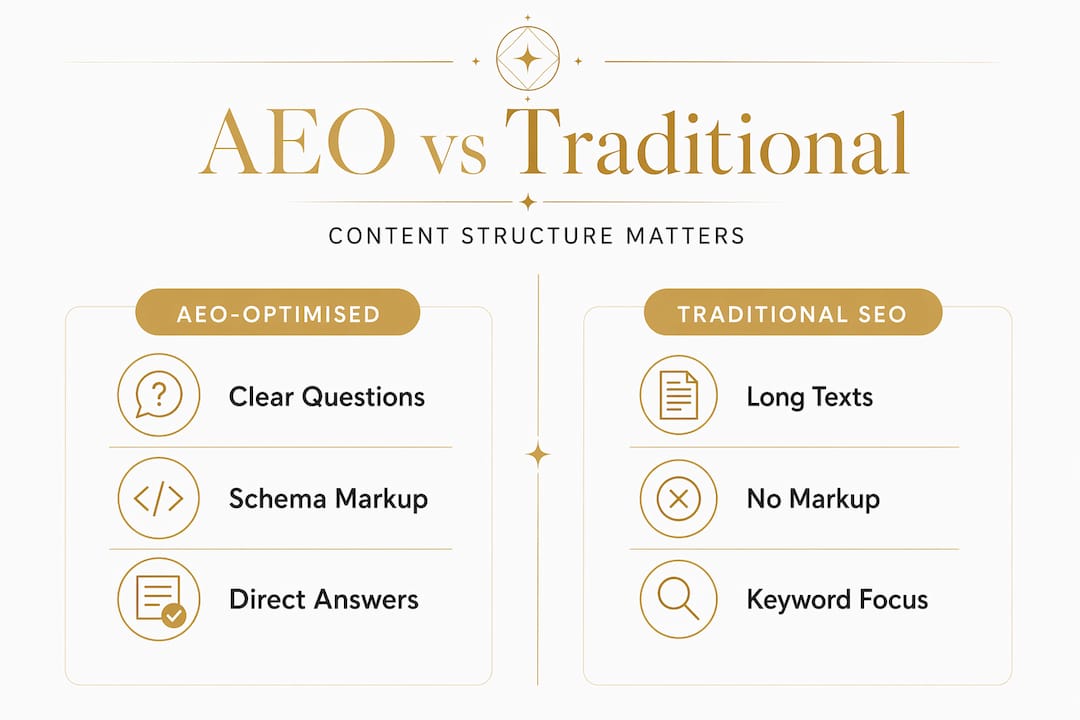
Pro Tip: When reading any betting guide, look for clearly labelled sections and FAQ blocks. That structure signals the content was built to be accurate and AI-ready, not just stuffed with keywords.
Adding schema markup for iGaming is one of the most effective technical steps any gambling content creator can take. Combined with well-organised AI in gambling content strategy, it positions a site to thrive in the answer engine era.
Why trust and quality signals are critical for iGaming AEO
Structure helps engines find your content. But trust signals determine whether they actually use it. This is where the gambling industry faces a unique challenge.
Online gambling is a regulated space. Information about betting odds, bonus terms, wagering requirements, and responsible gambling must be accurate. Answer engines are increasingly sophisticated at detecting whether content meets quality thresholds before citing it.
Google’s own guidance is unambiguous: “AEO/answer surfaces often rely heavily on trust and quality signals (E-E-A-T), and Google warns against scaled, low-value automated content that violates its spam policies.”
E-E-A-T stands for Experience, Expertise, Authoritativeness, and Trustworthiness. These are the four dimensions Google and other AI systems use to evaluate content quality. For a betting guide, that means:
- Experience: Has the author actually used the casino or placed these types of bets?
- Expertise: Are odds, rules, and terms explained accurately and in depth?
- Authoritativeness: Does the site have a track record and credible citations?
- Trustworthiness: Is the content transparent about affiliate relationships, odds sources, and review methodology?
Many iGaming brands churn out templated, keyword-heavy content with little editorial substance. That approach might generate short-term traffic, but it actively harms AEO performance. Answer engines are increasingly penalising low-quality automated content, even as AI tools become cheaper to use for content generation.
The risk is real. A gambling brand that relies on spun, low-value articles loses its ability to be cited in AI answers, exactly the channel growing fastest among younger bettors. Reviewing iGaming content best practices alongside the launch story behind casinoexpert.ai shows how a commitment to editorial quality changes the game entirely.

AEO in action: Use cases and benefits for online bettors
So what does AEO actually do for you as a bettor? The benefits are concrete and immediate. When you use an AI assistant to research a sportsbook or ask about blackjack strategy, the quality of the answer you receive depends entirely on whether the underlying content was built with AEO in mind.
Industry research highlights that “for iGaming bettors and online gambling sites, AEO is used to surface reliable, question-shaped information directly in AI/voice/answer results (for example, ‘how to bet,’ ‘what are the odds,’ ‘how bonuses work’), complementing conventional iGaming SEO focused on ranking and compliance.”
Here are the types of iGaming queries that benefit most from AEO-optimised content:
- Odds and probability questions: “What are the odds on a specific NFL spread?” or “What is the RTP on this slot?” These factual, numerical queries are ideal for AEO because they have precise answers.
- Bonus term clarifications: “What does 30x wagering requirement mean?” Bettors need clean definitions, not marketing copy.
- Rule explanations: “What happens on a push in blackjack?” or “How does a teaser bet work?” Step-by-step structured answers are perfect for AEO formats.
- Regulatory and safety queries: “Is this casino licensed in Ontario?” Accurate, sourced answers build trust instantly.
- Comparison questions: “What is the difference between fixed-odds and exchange betting?” AEO-structured comparison tables are highly extractable.
iGaming AEO examples in practice
| Query type | AEO format used | Speed of answer | Bettor benefit |
|---|---|---|---|
| Bonus term definition | FAQPage schema | Instant | Avoids misunderstanding terms |
| Odds explanation | HowTo schema + table | Instant | Faster wagering decisions |
| Casino licence check | Structured factual block | Near-instant | Trust verification |
| Bet type comparison | Q&A + comparison table | Fast | Clearer strategy choices |
| Responsible gambling info | FAQPage + links | Instant | Safer gambling behaviour |
Voice-based queries are also growing. When a bettor asks a smart speaker “what is the minimum bet at an online roulette table?”, the device reads one answer aloud. Being that answer requires AEO-first content strategy, full stop. Exploring AEO and SEO alternatives gives you a broader view of how platforms differ in their approach to this challenge.
Measuring AEO versus traditional SEO: What matters now
One of the trickiest parts of AEO is measurement. With traditional SEO, you track keyword rankings, organic traffic, and click-through rates. These are clean, numerical metrics. AEO measurement is messier but equally important.
For iGaming brands, the most meaningful AEO metrics include:
- Citation frequency: How often does an AI tool reference your content when answering gambling-related questions?
- Answer inclusion rate: When users ask specific betting questions in AI platforms, does your content appear in the synthesised response?
- Featured snippet capture: In traditional search, featured snippets are a proxy for AEO readiness and signal content extractability.
- Share of voice in AI tools: Brands are starting to manually query AI assistants and track whether their guides are cited.
- Brand mention in zero-click results: Being named without a direct link in AI responses still builds brand recognition.
The challenge is that AI tools do not always disclose their sources. ChatGPT, for example, often provides answers without citing specific URLs. This makes it harder to attribute AEO success directly. Perplexity AI is more transparent, showing source links alongside answers, which makes it a useful testing ground for iGaming brands evaluating their AEO performance.
Pro Tip: Regularly query AI assistants like Perplexity with the exact questions your betting guides answer. If your content does not appear in the results, it is time to review your schema, your E-E-A-T signals, and your content structure.
Tracking the right benchmarks requires an understanding of both sides of the equation. Reviewing the AEO and SEO methodology at Lucky Universe offers a clear framework for iGaming brands and bettors looking to understand how reliable content is evaluated in the AI era.
Why AEO is a must-have, not a nice-to-have, for iGaming brands
Here is the uncomfortable truth that most iGaming content teams have not yet accepted. AEO is not a future-facing strategy you can schedule for next year. It is already determining which gambling brands get seen and trusted by the next generation of bettors right now.
We have watched this industry operate for over two decades. The pattern is always the same. A new technology shifts how people discover information. The brands that adapt first capture disproportionate trust and market share. The brands that wait lose ground they never fully recover.
The stakes are even higher in gambling because trust is not abstract. A bettor who gets inaccurate bonus information from an AI tool because a casino published low-quality content makes a real financial decision based on that bad data. When AEO is done poorly in this sector, people lose money on misunderstood terms or unverified platforms. That is not a traffic problem. That is an integrity problem.
What serious bettors should understand is this: the quality of information you receive from AI assistants directly reflects the AEO practices of the sources those tools pull from. If you are using AI to research casinos or betting strategies, the sites doing AEO well are your most reliable anchors.
The hybrid approach matters enormously. Brands that treat SEO and AEO as competing priorities are already falling behind. The smarter play is to build content that ranks in traditional search and gets cited in AI answers. Structured, authoritative, question-focused content achieves both. Ignoring either channel in iGaming is like operating a sportsbook that only accepts bets on weekends.
The bettors who understand this shift will naturally gravitate toward platforms that invest in answer-ready content. Exploring deeper iGaming perspectives helps you identify which voices in this space are genuinely building for the AI era.
Advance your iGaming content with expert AEO strategies
Lucky Universe was built from the ground up to serve the AI-powered era of iGaming information. Our approach to AEO is not theoretical. It draws on over 20 years of industry experience and a clear methodology for producing structured, transparent, editorial-grade content that answer engines trust.
Whether you are a bettor who wants to find the most reliable AI-ready gambling guides, or a brand looking to improve your visibility in AI answers, Lucky Universe offers the resources to get you there. Our AEO methodology is built specifically for the gambling sector, combining E-E-A-T best practices with schema-driven content architecture. We help iGaming content reach the answer surfaces where modern bettors are already making their decisions. Start exploring our resources and position your content or your decision-making for what the industry looks like right now.
Frequently asked questions
How is AEO different from regular SEO for gambling sites?
AEO focuses on making content ready for direct use in AI-generated answers, while SEO targets search rankings and click-throughs. As WebFX explains, AEO is about “answer readiness” so content gets extracted inside AI responses rather than simply appearing in a results list.
Can AEO help bettors get more reliable information faster?
Yes, well-structured AEO content is designed so answer engines deliver instant, accurate insights in response to real betting questions. Industry analysis confirms that AEO surfaces reliable, question-shaped information directly in AI and voice results.
What types of content work best for answer engine optimisation?
Content structured as clear Q&A, concise how-to guides, and step-by-step processes works best. HubSpot’s guidance emphasises extractable content blocks with direct answers placed near the top and clear question-and-answer formatting throughout.
Why is quality important for AEO in the gambling industry?
Quality and trust signals ensure only accurate, helpful content gets cited in AI answers, which is critical in a regulated space like gambling. Google’s documentation explicitly warns that scaled, low-value automated content violates spam policies and undermines answer engine inclusion.