Insights
Why AI-native media differs from traditional media

Most content creators and marketers assume they understand AI-native media because they use AI tools. That assumption is where the confusion starts. Understanding why AI native media differs traditional approaches requires looking past the tools themselves and into the architecture underneath. This is not about whether you use ChatGPT to draft a headline or Midjourney to generate an image. It is about whether AI is woven into the operating system of how content gets created, distributed, and optimised. The difference is structural, and it changes everything.
Table of Contents
- Key takeaways
- Why AI-native media differs from traditional approaches
- Measurable advantages for content teams
- Human roles, workflow redesign, and what industry leaders know
- How to transition to AI-native media workflows
- AI-native vs traditional media: a side-by-side view
- My take on where this is all heading
- Explore AI-native media with Myluckyuniverse
- FAQ
Key takeaways
| Point | Details |
|---|---|
| Architecture over tools | AI-native media embeds AI into workflows by design, not as an add-on to existing processes. |
| Significant efficiency gains | Teams report saving 60 to 150 hours weekly and cutting production costs by up to 65%. |
| Evolving human roles | Humans shift toward creative direction and quality oversight while AI handles research, drafting, and formatting. |
| Dual-track content required | AI-native strategies produce content optimised for both human readers and AI indexing engines simultaneously. |
| Workflow redesign is the goal | Mapping and rebuilding content pipelines around AI participation delivers compounding advantages over time. |
Why AI-native media differs from traditional approaches
The most common misconception is treating AI-native and AI-enhanced as interchangeable terms. They are not. AI-enhanced media treats AI as a set of tools layered onto workflows that were designed for humans. Writers still receive briefs, editors still chase drafts, and distribution still follows a manual schedule. AI speeds things up at individual steps, but the pipeline itself remains unchanged.
AI-native media is built differently from the ground up. AI agents are embedded directly into the architecture so that content pipelines depend on AI participation at every stage. Research, structuring, SEO checks, formatting, and distribution scheduling happen inside a continuous, automated feedback loop rather than as discrete human tasks.
The analogy that makes this click: traditional media with AI tools added is like putting a powerful engine into a horse-drawn carriage. AI-native media is designing the vehicle specifically for that engine. The destination might be the same, but the performance, speed, and scalability are in entirely different categories.
| Feature | Traditional media | AI-native media |
|---|---|---|
| Workflow design | Linear, human-directed | Continuous, AI-integrated loops |
| AI role | Optional enhancement | Architectural dependency |
| Feedback cycles | Periodic and manual | Real-time and autonomous |
| Scalability | Limited by team size | Scales with system capacity |
| Decision-making speed | Days to weeks | Hours to minutes |
Pro Tip: If your AI tools disappear tomorrow and your workflow is unchanged, you are AI-enhanced, not AI-native. The goal is to build systems that cannot function without AI participation.
Measurable advantages for content teams
The performance gap between AI-native and traditional media is not theoretical. The numbers are stark, and they matter directly to content creators and marketing teams managing budgets and deadlines.
58% of marketers report saving at least three hours per content piece when using AI-integrated workflows, translating to 60 to 150 recovered team hours every week. That recovered capacity gets redirected toward strategy, creative direction, and the editorial judgement that AI genuinely cannot replicate.
The cost picture is equally significant:
- Media production costs drop by up to 65% with AI-native content workflows compared to traditional manual methods.
- Decision-making becomes 73% faster, allowing teams to respond to trending topics and performance signals in near real-time.
- Campaign performance reaches 2.9 times higher output compared to traditional approaches, measured across content volume, engagement, and conversion metrics.
- AI-powered audience segmentation generates 20 to 40% higher CPMs for publishers monetising their content through programmatic advertising.
These are not marginal improvements. A 65% cost reduction fundamentally changes what a content team can produce on a fixed budget. A 2.9x performance multiplier changes how a marketing team justifies headcount and technology investment.
Pro Tip: Do not benchmark AI-native workflows against your old production speed. Benchmark them against what your competitors are publishing and the cost per qualified lead generated. Volume without performance is not a win.
The human role does not shrink in this model. It evolves. Human creatives shift toward quality control, brand voice stewardship, and strategic oversight while AI handles the operational throughput. This is a better use of human talent, and most creators who have made the transition report higher job satisfaction once the tedious mechanical work is off their plate.

Human roles, workflow redesign, and what industry leaders know
One of the most persistent myths about AI-native media is that it replaces human creativity. The opposite is true, but only when the transition is done with intention.
AI-native platforms augment human decisions by surfacing insights that humans would otherwise miss entirely. Think of it as adding a highly capable analyst to your team who works continuously, never sleeps, and flags performance anomalies before they become problems. The editorial judgement of what to do with that information still belongs to your team.
The distinction between AI-enhanced teams and AI-native teams comes down to four practical differences:
- Workflow ownership. AI-enhanced teams own workflows and use AI to speed up steps. AI-native teams design workflows where AI participation is a structural requirement, not a convenience.
- Feedback loops. Traditional media teams review performance weekly or monthly. AI-native teams operate with real-time optimisation running continuously across content cycles, adjusting distribution and format without manual intervention.
- Content architecture. The Economist’s dual content approach illustrates this well. Leading publishers now produce two versions of their content: rich, narrative-driven material for human readers and structured, Q&A-formatted content optimised for AI indexing and agent consumption. Traditional media produces one version and hopes for the best.
- Organisational culture. AI-native media requires a culture that treats data as a dynamic asset in continuous feedback loops rather than a static reporting input. Teams stop asking “what happened last month” and start asking “what is happening right now and what should we adjust.”
“AI-native media supplements rather than replaces human creativity, preserving premium editorial quality.” — Condé Nast CEO
The organisational shift is real and it requires deliberate management. Teams that simply add AI tools without redesigning how work gets done will capture a fraction of the available advantage.
How to transition to AI-native media workflows
Understanding the concept is one thing. Actually rebuilding how your team works is another. Here is a grounded approach for content creators and marketers who are ready to move beyond AI-enhanced into genuinely AI-native operations.
Start with a workflow audit. Map every step in your current content production cycle from brief to publication to distribution. Identify where manual handoffs slow things down, where information gets duplicated, and where human effort is spent on tasks that follow predictable rules. Those friction points are where automation belongs.
Prioritise operational bottlenecks, not flashy features. Most teams get distracted by AI capabilities that are impressive in demos but irrelevant to their actual workflow. The highest-value automation targets are usually unglamorous: brief standardisation, research aggregation, SEO checks, internal linking, and social scheduling. Automate these first.
- Map current workflows with specific attention to time-per-task at each stage.
- Redesign end-to-end pipelines so AI handles throughput and humans intervene only at defined quality and decision gates.
- Document your prompt systems, quality standards, and workflow logic so new team members can onboard without rebuilding processes from scratch.
- Build your dual-track content strategy: one format for human engagement, one structured for AI indexing.
- Measure ROI at the workflow level using time saved, cost per published piece, and content volume per team member rather than vanity metrics.
Pro Tip: Document every AI workflow you build as if you are handing it to a new hire on their first day. Scalable AI-native workflows depend on documented processes, not tribal knowledge sitting in one person’s head.
The balance between human creativity and AI operational efficiency is not a philosophical question. It is an engineering question. Design the system so AI does what it does better than humans (pattern recognition, formatting, scheduling, performance monitoring) and humans do what they do better than AI (original ideas, brand voice, ethical judgement, relationship-driven content).
AI-native vs traditional media: a side-by-side view
For content creators and marketers who need a fast reference, here is how the two models compare across the dimensions that matter most to production teams and campaign managers.
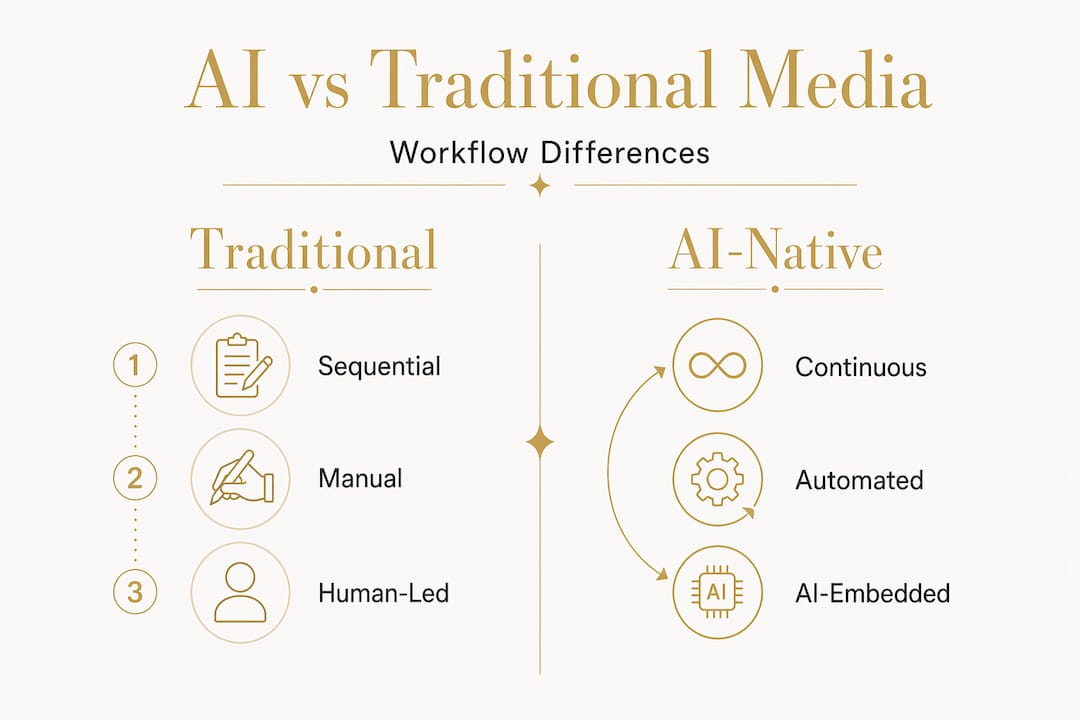
| Dimension | Traditional media | AI-native media |
|---|---|---|
| Workflow design | Sequential, manually managed | End-to-end AI-integrated pipelines |
| Human role | Executes all production tasks | Oversees strategy and quality gates |
| Content delivery | Single format, manually scheduled | Multi-format, dynamically distributed |
| Performance monitoring | Periodic reporting | Continuous, real-time optimisation |
| Cost per content piece | High due to manual labour | Reduced by up to 65% |
| Decision speed | Days to weeks | Hours to minutes |
| Scalability ceiling | Team headcount | System and data capacity |
The implications for marketers planning ahead are hard to ignore. Organisations that rely on bolted-on AI tools risk falling behind competitors who have rebuilt their operating architectures around AI participation. The gap compounds over time because AI-native systems learn and improve with every content cycle while traditional systems stay static between manual updates.
The benefits of AI media are not hypothetical future advantages. Teams adopting AI-native approaches are already reporting real performance and cost data that traditional competitors cannot match.
My take on where this is all heading
I have spent years watching media teams add AI tools and wonder why the results felt incremental. The answer, in almost every case, was that the tools were impressive but the architecture was unchanged. Adding a powerful AI writing assistant to a broken content workflow produces better-written content that still arrives late, costs too much, and misses its audience.
What I have found working with AI-native teams is that the breakthrough moment is never about a specific tool. It is about the decision to stop treating AI as a helper and start treating it as infrastructure. Once a team genuinely redesigns its workflows so that AI participation is structural rather than optional, the compounding advantages become very hard to ignore.
My honest view is that AI-native adoption is not an incremental improvement. It is a category shift. Early adopters are not just working faster. They are operating in a fundamentally different mode that traditional media teams cannot replicate by downloading another app. The structural advantage builds over time and becomes a genuine moat. That is worth understanding before the gap gets wider.
— Lucky
Explore AI-native media with Myluckyuniverse
Myluckyuniverse is built on the exact principles covered in this article. As an AI-native media company operating in the iGaming space, the platform produces structured, editorial-grade content powered by integrated AI workflows rather than bolted-on tools. Whether you are looking to understand how AI-native principles apply to your content strategy or want to see what a fully AI-native media property looks like in practice, the Myluckyuniverse blog offers real examples drawn from live production. Explore the full platform and see how AI-native iGaming content gets built at scale.
FAQ
What makes AI-native media different from traditional media?
AI-native media embeds AI into workflow architecture from the ground up, enabling continuous feedback loops and autonomous optimisation. Traditional media adds AI tools as optional enhancements to manually managed pipelines.
Does AI-native media eliminate the need for human content creators?
No. Human creatives in AI-native teams shift to strategy, quality control, and brand voice oversight while AI handles research, drafting, and formatting tasks.
How much can AI-native workflows reduce content production costs?
AI-native workflows reduce production costs by up to 65% compared to traditional manual methods, while enabling 73% faster decision-making.
What is dual-track content in AI-native media?
Dual-track content means producing rich material for human readers alongside structured, Q&A-formatted content built for AI indexing engines and agent consumption. Publishers like The Economist use this approach to maintain visibility across both channels.
How do I know if my team is AI-native or just AI-enhanced?
If your workflows were designed before AI and AI tools were added later, you are AI-enhanced. AI-native means your content pipelines depend on AI participation by design and cannot function at the same scale or speed without it.