Insights
Why iGaming UX design impacts retention

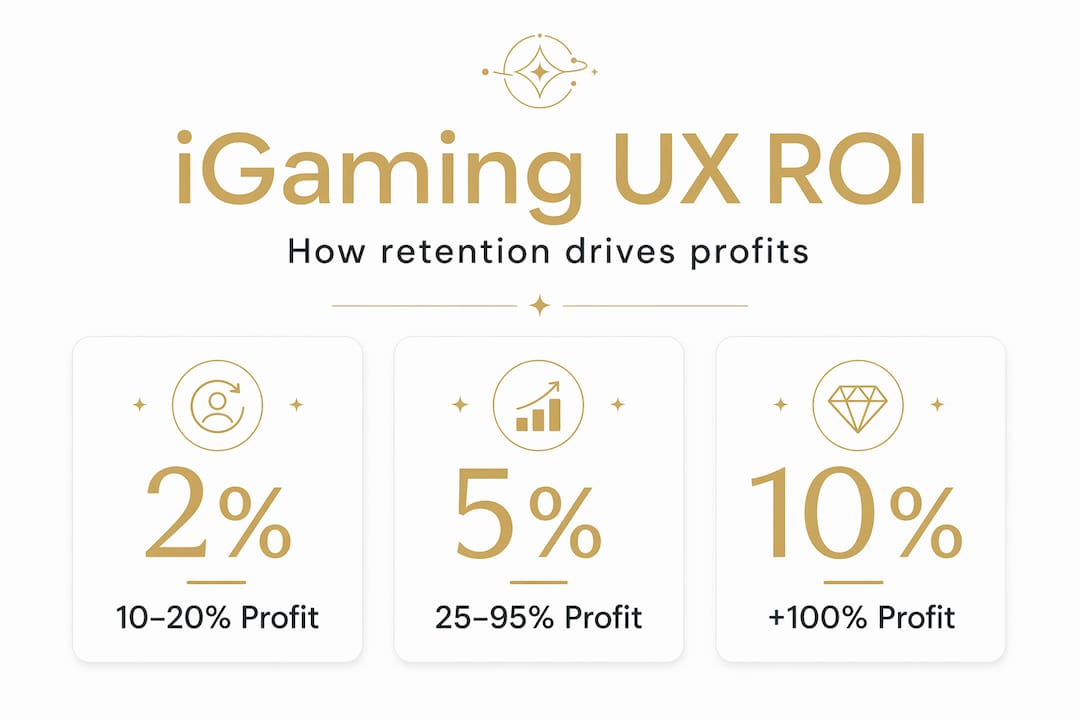
Understanding why iGaming UX design impacts retention is the difference between a platform that bleeds players and one that builds loyal communities. Most operators still treat UX as a finishing coat of paint applied after the real product work is done. That framing costs money. Well-designed interfaces can increase conversion rates by 200% to 400%, and a 5% retention lift can translate into a 25% to 95% profit increase. UX is not decoration. It is your most underleveraged revenue function.
Table of Contents
- Key takeaways
- The business case for UX in iGaming
- Psychology at the core of UX design
- Performance metrics that players feel
- Advanced tactics: gamification, AI, and responsible design
- How operators can act on UX improvements
- My honest take on ethical UX in iGaming
- Explore more with Myluckyuniverse
- FAQ
Key takeaways
| Point | Details |
|---|---|
| UX directly drives profit | A 5% retention improvement can produce a 25–95% profit lift, making UX a financial priority. |
| Onboarding quality shapes loyalty | Well-designed onboarding flows improve day-seven retention by 20 to 40 percentage points. |
| Perceived performance builds trust | Skeleton screens and micro-interactions maintain player confidence even when backend processes are slow. |
| Gamification extends engagement | Gamification features extend player sessions by up to 40%, while AI personalisation boosts retention by 28%. |
| Responsible UX sustains lifecycles | Transparent session summaries and reality checks build the long-term trust that keeps players returning. |
The business case for UX in iGaming
Stop treating UX as a budget line item under “design.” The numbers make a compelling argument for treating it as a core business function. A 5% retention increase can lift profits by 25% to 95%, which means small, targeted improvements to how players experience your platform pay back many times over.
Site speed alone is worth obsessing about. Platforms that load in one second convert up to three times better than those taking five seconds to respond. That is not a marginal difference. It is the kind of gap that separates market leaders from also-rans.
| Retention improvement | Estimated profit uplift |
|---|---|
| 2% | ~10–20% |
| 5% | 25–95% |
| 10% | 50–100%+ |
| Onboarding optimisation | 20–40 point D7 retention gain |
Compare the cost of a focused UX audit and redesign sprint against the budget most operators pour into paid acquisition. Acquiring a new player typically costs five to seven times more than retaining an existing one. When you invest in UX improvements instead of relying on perpetual re-acquisition, the economics shift decisively in your favour.
The importance of iGaming UX extends beyond conversion too. Players who have a friction-free experience are more likely to explore more game categories, deposit again, and refer friends. Every element of the interface that reduces frustration compounds into better lifetime value.
Psychology at the core of UX design
What separates average iGaming platforms from sticky ones is not feature count. It is how well the design respects how players actually think.
Cognitive load is the mental effort required to use your platform. High cognitive load pushes players toward decisions they regret or, more commonly, toward abandoning the session entirely. Every unnecessary pop-up, cluttered lobby, or ambiguous navigation menu adds load that bleeds engagement.
Choice paralysis is a related problem. When players face too many options without sufficient guidance, conversion suffers. Hick’s Law, which states that decision time increases logarithmically with the number of choices, applies directly to game lobby design. Progressive disclosure, where you surface the most relevant options first and reveal complexity gradually, is the structural solution.
Behaviour models like the Hook Model and the Fogg Behavior Model offer useful frameworks for product managers building engagement loops. The Hook Model describes a cycle of trigger, action, variable reward, and investment. In iGaming, that looks like a notification triggering a login, a one-tap deposit flow, a win or near-miss reward, and a progress bar that records the player’s status. Each loop reinforces the next visit.
- Reduce lobby clutter by surfacing personalised game recommendations rather than every available title
- Use progressive disclosure in bonus terms: show the headline benefit first, with full conditions one tap away
- Apply the Fogg Behavior Model by reducing the effort required for core actions like depositing and game launch
- Build in positive friction at responsible gaming checkpoints, so players make an active choice rather than sleepwalking into longer sessions
Pro Tip: The difference between manipulative UX and mindful UX often comes down to intent. Friction that slows a player down to protect them is responsible design. Friction that exists to confuse withdrawal flows is not. Audit your platform for both.
Retention and conversion share a nervous system. Forcing engagement without genuine value leads to fast churn. The player experience must feel rewarding rather than like a system designed to trap them.
Performance metrics that players feel
Latency is not a technical metric. It is a psychological one. When a player taps a game and nothing happens for two seconds, the micro-anxiety that follows erodes trust. Repeat that experience three or four times per session and you have a disengaged player who starts looking elsewhere.

Skeleton screens and micro-interactions change that equation. By displaying a visual placeholder the moment a player takes an action, you signal that the system is working. Perceived performance is a design feature, not a backend concern. The player’s brain registers movement as progress even when the data has not yet loaded.
| Onboarding best practice | Common pitfall |
|---|---|
| Guided first-time experience with three to five key actions | Feature tour that lists everything at once |
| Contextual prompts triggered by behaviour | Generic welcome emails sent hours later |
| Single-step deposit flow with saved preferences | Multi-screen KYC before any engagement |
| Progress indicators showing completion status | No visual feedback on registration stage |
| Soft onboarding with value shown before commitment | Hard paywall before players see any content |
Monthly churn in iGaming typically runs between 20% and 30%. A well-designed onboarding flow can improve day-seven retention by 20 to 40 percentage points. That gap is almost entirely determined by whether your new player reaches their “aha moment.” That is the instant they experience genuine value: a smooth first deposit, a favourite game found in seconds, a bonus that feels personalised rather than generic.
Filling the activation gap by guiding players through meaningful core actions in their first session is the single highest-leverage onboarding investment you can make. Feature tours do not achieve this. Guided experiences that force exactly three or four key actions do.
Pro Tip: Design your onboarding as if the player has six minutes and zero patience. Remove every step that does not directly contribute to their first meaningful experience. If a step exists for compliance, make it feel like a benefit rather than a gate.
Advanced tactics: gamification, AI, and responsible design
The most forward-thinking operators are combining three disciplines into a single retention system: gamification, AI-driven personalisation, and responsible gaming UX. Each one reinforces the others when implemented thoughtfully.
Gamification features extend player sessions by up to 40%. Daily challenges, leaderboards, loyalty progress bars, and achievement systems tap into intrinsic motivation rather than relying purely on bonus spend. The key distinction is that well-designed gamification creates genuine reasons to return, not just monetary incentives that erode margins.
AI-driven hyper-personalisation takes this further. Generic welcome bonuses underperform by a wide margin against personalised offers that match a player’s actual game preferences and session patterns. Hyper-personalised experiences boost retention by 28% compared to generic bonuses. For a deeper look at how this works technically, the Myluckyuniverse piece on AI-driven personalisation is worth your time.
Responsible gaming UX is where many operators still underinvest, often because it feels like a regulatory obligation rather than a retention tool. That framing is wrong. Transparent session summaries that normalise gambling outcomes and present balanced play histories build exactly the kind of long-term trust that keeps players active for years rather than months.
- Use session time visualisations that surface total play time without requiring players to calculate it themselves
- Trigger reality checks based on session behaviour patterns, not just fixed time intervals
- Present loss data in context: “You’ve played 47 sessions this month and your average session cost was $12”
- Make responsible gaming tools prominent, not buried in settings menus
Pro Tip: Personalised responsible gaming messages reduce risk and improve player wellbeing, which translates directly into longer player lifecycles and fewer compliance escalations. Frame your responsible gaming UX as a retention feature in internal roadmap discussions. That framing gets it funded.
How operators can act on UX improvements
Theory does not retain players. Execution does. Here is a practical sequence that product teams can follow regardless of platform maturity.
- Audit speed and perceived performance first. Measure real-world load times across mobile and desktop. Fix the worst offenders before anything else. Speed improvements pay back immediately.
- Redesign the onboarding flow around the activation moment. Map the steps between registration and first meaningful play. Remove anything that does not serve that journey. Add progress indicators and contextual prompts.
- Introduce transparent UX elements. Add clear RTP panels, honest bonus term summaries, and session summaries. Building trust signals into the interface directly reduces disputes and improves player confidence.
- Run iterative testing with real player cohorts. Do not rely on internal opinions. A/B test onboarding variants and measure day-seven and day-thirty retention. Use that data to drive the next iteration.
- Integrate retention metrics into product KPIs. If your product team is measured purely on feature delivery and conversion, UX retention work will always be deprioritised. Make churn rate and day-seven retention part of how the team is evaluated.
- Build cross-functional ownership. UX improvements that sit only with the design team stall. Effective iGaming design and player loyalty requires collaboration between product managers, UX designers, data analysts, and compliance teams. Responsible gaming features need legal input at the design stage, not as a sign-off at the end.
Operators using unified CRM with AI-driven retention tactics and omnichannel support achieve 25% to 40% uplifts in lifetime value. That data point underscores why how UX affects gaming retention cannot be separated from the broader commercial strategy.
My honest take on ethical UX in iGaming
I’ve watched the iGaming industry cycle through trends for a long time, and the shift I find most meaningful right now is operators beginning to treat UX as a revenue driver with ethical weight rather than a cosmetic exercise. That shift is not complete. But it is real.
What I’ve learned watching retention data across dozens of platforms is this: the operators who invested in mindful onboarding and transparent interfaces five years ago are now sitting on far healthier player bases than those who optimised for short-term conversion at every step. Aggressive tactics work briefly. They destroy lifecycle value systematically.
The uncomfortable truth is that best practices for iGaming UX design sometimes require operators to slow players down or surface information that might reduce a session’s immediate duration. A reality check that prompts a player to stop for the night looks like lost revenue on a Tuesday. Over a twelve-month horizon, that player is still active, trusts the platform, and refers others. The player acquired through manipulative UX is often gone in thirty days.
I’d encourage product managers to stop asking “how do we keep players on the platform longer this session” and start asking “how do we make the platform worth returning to tomorrow.” That reframe produces completely different design decisions. And in my experience, it produces far better retention numbers to back them up.
— Lucky
Explore more with Myluckyuniverse
At Myluckyuniverse, we have spent more than two decades at the intersection of iGaming and digital technology, which means we understand what actually moves retention numbers and what just looks good in a presentation. Our platform combines editorial-grade research with AI-native tools to help operators and product managers make better decisions faster. Whether you are evaluating onboarding flows, personalisation strategy, or responsible gaming UX, our content is structured to give you answers rather than more questions. Visit Myluckyuniverse to explore our full catalogue of operator-focused resources, and see why forward-thinking iGaming teams rely on us to stay ahead.
FAQ
Why does iGaming UX design impact retention so directly?
UX design shapes every moment of the player journey, from first load to repeat deposit. Poor design creates friction and erodes trust, both of which are leading causes of churn in iGaming.
What is the most important UX element for day-seven retention?
Onboarding flow quality has the greatest measurable impact. A well-designed guided first experience can improve day-seven retention by 20 to 40 percentage points compared to a generic registration flow.
How does site speed relate to player retention?
Platforms loading in one second convert up to three times better than those taking five seconds, and faster load times directly reduce session abandonment, which compounds into better long-term retention.
Does responsible gaming UX hurt conversion rates?
No. Transparent session summaries and responsible gaming tools build trust that extends player lifecycles, reduces chargebacks, and improves regulatory standing without meaningfully reducing engaged player activity.
How does AI personalisation support retention in iGaming?
AI-driven hyper-personalised experiences boost retention by 28% compared to generic bonuses, because they surface offers and content that match each player’s actual behaviour rather than broadcasting the same message to everyone.