Insights
How to manage a multi-brand iGaming portfolio for growth

Running multiple casino or betting brands simultaneously is one of the most rewarding—and punishing—challenges in the iGaming industry. Operators who crack the formula can diversify revenue by 60-80% by targeting distinct regions and player niches, while also stress-testing new products without putting their flagship brand at risk. But those gains evaporate quickly when compliance gaps, fragmented technology stacks, and siloed marketing teams start pulling in opposite directions. This guide lays out a practical, research-backed playbook for operators who want to scale a multi-brand portfolio with purpose and precision.
Table of Contents
- Assessing your portfolio and aligning goals
- Building a scalable unified platform
- Marketing, engagement, and retention under one roof
- Field data: how player value concentrates across a portfolio
- Compliance, responsible gaming, and localisation essentials
- What most iGaming operators get wrong about multi-brand management
- Unlock growth with proven multi-brand solutions
- Frequently asked questions
Key Takeaways
| Point | Details |
|---|---|
| Diversify for growth | Multi-brand strategies increase revenue, reach more users, and reduce operational risk. |
| Centralise technology | Unified platforms cut costs and simplify cross-brand management. |
| Prioritize engagement | Centralized marketing and analytics drive better retention and player lifetime value. |
| Streamline compliance | A single backend supports consistent, efficient regulatory and localisation practices. |
| Maintain coherence | Balance global strategy with local adaptation for true portfolio agility. |
| Weight by value, not count | Measured across our own 2020–2026 player book, revenue per referred player differed roughly 8x between brands in the same operator group — re-weighting placement beats negotiating acquisition cost. |
| One property usually dominates | In the same book a single loyalty-led surface produced 64% of revenue from 45% of players, at about 2.2x the per-player value of everything else. |
Assessing your portfolio and aligning goals
Once you understand the scope of multi-brand potential, the next step is to assess where you stand and what you want to achieve. Most operators launch a second or third brand reactively, chasing a new licence or a competitor’s market share, without pausing to map what they already have. That reactive pattern is expensive.
Start with a full brand audit. Map every property you operate against three key dimensions: geographic region, player segment (sports bettors, slots players, high rollers), and the technology stack sitting beneath each one. This inventory often reveals surprising overlaps. Two brands targeting the same German-speaking market with near-identical slot catalogues are not diversification; they are internal competition eating into your own margins.
Multi-brand strategies, done well, enable revenue diversification through regional and niche brands. That word “niche” matters. Each brand in your portfolio should have a defensible reason to exist, whether that is a specific payment method popular in a local market, a distinct brand personality that resonates with a younger demographic, or a live casino focus that your core brand does not cover deeply enough.
Portfolio performance benchmarks to track:
- Traffic quality: Organic share versus paid per brand, with targets segmented by region
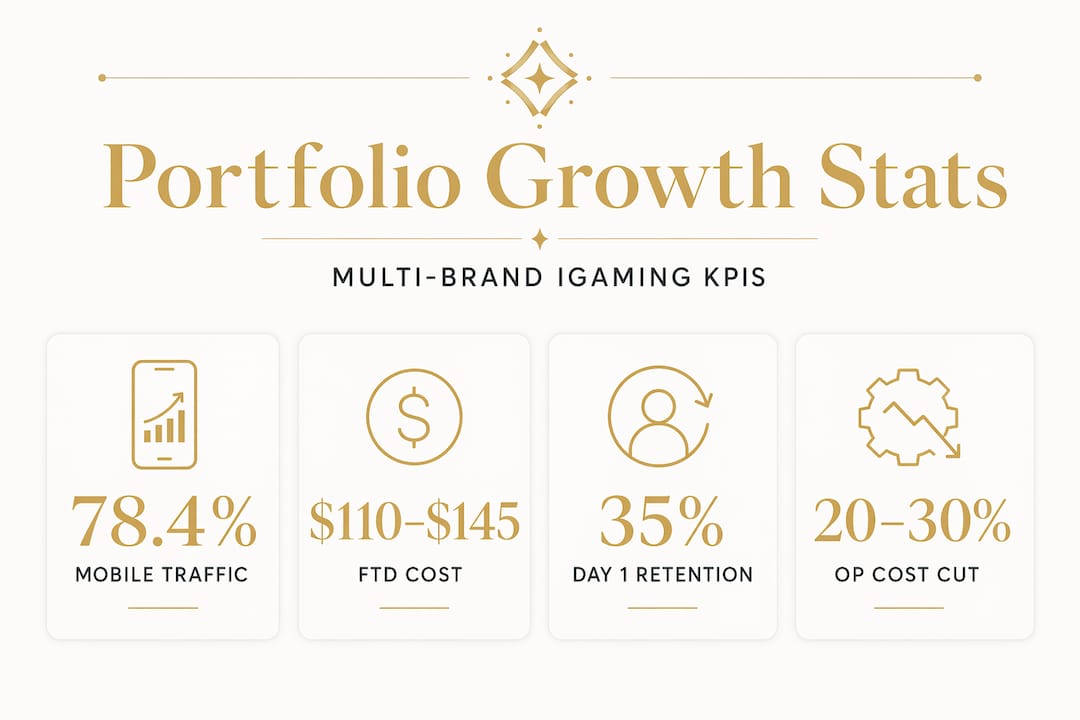
- First-time depositor (FTD) cost: Industry average sits between $110 and $145 per player
- Day 1 retention: Aim for 35% or above across all brands
- Day 30 retention: 12% is the baseline; top-tier portfolios push past 18%
- Cross-brand overlap: What percentage of your active users hold accounts on more than one property?
When you are managing several gambling brands simultaneously, goal alignment becomes a governance issue, not just a marketing one. Every brand manager needs to know what success looks like for their specific property, and those metrics must feed into a single portfolio scorecard reviewed at the operator level.
| Metric | Single brand target | Multi-brand portfolio target |
|---|---|---|
| FTD acquisition cost | $110–$145 | $100–$130 (shared creative) |
| Day 1 player retention | 35% | 35–40% |
| Day 30 player retention | 12% | 14–16% |
| Organic traffic share | 40% | 50%+ (centralised SEO) |
| Compliance incident rate | <2% | <1% (unified backend) |
2026 benchmark update (July): The retention bars have moved upward. Xtremepush’s 2026 iGaming benchmarks now put best-in-class Day-1 retention at 45–55% and Day-30 at 30–40% — roughly double the 15–25% industry average — with almost the entire gap driven by operators that trigger rewards in real time during the session rather than via overnight batch sync. For a multi-brand portfolio the implication is direct: build the shared retention layer as an event-driven system, because the retention edge then compounds across every property riding on it, not just the flagship.
Pro Tip: Before adding a new brand, run a 90-day “cannibalisation check.” If more than 25% of new sign-ups on the incoming brand are existing players from another property, reconsider the positioning before launch.
Building a scalable unified platform
With clear goals, the focus moves to your technical foundation and how to run multiple brands seamlessly at scale. The biggest operational mistake multi-brand operators make is allowing each brand to accumulate its own siloed tech stack. It starts innocently enough: brand A uses one payments provider, brand B signs a different CRM contract, brand C runs a separate KYC solution. Within two years, you are managing a dozen vendor relationships, and your compliance team is drowning.

A unified platform solves this structurally. Operational costs drop by 20-30% when you consolidate back-office functions, payments, and reporting under a single provider. That is not a small efficiency gain; at scale it represents millions of dollars annually in reduced licence fees, integration maintenance, and support overhead.
The aggregator model adds another layer of speed. One operator using a multi-brand aggregator added 12,000 games to their portfolio through shared infrastructure, boosting both engagement and retention metrics across all properties simultaneously. When game content, bonus engines, and player wallets live on shared rails, launching a new brand becomes a configuration exercise rather than a full engineering project.
How to evaluate a unified platform for your portfolio:
- Modular frontend capability: Each brand must be able to carry its own visual identity, localised language, and market-specific promotions without requiring backend changes.
- Centralised CRM and bonus engine: One player record system means you can identify shared users, apply responsible gambling (RG) controls consistently, and run cross-brand campaigns without data leakage.
- Unified compliance and KYC layer: A single identity verification and anti-money laundering workflow that serves all brands under a master compliance framework dramatically reduces regulatory risk.
- Single reporting dashboard: Real-time visibility across all properties in one interface. If you are logging into five different back-offices each morning, you are already behind.
- Scalable API architecture: Adding the 10th brand should be meaningfully cheaper and faster than adding the second one.
You can explore how unified backend services underpin efficient portfolio operations, and the operational advantages of unified platforms become clear when you compare them against fragmented alternatives. For operators exploring the aggregator route specifically, understanding scaling features with aggregators can surface practical implementation options.
Fragmented vs. unified vs. aggregator: A comparison
| Model | Launch time per new brand | Cost complexity | Compliance control | Scalability |
|---|---|---|---|---|
| Fragmented (separate stacks) | 6–12 months | Very high | Difficult | Poor |
| Unified single provider | 2–4 months | Low to medium | Excellent | Strong |
| Aggregator model | 4–8 weeks | Low | Good (with governance) | Very strong |
Pro Tip: Negotiate a “brand slot” pricing structure with your platform provider upfront. Paying per brand rather than per feature encourages controlled growth and prevents cost surprises when you scale.
Marketing, engagement, and retention under one roof
A solid technical base enables you to focus on activating and maximising user value across all your brands. With shared infrastructure in place, your marketing team gains access to a powerful asset that most single-brand operators simply do not have: portfolio-wide player data.
Centralised campaign management is the most immediate win. When one creative team produces assets for multiple brands simultaneously, you eliminate redundant briefing cycles, reduce agency fees, and maintain tighter brand governance across markets. Top operators understand this approach well. Kindred Group, for example, manages 11 brands with centralised ad production, enabling real-time rebrands and compliance updates across markets without bottlenecks.
Retention is where the data advantage really compounds. Retargeting lapsed players is dramatically more cost-effective than acquiring new ones. iGaming retargeting achieves 12x ROAS on lapsed players, with user-generated content (UGC) videos generating 3x the click-through rate of standard creative. Perhaps most striking: cost per acquisition drops from $70 to $13 when retargeting is executed well. Across a portfolio of five brands, that efficiency improvement is transformative.
High-impact multi-brand marketing tactics:
- Cross-brand welcome flows: Identify users who convert on one brand and enrol them in a tailored nurture sequence that introduces complementary properties at the right moment in their player journey.
- Shared loyalty mechanics: A portfolio-wide points programme that rewards activity across any brand creates genuine switching incentive and deepens overall player lifetime value.
- Localised UGC campaigns: Source and amplify player testimonials and streamer content that speaks to regional audiences. A Portuguese player trusts a review from someone in Lisbon far more than a generic global ad.
- Attribution modelling across brands: Use multi-touch attribution to understand which acquisition channel actually drives the highest-value players, not just the most registrations.
- Centralised A/B testing: Run experiments on your smaller brands first, validate results, then roll winning variants across the full portfolio.
“The operators winning at multi-brand retention are not the ones spending the most on acquisition. They are the ones who know exactly which player segment responds to which message, because they have the data infrastructure to ask the question properly.” — Lucky Universe editorial team
Casino marketing benchmarks for iGaming confirm that mobile traffic now accounts for 78.4% of sessions, with an average session duration of 14 minutes and 20 seconds. Any marketing strategy that does not start with mobile-first creative is already misaligned with where players actually spend their time. For a deeper look at how these principles apply in practice, our casino marketing best practices guide covers 2026-specific channel strategies and budget allocation frameworks. Additional insights for iGaming operators covering audience segmentation and content strategy are available for operators looking to build a more structured approach.
Field data: how player value concentrates across a portfolio
The benchmarks above are industry figures. In August 2026 we measured our own: 2,932 players referred into one operator group’s brand portfolio across report-years 2020 to 2026, tracked by first play date and cumulative revenue per player. The result reframes what a portfolio scorecard should actually rank brands on.
Per-player value differed by roughly 8x between brands in the same group. Same parent operator, same underlying platform, heavily overlapping game catalogue, and traffic arriving through the same channels — yet cumulative revenue per referred player varied enormously by which brand the player landed on.
| Brand (anonymised, same operator group) | Indexed revenue per referred player | Portfolio note |
|---|---|---|
| Brand A | 7.9 | Highest-value property; strongest brand recognition in its core market |
| Brand B | 2.8 | Mid-tier; broad positioning, no distinct niche |
| Brand C | 1.0 (baseline) | Lowest-value property despite comparable traffic volume |
This is the single most actionable finding in the dataset, because acting on it costs nothing. Most portfolio optimisation effort goes into reducing acquisition cost — renegotiating rates, tightening creative, squeezing CPA down by ten or fifteen per cent. Meanwhile an 8x spread sits on the revenue side of the same equation, addressable by changing which brand gets the placement. Re-weighting distribution toward the top-value property is free margin, and it is invisible to any scorecard that ranks brands by registrations or FTD count rather than by revenue per player.
A single surface tends to dominate high-value capture. Within the same book, one loyalty-led product surface produced 64% of total revenue from 45% of the players, at roughly 2.2x the per-player value of every other route combined. That is not a marketing-spend artefact; it reflects which environment high-value players choose to keep returning to. The portfolio lesson is that one property is usually structurally better at capturing and holding valuable players, and you cannot find out which one without per-player value reporting at brand granularity.
Both findings point at the same instrumentation gap. The cannibalisation check earlier in this guide asks what percentage of new sign-ups on an incoming brand came from another property. Run the value version of that question too: what is cumulative revenue per player, by brand, by acquisition cohort? Operators who track only cost per acquisition and registration counts are optimising the cheaper half of the equation. The distribution underneath is also severely skewed — the top decile of players produced 92–97% of revenue — which is why brand-level averages need a percentile view beside them, as covered in our guide to casino CRM segmentation.
Caveats: this is an affiliate-side commission view of one operator group, brands are anonymised, the book spans several jurisdictions without a clean geographic split, and the revenue share carried no negative carryover. The 8x spread and the concentration pattern are the transferable findings; exact multiples will differ by portfolio.
Compliance, responsible gaming, and localisation essentials
Centralising marketing must be matched by equally robust compliance and localisation to protect the enterprise. This is the section most operators skim, and it is often where portfolios unravel. A single compliance failure in a regulated market can result in fines that wipe out years of profit from an entire brand cluster.
The good news is that the same unified platform architecture that reduces your operational costs also simplifies regulatory oversight significantly. When all brands run through one backend, rolling out a new responsible gaming tool, an updated KYC workflow, or a revised bonus terms framework becomes a single deployment rather than a brand-by-brand project.
Modular platforms for frontend customisation with unified backend compliance allow operators to test features on new brands before rolling them to flagship properties. This is a genuine competitive advantage. You can validate a new self-exclusion flow on a smaller brand in a less scrutinised market, collect data, refine the experience, and then deploy it confidently across your regulated European properties.
Compliance and localisation checklist for multi-brand portfolios:
- Assign a dedicated compliance lead per jurisdiction cluster, not per individual brand.
- Maintain a centralised regulatory calendar tracking licence renewal dates, audit windows, and reporting deadlines across all markets.
- Localise payment methods per region: iDEAL for the Netherlands, Trustly for Scandinavia, PIX for Brazil. Payment friction is one of the top reasons for registration abandonment.
- Translate all terms and conditions, bonus rules, and RG messaging into the primary language of each market. Machine translation is not sufficient for legal documents.
- Implement geofencing controls at the platform level so that restricted promotions cannot be served to players in markets where they are not compliant.
- Run quarterly RG audits across all brands simultaneously using shared tooling to identify at-risk player patterns early.
“Brand coherence across markets does not mean every property looks the same. It means every property feels trustworthy, even when the language, currency, and colour palette are completely different.” — Lucky Universe editorial team
Localisation goes deeper than language. It includes understanding local sporting calendars for sportsbook brands, culturally relevant bonus themes, customer support hours aligned with local time zones, and payment processing speeds that match regional expectations. Operators who treat localisation as translation will consistently underperform against those who treat it as cultural adaptation.
You can explore how establishing trust through compliance shapes player decisions and long-term retention across different market contexts.
What most iGaming operators get wrong about multi-brand management
Here is the uncomfortable truth most portfolio playbooks avoid: complexity is the enemy of agility, and most operators build complexity deliberately, thinking they are building resilience.
Every additional tool, vendor, and bespoke integration in your stack slows down every decision that touches it. Compliance updates take longer. Marketing campaigns take longer. New brand launches take longer. The operator with three brands on one clean unified platform will outmanoeuvre the operator with five brands on five different systems every single time, because their speed of response to market changes is structurally faster.
The second pitfall is confusing consistency with coherence. Operators spend enormous energy making sure every brand uses the same font system and colour guidelines. That is consistency. Coherence is something deeper: it is the feeling a player gets that this operator actually understands them, regardless of which brand they are on. You can achieve coherence with completely different visual identities if your CRM logic, bonus fairness, customer support quality, and responsible gaming culture are unified underneath.
Multi-brand strategies scale via diversification but risk creating silos without deliberate unification effort. Single-brand operations suit newer entrants or operators in highly specialised niches, while multi-brand structures reward established operators who have the governance infrastructure to hold it together. Knowing which stage you are actually at, not which stage you aspire to, is the starting point for every portfolio decision.
The third mistake is chasing marketing fads at the portfolio level. A trendy channel that works for one brand’s demographic may actively harm another brand’s positioning. Test new tactics at the brand level first. Validate them with real data. Then decide whether they belong in the portfolio playbook. Integrity and player trust, built over time through insights on multi-brand growth, are worth far more than any short-term performance spike from a campaign that compromises your operator reputation.
Unlock growth with proven multi-brand solutions
Building a high-performing multi-brand portfolio requires more than good intentions; it requires the right infrastructure, the right data frameworks, and editorial-grade content that communicates trust to players at scale.

At Lucky Universe, we operate at the intersection of AI innovation and iGaming media, and we have built our multi-brand management methodology specifically to support operators navigating exactly the challenges covered in this guide. Whether you are auditing an existing portfolio or planning your next brand launch, our platform gives you structured, AI-optimised intelligence to make faster and smarter decisions. Explore Lucky Universe technology to see how our growing portfolio of properties and 20-plus years of industry expertise can support your next phase of growth.
Frequently asked questions
What is the biggest advantage of a multi-brand iGaming portfolio?
You can spread risk, test innovations, and diversify revenue streams without disrupting your main brand’s player experience or regulatory standing.
How do unified platforms reduce costs for multi-brand operators?
Consolidated back-office, payments, and reporting can cut operational costs by as much as 30%, primarily by eliminating redundant vendor contracts and integration maintenance.
What is a typical player retention rate for a multi-brand casino?
Day 1 retention averages around 35%, with Day 30 at approximately 12% across iGaming brands; top-performing portfolios consistently exceed both benchmarks.
How do top operators handle brand localisation and compliance?
They use modular platforms for local customisation with a single backend controlling compliance, CRM, and payments, allowing brand-level flexibility without sacrificing regulatory control.
Is managing many brands better than focusing on one?
For large operators, multi-brand offers scale and market agility, but single-brand strategies can be more appropriate for newer entrants or operators in tightly defined niches.
How much does player value vary between brands in the same iGaming portfolio?
Far more than most scorecards reveal. Measured across 2,932 players referred into one operator group between 2020 and 2026, cumulative revenue per referred player differed by roughly 8x between the group’s highest and lowest-value brands, with a mid-tier property sitting at about 2.8x the baseline — despite a shared platform, an overlapping game catalogue, and traffic from the same channels. Brand-level revenue per player, tracked by acquisition cohort, is therefore a more useful portfolio metric than registration or FTD counts.
What is the fastest margin lever in a multi-brand portfolio?
Re-weighting distribution toward your highest-value brand, because it costs nothing to execute. Operators typically spend their optimisation effort shaving ten or fifteen per cent off acquisition cost while an 8x spread sits unaddressed on the revenue side of the same equation. Measure cumulative revenue per player by brand first, then shift placement weight accordingly; the gain lands without any new spend, new creative, or new vendor negotiation.
How much does player acquisition cost across an iGaming portfolio?
Industry estimates put iGaming customer acquisition cost at roughly $250–$500 per player, climbing to $800 or more for sports betting during peak events. Because acquiring a new player costs five to seven times more than retaining an existing one, a multi-brand portfolio that shares retention infrastructure across properties defends margins far better than one paying to re-acquire similar players brand by brand — the case for a unified CRM and loyalty layer is as much an acquisition-cost decision as a retention one.