Insights
How to create answer-engine optimized reviews in 2026

Answer-engine optimized reviews are product or service reviews structured and written specifically to appear prominently in AI-driven answer engines like ChatGPT, Perplexity, and Google’s AI Overviews. The standard industry term for this practice is generative engine optimisation (GEO), and it goes well beyond traditional SEO. To create answer-engine optimized reviews that AI models actually cite, you need three things working together: valid structured data, decision-focused writing, and a consistent review management strategy. This guide covers all three, with the technical specifics and content frameworks that matter most in 2026.
What tools and prerequisites do you need to create answer-engine optimized reviews?
The foundation of any optimised review is structured data. Specifically, you need JSON-LD markup implementing the Product, Review, and AggregateRating schema types from Schema.org. These tell AI crawlers exactly what your content is, who wrote it, and what rating it carries. Without them, even a brilliantly written review is invisible to AI agents scanning for citable content.
Product reviews with complete, valid schema markup are 3.4 times more likely to appear in AI-generated overviews compared to pages lacking structured data. That gap is large enough to treat schema as non-negotiable, not optional. Beyond schema, you also need a FAQPage schema block if your review includes a Q&A section, which it should.

The table below compares the core tools and schema types every content creator needs before writing a single word.
| Tool or schema type | Purpose | Priority |
|---|---|---|
| JSON-LD with Product schema | Identifies product name, brand, and description to AI crawlers | Critical |
| Review and AggregateRating schema | Surfaces star ratings in rich snippets and AI Overviews | Critical |
| FAQPage schema | Marks up Q&A blocks for zero-click and voice results | High |
| Google Rich Results Test | Validates that schema is correctly implemented and visible | High |
| Grammarly or Hemingway Editor | Improves readability and sentence clarity for human readers | Medium |
Key prerequisites before you publish any optimised review:
- Confirm your CMS or platform renders JSON-LD server-side, not via client-side JavaScript
- Collect at least five to ten reviews with substantive written content before publishing an
AggregateRating - Verify your schema passes Google’s Rich Results Test with zero errors
- Keep review content fresh by adding new reviews regularly, not just at launch
Pro Tip: Run your page through Google’s Rich Results Test immediately after publishing. If the schema does not appear, your platform is likely injecting it client-side, which means AI crawlers like GPTBot and PerplexityBot will not see it.
How to write reviews that AI models prefer to cite
The single most important structural choice is where you put your verdict. A concise “Quick Take” verdict at the start of a review significantly boosts the chances of AI extracting your content for zero-click results. Place it within the first 100 words. Make it one to three sentences. State the product, the primary benefit, and who it suits best.
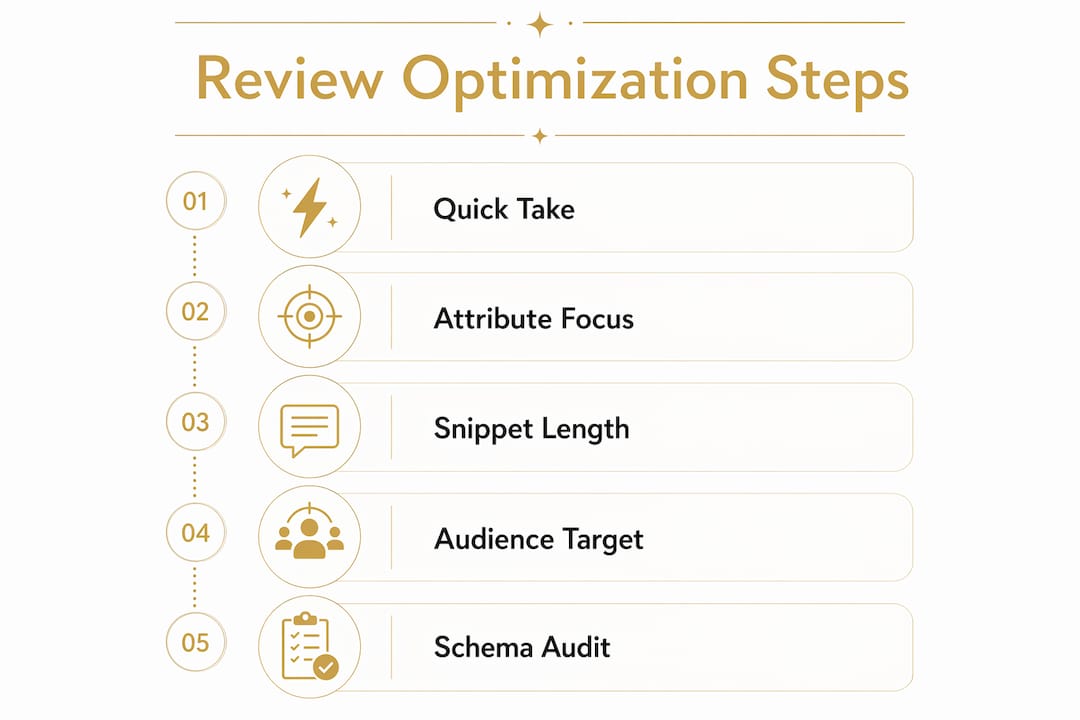
AI Overviews prefer reviews with concrete attributes like battery life, durability, or payout speed over generic feedback. “Great product, highly recommend” is not citable. “The battery lasts 14 hours under continuous use, making it reliable for full-day travel” is. The difference is specificity tied to a real use case.
Optimal review snippet length for AI citations is 40–150 words. Too short and the review lacks the context AI needs to extract a meaningful answer. Too long and the key claim gets buried. Aim for tight paragraphs that answer one question completely before moving to the next.
Writing for decisions rather than just keywords produces reviews that align better with AI indexing and purchase-intent queries. Structure your review around the three stages of a buyer’s journey: pre-use expectations, first-use impressions, and a 30-day verdict. Each stage answers a different question a buyer might ask an AI assistant.
Best writing tips for AI-citable reviews:
- Open with a one-sentence verdict naming the product and its strongest attribute
- Use specific measurements, timeframes, and comparisons instead of adjectives like “great” or “fast”
- Include a focused Q&A block with two to four questions that match purchase-intent searches
- Write each paragraph to answer one question completely, then stop
- Avoid filler phrases like “in my opinion” or “I think” — state the finding directly
- Match your language to how buyers actually search, not how marketers write
Pro Tip: Write a “Who should buy this” and “Who should skip this” section. AI Overviews frequently extract these contrast statements because they directly answer decision-stage queries.
How to implement structured data markup for maximum AI visibility
Schema implementation fails most often at the rendering stage. Many review apps inject JSON-LD client-side, making schema invisible to AI crawlers. Server-side rendering is the fix. When your server delivers the JSON-LD block inside the raw HTML response, crawlers like GPTBot and PerplexityBot read it on the first pass without needing to execute JavaScript.
Server-side rendering of structured data is often overlooked but is a key factor influencing AI agent visibility. If you are on a platform like Shopify or WordPress, check whether your review app renders schema in the page source or only after JavaScript loads. View the page source directly in your browser and search for "@type": "Review". If it is not there, the schema is client-side and needs to be fixed.
Step-by-step schema implementation for product reviews:
- Add a
ProductJSON-LD block to every review page, includingname,brand,description, andimagefields - Nest a
Reviewobject inside theProductblock withauthor,datePublished,reviewRating, andreviewBodyfields - Add an
AggregateRatingobject withratingValue,reviewCount, andbestRatingfields - Include a
FAQPageblock if your review contains a Q&A section - Validate the full page using Google’s Rich Results Test before publishing
- Re-validate after any CMS update or plugin change that could affect schema output
- Update
AggregateRatingdynamically as new reviews are added, not just at launch
Common mistakes that kill schema visibility:
- Leaving
reviewBodyempty or filling it with a single sentence - Using a
ratingValuethat does not match the visible star rating on the page - Injecting schema via a tag manager instead of the server response
- Forgetting to update
reviewCountwhen new reviews are added
Pro Tip: Set a calendar reminder to audit your schema every 90 days. CMS updates and plugin changes frequently break structured data silently, and you will not notice until your rich snippets disappear.
How do AI and review management strategies improve freshness and response rates?
Review freshness signals relevance to AI Overviews. A page with ten reviews from three years ago ranks lower in AI-generated summaries than a page with eight reviews from the past six months. Ongoing review freshness and diversity signal trustworthiness, boosting visibility in AI-generated summaries and answer engines. The practical implication is that review collection is a continuous process, not a one-time setup.
AI-powered post-purchase follow-up sequencing can increase review response rates from 5–8% to 12–15%. The key is timing. Sending a review request immediately after purchase rarely works. Sending it after the customer has had time to use the product, typically three to seven days post-delivery, produces far more substantive responses.
A few detailed, recent reviews with mixed ratings offer better AI citation potential than many short, uniform 5-star reviews. A 4-star review that explains exactly what fell short is more useful to an AI agent than ten identical 5-star reviews with no body text. Diversity in ratings, combined with substantive written content, signals authenticity to both AI systems and human readers.
AI-generated review summaries synthesise key themes, produce unique keyword-rich content, and improve both SEO and conversion rates. Tools that generate these summaries from your existing review corpus give you a structured, scannable block of content that AI Overviews can extract directly.
Review management best practices:
- Send follow-up review requests three to seven days after confirmed product use
- Ask specific questions in your follow-up email to prompt attribute-rich responses
- Respond publicly to all reviews, including negative ones, to signal active management
- Rotate featured reviews on your page to keep the most recent content visible
- Use AI summarisation tools to generate a “What customers say” block from your review corpus
What I have learned about review optimisation after two decades in iGaming
The biggest mistake I see content creators make is treating review optimisation as a one-time technical task. You add the schema, publish the review, and move on. That approach worked in 2020. It does not work now.
AI Overviews have shifted reviews from on-site conversion tools to discovery assets that synthesise sentiment and specific themes. That shift changes everything about how you write. A review that reads well for a human but buries its verdict in paragraph four will never be cited by an AI model. The AI needs the answer in the first 100 words, or it moves on.
The trend I watch most closely is micro-segmentation in review content. Generic reviews are losing ground fast. Reviews that address a specific user type, such as a casual bettor, a high-volume player, or a mobile-first user, get cited far more often because they match the specificity of AI-generated queries. Writing “this casino app works well” is useless. Writing “this casino app loads in under three seconds on a mid-range Android device and supports Apple Pay deposits” is citable.
My honest warning on over-optimisation: do not sacrifice readability for schema completeness. A review stuffed with attributes but written in robotic, list-heavy prose will confuse human readers and produce high bounce rates. AI models are increasingly trained to detect and deprioritise content that reads as machine-generated. The sweet spot is a review that a real person would find genuinely useful, structured so that an AI can extract the key claim in one pass.
Regular technical audits matter more than most creators realise. Schema breaks silently. A plugin update, a CMS migration, or a template change can strip your structured data overnight. Build a 90-day audit cycle into your content calendar and treat it as non-negotiable.
— Lucky
Myluckyuniverse: built for answer-engine visibility in iGaming
Myluckyuniverse operates at the intersection of AI technology and iGaming media, producing editorial-grade reviews structured specifically for AI Overviews, ChatGPT, Perplexity, and Claude. Every review published across the Myluckyuniverse portfolio, including casinoexpert.ai, follows the schema, content structure, and freshness standards covered in this article.
Content creators and digital marketers working in the gambling sector can find detailed guidance on answer engine optimisation for iGaming and structured data implementation through the Myluckyuniverse blog. For a deeper look at how schema markup applies specifically to casino and betting content, the iGaming schema markup guide covers implementation from the ground up. Visit Myluckyuniverse to explore the full resource library.
FAQ
What is an answer-engine optimized review?
An answer-engine optimized review is a product or service review structured with valid schema markup and decision-focused writing so that AI models like ChatGPT, Perplexity, and Google’s AI Overviews can extract and cite it directly. The goal is visibility in AI-generated answers, not just traditional search rankings.
How long should a review be for AI citation?
The optimal review snippet length for AI citations is 40–150 words. Reviews shorter than 40 words lack the context AI needs, while reviews longer than 150 words risk burying the key claim too deep for extraction.
Does schema markup really affect AI visibility?
Yes. Pages with complete, valid schema markup are 3.4 times more likely to appear in AI-generated overviews than pages without structured data. Schema is the primary signal AI crawlers use to identify and classify review content.
What makes a review citable by AI Overviews?
AI Overviews favour reviews with concrete, attribute-rich statements over generic praise. Specific details like load time, battery life, or payout speed give AI models the precise information they need to answer a user’s query.
How often should I update my review schema?
Audit your schema every 90 days at minimum. CMS updates and plugin changes frequently break structured data without warning, and lost rich snippets directly reduce your visibility in both traditional search and AI-generated answers.
Key takeaways
Answer-engine optimized reviews require valid server-side schema, decision-focused writing within 40–150 words, and a continuous review management strategy to maintain AI visibility in 2026.
| Point | Details |
|---|---|
| Schema is non-negotiable | Complete JSON-LD with Product, Review, and AggregateRating schema makes pages 3.4x more likely to appear in AI Overviews. |
| Lead with your verdict | Place a concise “Quick Take” verdict within the first 100 words to maximise AI extraction and zero-click visibility. |
| Write with specificity | Concrete attributes like battery life or load time are far more citable than generic praise. |
| Render schema server-side | Client-side JSON-LD injection is invisible to AI crawlers like GPTBot and PerplexityBot. |
| Keep reviews fresh and diverse | A mix of recent, detailed reviews with varied ratings signals authenticity and boosts AI-generated summary visibility. |