Insights
How AI driven content curation works: a 2026 guide

AI-driven content curation is the process of using machine learning algorithms and natural language processing to automatically gather, filter, and organise content tailored to specific audiences. Tools like Feedly, EdCast, and Grammarly have made this process accessible to content creators and marketers at every scale. The AI content curation process can increase productivity by up to 40% by removing the manual labour of sorting through thousands of sources daily. This guide explains the core mechanics, the best tools, and the practical steps to apply automated content curation inside your own workflow.
How AI driven content curation works at its core
AI-driven content curation runs on three foundational technologies: natural language processing (NLP), machine learning, and recommendation engines. Each plays a distinct role in turning raw data into relevant, personalised content.
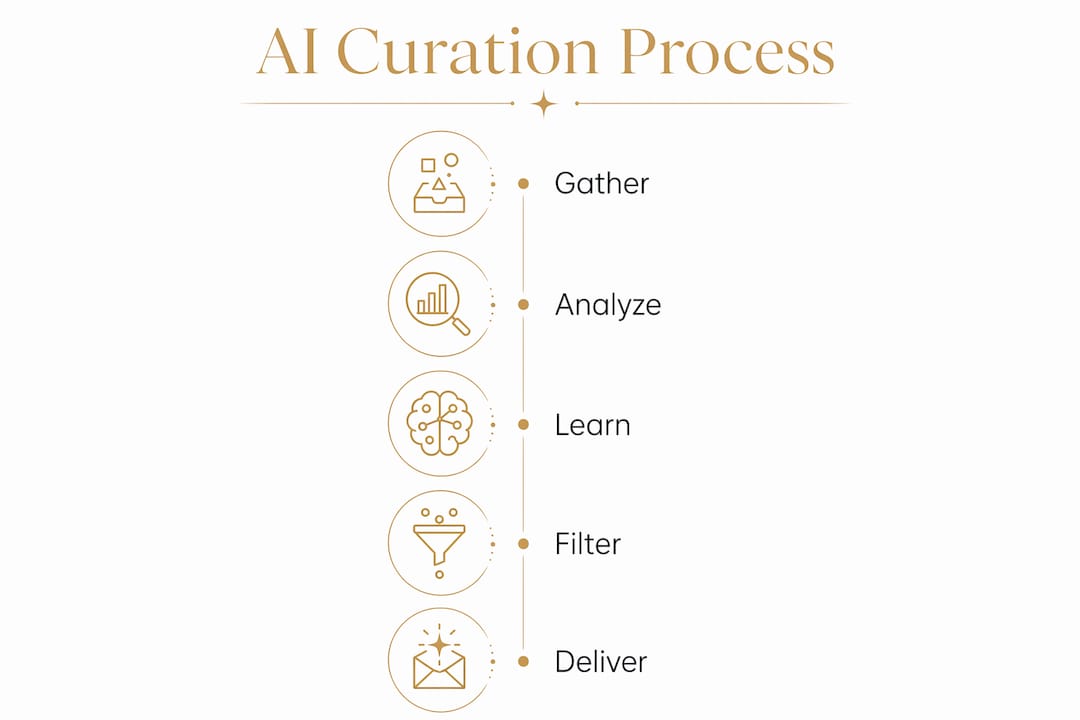
The process begins with data gathering. AI systems pull content from social media platforms, news sites, industry blogs, RSS feeds, and academic databases simultaneously. This breadth is impossible to replicate manually at any useful speed.

Once gathered, NLP takes over. NLP enables semantic understanding by detecting trends, sentiment, and contextual relevance across thousands of articles at once. The system does not just match keywords. It reads meaning, tone, and topic relationships the way a trained editor would, but at machine speed.
After NLP analysis, machine learning algorithms identify patterns in what specific audiences engage with. They learn from clicks, reading time, shares, and feedback signals. The system continuously refines its model of what counts as relevant for each reader segment.
The final stage is personalised delivery through recommendation engines. Recommendation engines personalise content by analysing user behaviour, demographics, and contextual data to surface the most relevant items for each reader. This is the same mechanism powering Netflix recommendations, applied to editorial content.
The filtering process itself runs in multiple stages. Practitioners typically work through a multi-stage filter: keyword filtering first, then embedding-based filtering, then large language model (LLM) scoring for final quality assessment. This layered approach reduces noise and keeps only the most relevant 10–30 items per day for human review.
Pro Tip: Set your keyword filters narrowly at first. Broad filters flood the pipeline with low-relevance content and force your LLM scoring stage to do too much heavy lifting.
What features do AI content curation tools offer?
Popular AI curation tools differ significantly in their capabilities, target users, and workflow integration. The table below compares four widely used platforms.
| Tool | Primary strength | Best for | Key feature |
|---|---|---|---|
| Feedly | Real-time aggregation | Marketers and researchers | AI-powered topic feeds and trend detection |
| EdCast | Enterprise learning | Large organisations | Knowledge curation and employee upskilling |
| Grammarly | Editorial quality | Writers and content teams | Tone analysis and clarity scoring |
| Perplexity | Answer-engine retrieval | Research-heavy workflows | Source-cited AI summaries |
Beyond the table, each tool handles the human editorial layer differently. Feedly surfaces content and lets editors tag, annotate, and schedule. EdCast integrates curation directly into learning management systems. Grammarly focuses on the post-curation editing stage rather than aggregation. Perplexity generates summaries with citations, which makes it useful for briefing documents.
Key capabilities to look for in any AI curation tool:
- Real-time aggregation from multiple source types (RSS, social, news APIs)
- Summary generation that condenses long articles into scannable briefs
- Tagging and categorisation that organises content by topic, format, or audience segment
- Scheduling and distribution that connects directly to email or social publishing tools
- Human editorial controls that let your team review, approve, or reject before anything goes live
No tool on this list replaces editorial judgement. The best platforms are built to support it, not bypass it.
What are the best practices for AI content curation?
The single most important rule in AI content curation is this: never publish directly from an automated feed without human review. Fully automated direct publishing is the most common pitfall, and it produces errors, hallucinations, and brand voice inconsistencies that damage credibility fast.
A draft-first workflow is the standard among teams that do this well. The AI gathers and scores content, then outputs a draft briefing or newsletter. A human editor reviews the draft, adds context, cuts weak items, and approves the final version. This draft-first approach ensures higher content trustworthiness and brand consistency than any fully automated system.
Quality assurance at scale introduces a second challenge: scoring inconsistency. When multiple AI agents evaluate content in parallel, they can anchor to each other’s scores and produce homogenous results. Calibration anchors and parallel evaluation solve this by giving each agent concrete score-level examples and running evaluations independently before aggregating results.
Common mistakes to avoid:
- Over-relying on AI to make final editorial decisions without human sign-off
- Optimising only for SEO rather than genuine audience relevance
- Ignoring brand voice by publishing AI-generated summaries without tone review
- Skipping iterative tuning of your keyword and embedding filters as audience interests shift
- Treating scaling as an architecture problem when it is actually a quality assurance problem
Successful AI curation workflows combine automated heavy lifting with 10–15 minutes of daily human editorial judgement. That small investment protects everything the automation builds.
Pro Tip: Build a calibration document with three to five scored examples at each quality level (strong, acceptable, reject). Share it with every AI agent and every human reviewer on your team. Consistent scoring criteria cut review time significantly.
How can marketers apply AI curation to improve engagement?
A practical AI curation pipeline follows four steps: gather, filter, synthesise, and distribute. This four-stage pipeline is the backbone of every effective always-on briefing or newsletter system.
- Gather. Pull content from 15–30 curated sources using RSS feeds, news APIs, and social listening tools. Set source quality thresholds upfront so low-authority sites never enter the pipeline.
- Filter. Run keyword filtering first to eliminate off-topic content. Then apply embedding-based filtering to catch semantically relevant items that keyword filters miss. Finally, use LLM scoring to rank remaining items by quality and relevance.
- Synthesise. Generate AI summaries for the top-ranked items. Add a human “so what” sentence to each summary. This single editorial sentence is what separates a useful briefing from a generic content dump.
- Distribute. Push approved content to your chosen channels: email newsletters, Slack briefings, social queues, or content hubs. Track open rates, click-through rates, and time-on-page to measure what resonates.
The table below maps each pipeline stage to the KPIs that tell you whether it is working.
| Pipeline stage | Primary KPI | What a poor result signals |
|---|---|---|
| Gather | Source diversity score | Over-reliance on a narrow source set |
| Filter | Relevance acceptance rate | Filters are too broad or too narrow |
| Synthesise | Editor approval rate | AI summaries need prompt or model tuning |
| Distribute | Click-through rate | Content does not match audience interests |
Personalised newsletters built on this pipeline consistently outperform generic content blasts. The reason is simple: AI personalisation matches content to individual reader behaviour rather than broadcasting the same items to every subscriber. At Myluckyuniverse, this principle shapes how editorial content is structured and delivered across the platform’s properties.
Structured content with direct-answer leads, FAQ sections, and semantic markup also performs better in AI search systems. Marketers who build curation pipelines with AI discoverability in mind get compounding returns: better engagement from human readers and better visibility in AI-powered search results.
What does a curation pipeline actually produce? Our own numbers
Most writing about AI curation stops at the architecture diagram. We run a curation-and-drafting pipeline on this site, so here is what the operational reality looks like rather than the theory.
The pipeline follows the same gather-filter-synthesise-distribute shape described above, with one addition: a deterministic gate sits between synthesis and distribution. It is a script, not a model. It runs 16 mechanical checks and it cannot be talked out of a verdict — a draft that fails is never published, regardless of how good it reads.
| Gate check category | Threshold enforced |
|---|---|
| Structure | Answer capsule of 25–80 words; at least 3 H2s with half or more phrased as questions; at least 1 table |
| Length | 900–3,200 words |
| Information gain | At least 5 quantified claims, at least 2 proprietary data points, at least 3 cited sources, at least 2 inline external links |
| Answerability | At least 3 explicit FAQ question-and-answer pairs |
| Originality | Under 0.25 n-gram similarity against every piece already in the corpus |
| Compliance and tone | Regulatory-language screen, promotional-tone screen, and a scan for stray model-refusal artefacts |
| Topic fit | Must map to one of 4 defined content pillars, or it is rejected outright |
Three findings from running this for eight weeks are worth more than the architecture:
The originality check is the one that fires. Semantic dedupe against your own back catalogue matters more than dedupe against the open web. A pipeline pointed at a fixed topic map converges on itself surprisingly fast, and without a hard similarity ceiling you publish four near-identical pieces before anyone notices.
The human approval step, not the AI, is the bottleneck. Between 14 July and 7 September 2026 the pipeline produced 16 drafts that passed every gate check and published 1 of them. Generation capacity was never the constraint. Review capacity was. The table below is the same pipeline measured at four weeks and again at eight.
| Pipeline measure | 4 weeks (14 Jul – 10 Aug) | 8 weeks (14 Jul – 7 Sep) |
|---|---|---|
| Gate-passing drafts produced | 7 | 16 |
| Published | 0 | 1 |
| Publication rate | 0% | 6.3% |
| Drafts added per week | 1.8 | 1.9 |
| Drafts cleared per week | 0 | 0.13 |
| Age of the oldest unpublished draft | 27 days | 55 days |
Generation held steady at roughly two drafts a week across both months. Clearance did not. The queue drains at about 7% of the rate it fills, so the backlog grew from 7 pieces to 15 while every automated component worked exactly as designed, and 52 days elapsed between the first gate-passing draft and the first publication. Teams planning an AI curation rollout consistently budget for model costs and tooling, then discover the binding constraint is 20 minutes of a senior editor’s attention per piece — the one input that does not scale with spend.
A gate that never fails has stopped being a filter. Every one of those 16 drafts passed all 16 checks. The gate’s pass rate is 100% and has been since it went live, which is not evidence that the gate is well built. It means the drafting step has internalised the thresholds, so the script now measures conformance to rules the writer already knows rather than screening for quality the writer might miss. At that point the gate is a regression test — valuable for catching a broken run, useless for ranking a queue. Anyone quoting a curation gate’s pass rate as a quality metric should first check whether the number has ever been anything other than 100%.
This is why a graduated approval model is worth designing in from the start: require explicit human sign-off on the first cohort of pieces, measure the gate’s false-pass rate against those human verdicts, and only then relax to review-by-exception. A pass-rate floor makes the relaxation reversible — if quality drops below 95% across the trailing 10 drafts, generation pauses automatically rather than waiting for someone to notice.
Key takeaways
AI-driven content curation works best when machine learning handles volume and human editors handle judgement, connected through a structured gather-filter-synthesise-distribute pipeline.
| Point | Details |
|---|---|
| Multi-stage filtering is non-negotiable | Use keyword, embedding, and LLM scoring in sequence to reduce noise and maintain relevance. |
| Draft-first workflows prevent errors | Never publish directly from an automated feed; human review protects brand voice and accuracy. |
| Calibration anchors maintain scoring quality | Provide scored examples to AI agents and run evaluations independently to avoid anchoring bias. |
| Four-stage pipeline drives results | Gather, filter, synthesise, and distribute with KPIs at each stage for iterative improvement. |
| Personalisation lifts engagement | Recommendation engines that analyse user behaviour consistently outperform generic content delivery. |
| Review capacity is the real ceiling | In our own pipeline, 16 gate-passing drafts were produced and 1 published over eight weeks — editorial review, not generation, set the throughput. |
| A 100% gate pass rate is a warning sign | A deterministic gate that has never rejected a draft is measuring conformance to known rules, not filtering for quality. |
Why I think most teams are solving the wrong problem
After working at the intersection of AI and editorial content for years, the pattern I see most often is this: teams invest heavily in the technology stack and almost nothing in calibration. They buy the tool, connect the feeds, and assume the output will be good because the model is good. It rarely is, at least not without deliberate tuning.
The real work in AI content curation is not architectural. It is editorial. You need to decide what “good” looks like before the AI can replicate it. That means writing down your quality criteria, scoring examples, and reviewing the pipeline output weekly until the system learns your standards. Most teams skip this entirely.
The other thing I have noticed is that content homogeneity is a bigger risk than hallucinations. When every AI agent in your pipeline reads the same sources and applies the same scoring model, you end up with a briefing that looks like everyone else’s. The fix is source diversity and deliberate human curation of the source list, not just the output.
Transparency matters more than people expect. Readers and AI retrieval systems both favour credible third-party citations as a signal of trustworthiness. If your curated content does not cite its sources clearly, it will underperform in AI search and lose reader trust over time. Build citation discipline into your workflow from day one, not as an afterthought.
The future of this field belongs to teams that treat AI as a research assistant and human editors as the decision-makers. That balance is not a compromise. It is the actual best practice.
— Lucky
AI curation insights from Myluckyuniverse
Myluckyuniverse has spent over 20 years building editorial systems at the intersection of technology and audience trust. The platform’s AI-native approach to iGaming content applies the same gather-filter-synthesise-distribute logic described in this guide, at scale, across multiple brands including casinoexpert.ai.

Marketers and content professionals looking to apply these methods to their own workflows will find practical depth in the Myluckyuniverse content strategy insights and in the platform’s detailed breakdown of AI search optimisation for 2026. Both resources are built for teams that want structured, source-transparent content that performs in AI-powered discovery environments.
FAQ
What is AI-driven content curation?
AI-driven content curation is the automated process of gathering, filtering, and organising content from multiple sources using machine learning and natural language processing. It replaces manual research with algorithmic systems that surface the most relevant content for a specific audience.
How does AI filter content for relevance?
AI curation systems use a multi-stage filter: keyword matching first, then embedding-based semantic filtering, then LLM quality scoring. This layered approach keeps only the most relevant items and removes low-quality or off-topic content before human review.
What is the biggest risk in automated content curation?
The biggest risk is publishing directly from an automated feed without human editorial review. Fully automated pipelines produce hallucinations, brand voice inconsistencies, and factual errors that erode audience trust quickly.
How do recommendation engines personalise curated content?
Recommendation engines analyse user behaviour, demographics, and contextual signals to match content to individual reader preferences. This is the same mechanism used by streaming platforms, applied to editorial and marketing content.
How much human involvement does AI curation require?
Effective AI curation workflows require roughly 10–15 minutes of daily human editorial judgement. That time covers reviewing AI-scored drafts, approving final items, and tuning filters based on audience feedback.
What is the real bottleneck in an AI content curation pipeline?
Editorial review capacity, not model throughput. In our own pipeline, eight weeks of operation produced 16 drafts that passed every automated quality check and published 1 of them, because each piece still required explicit human sign-off. The queue cleared at roughly 7% of the rate it filled. Plan curation rollouts around available reviewer hours rather than around generation volume.
Should the quality gate be a model or a script?
A deterministic script, for anything that can be measured mechanically — word counts, table presence, citation counts, similarity against your existing corpus, compliance keyword screens. Scripts give the same verdict every run and can be unit-tested, whereas an LLM reviewer drifts and can be argued into a pass. Reserve model judgement for the subjective layer that sits on top.
What does a 100% quality-gate pass rate mean?
Usually that the gate has stopped filtering. If the same system writes the drafts and knows the gate’s thresholds, it will satisfy them by construction, and the gate degrades into a regression test that confirms nothing broke. Treat an unbroken run of passes as a prompt to tighten a threshold or add a check the drafting step cannot see, not as a quality result.