Insights
Content freshness in AI ranking: 2026 guide

Content freshness in AI ranking refers to how recently a page has been substantively updated, directly shaping its likelihood of being cited by AI-powered search engines like Google AI Overviews, Perplexity, and Gemini. The industry term for this concept is “query-time freshness,” and it operates as one of the top three AI ranking factors alongside entity authority and structured data. Approximately 50% of AI citations reference content less than 13 weeks old. That single statistic reframes the entire content maintenance conversation: publishing once and walking away is no longer a viable strategy for AI search visibility.
What is content freshness in AI ranking?
Content freshness is defined as how recently a page was published or substantively updated, signalled by visible dates and schema.org “dateModifiedmetadata. The key distinction is betweendatePublishedanddateModified. A page from 2021 with a 2026 dateModified` value and genuine content changes reads as fresh to AI systems. A page from last week with no updates already begins to age.
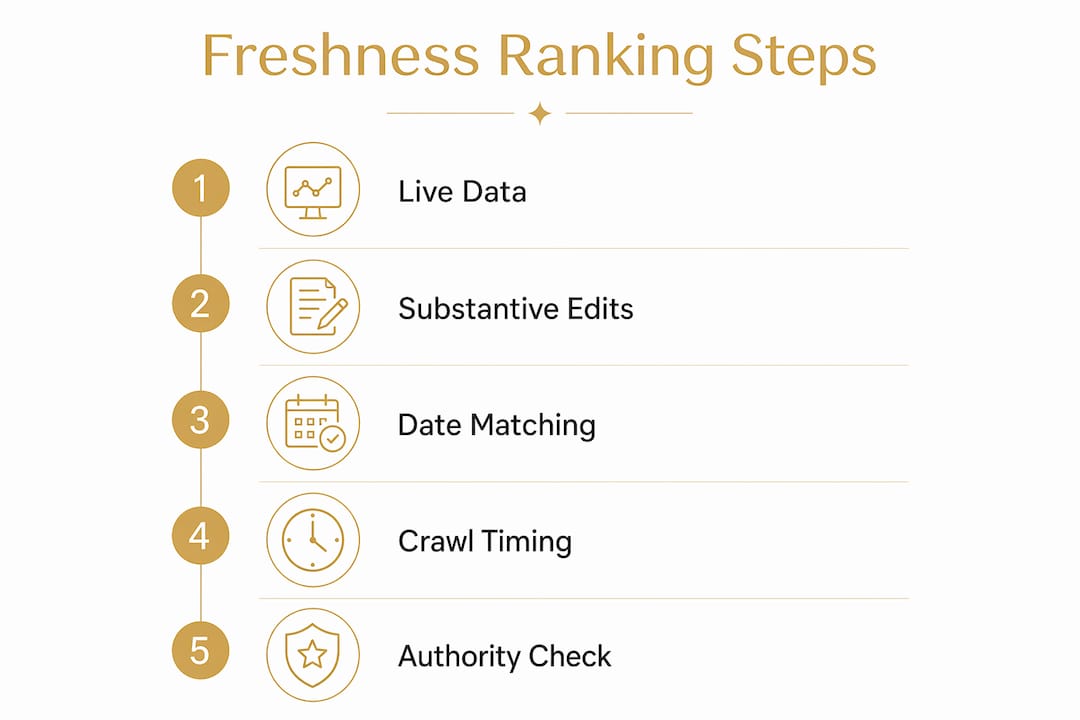
AI systems do not rely on a single signal. They cross-reference multiple data points to assess whether a page reflects current reality. For digital marketers, this means freshness is not a one-time publishing decision. It is an ongoing editorial discipline.

Freshness ranks alongside entity authority and structured data as a top-three AI ranking factor in 2026, according to research from Microsoft and AirOps. That positioning matters because it tells you where to invest editorial resources when you are competing for AI citation slots.
What signals do AI systems use to measure content freshness?
AI systems pull from several distinct data layers to assess recency. Understanding each layer helps you prioritise where to focus your technical and editorial efforts.
Structured data signals:
dateModifiedin JSON-LD markup on Article, BlogPosting, and NewsArticle schema types carries the most weight. Use ISO 8601 format and update this field only when substantive edits occur.datePublishedshould remain fixed at the original publication date. Changing it to appear newer is a manipulation signal that AI extractors recognise.- HTTP
Last-Modifiedresponse headers and sitemaplastmodentries provide secondary confirmation of recency.
Visible on-page signals:
- A clearly displayed “Last updated: [date]” line near the article title or byline gives AI crawlers a human-readable freshness cue.
- Body content changes are compared against cached versions. AI systems detect whether the page text has actually changed or whether only the timestamp was updated.
Real-time retrieval:
Google AI Overviews cite facts retrieved in real time from four to seven live sources, with freshness affecting source selection within roughly 24 to 72 hours of a page being re-indexed. This is not a training data question. It is a live index question, which means your update cadence directly influences citation eligibility on a near-daily basis.
Pro Tip: Verify that your CMS updates dateModified only when substantive edits are saved. Some publishing stacks update datePublished instead, creating a signal mismatch that AI systems can detect and discount.
How does content freshness influence AI ranking and citation?
The influence of freshness on AI citation is measurable and significant. The 13-week threshold is the clearest benchmark available: half of all AI citations come from content published or updated within that window. Content outside that window is not invisible, but it competes at a structural disadvantage.
The underlying reason is not that AI systems prefer novelty for its own sake. AI freshness prioritises being current enough to reduce answer risk. Outdated facts reduce AI answer accuracy, and AI systems are calibrated to minimise that risk. A page citing a 2022 regulatory figure in a 2026 query context is a liability, not an asset, for an AI system trying to give a reliable answer.
What the data shows for marketers:
- Pages updated at least monthly for competitive topics and quarterly for less competitive ones maintain freshness within the citation window, according to an Amsive study.
- AI-referred traffic tends to convert at higher rates than organic traffic because AI citations carry implicit credibility. Losing citation eligibility due to stale content has a direct revenue implication, not just a visibility one.
- Freshness compounds with entity authority. A well-established page that is also recently updated outperforms a fresh page with no authority history.
For iGaming and gambling content specifically, where regulations, bonus structures, and platform features change frequently, the freshness imperative is even sharper. A page describing a casino’s welcome offer from eight months ago is factually unreliable, and AI systems treat it accordingly. Myluckyuniverse’s approach to AI-optimised casino content reflects exactly this reality.
What distinguishes substantive updates from superficial ones?
This is where most content teams make their most costly mistake. Changing a date without changing content does not just fail to help. It actively harms your standing with AI systems.
Cosmetic date updates without content changes are recognised and penalised by AI systems, reducing ranking trust. AI extractors compare the current version of a page against cached versions. If the text is identical and only the timestamp changed, the system logs a manipulation signal. That signal erodes the credibility of your freshness data across the entire domain over time.
The research on what actually works is specific. Major content updates involving 31 to 100% of a document deliver statistically significant ranking improvements, with an average position gain of 5.45 places. Minor updates do not produce the same result and can actually hurt rank.
What counts as a substantive update:
- Adding a new section covering a development that occurred after the original publication date
- Replacing outdated statistics with current data from recent studies or reports
- Restructuring the argument or methodology section to reflect current best practice
- Removing content that is no longer accurate and replacing it with verified current information
What does not count:
- Changing the year in the title without editing the body
- Updating the
dateModifiedfield without any body text changes - Adding a single sentence to an otherwise unchanged article
Pro Tip: Before updating a page, run a word count comparison between the current version and the proposed revision. If the change is under 30% of total content, reconsider whether it is worth triggering a freshness signal at all. Partial updates that fall below the significance threshold may not move the needle.
How often should marketers update content for AI freshness?
Update frequency should be driven by query time-sensitivity, not by an arbitrary editorial calendar. The 13-week citation window gives you a practical anchor.
- Monthly updates for competitive, time-sensitive topics such as bonus comparisons, regulatory news, and product reviews. These pages face the highest freshness competition and the fastest content decay.
- Quarterly updates for moderately competitive topics where the core information changes less frequently. This keeps the page within the citation window without over-investing editorial resources.
- Bi-annual reviews for evergreen content with stable underlying facts. The goal here is accuracy verification rather than freshness signalling. If nothing has changed, do not force an update.
- Immediate updates when a material fact changes. A regulatory change, a platform closure, or a significant product update warrants same-week action regardless of where the page sits in the update schedule.
Updating high-performing pages every three to six months improves AI citation more reliably than constantly publishing new pages. This is a counterintuitive finding for content teams conditioned to measure output by volume. Authority and freshness combined outperform freshness alone.
Pro Tip: Coordinate your update timing with your site’s crawl cadence. Publishing an update the day before a known crawl window maximises the speed at which the fresh signal reaches the index. Tools like Google Search Console can help you identify how frequently your key pages are being crawled.
How to implement freshness signals technically and strategically
Technical implementation is where good editorial intentions either get reinforced or undermined. The following practices reflect current best standards for signalling freshness to AI systems.
| Signal type | Best practice | Common mistake |
|---|---|---|
JSON-LD dateModified | Update only on substantive edits; use ISO 8601 format | Updating on every minor CMS save |
| Visible on-page date | Display “Last updated” near the title; sync with dateModified | Showing only the original publish date |
Sitemap lastmod | Reflect the actual last substantive update date | Auto-generating from server timestamps |
HTTP Last-Modified header | Align with content edit date | Defaulting to server deployment date |
| Cached content comparison | Ensure AI crawlers see the updated version promptly | Caching layers serving stale HTML |
Visible and structured freshness signals must be exactly aligned to prevent AI extractors from flagging content as stale or untrustworthy. A page showing “Last updated: March 2026” in the body but carrying a dateModified of September 2024 in its JSON-LD creates a contradiction. AI systems resolve contradictions by discounting both signals.
Verify that your CMS or publishing stack updates dateModified only when substantive edits occur. Some systems change datePublished instead, which creates a mismatch that undermines your freshness credibility. For iGaming publishers managing high volumes of review content, this is a systemic risk worth auditing across the entire content catalogue. Myluckyuniverse’s guide to schema markup for AI visibility covers the technical setup in detail.
Coordinate update timing with crawl and indexing cadence to avoid content becoming stale before it is re-indexed. High-traffic pages are crawled more frequently, so they benefit from updates more quickly. Lower-traffic pages may sit in a stale state for days or weeks after an update, which is worth factoring into your prioritisation decisions.
Key takeaways
Content freshness is a top-three AI ranking factor, and only substantive updates involving 31% or more of a document’s content produce measurable citation and ranking gains.
| Point | Details |
|---|---|
| Freshness is a top-three AI factor | Freshness ranks alongside entity authority and structured data in AI citation decisions. |
| The 13-week citation window | Half of all AI citations reference content updated within the past 13 weeks. |
| Substantive updates only | Changes covering 31 to 100% of a document produce significant ranking gains; minor edits do not. |
| Align all freshness signals | Visible dates, JSON-LD dateModified, and sitemap lastmod must match to avoid trust penalties. |
| Prioritise by query sensitivity | Update competitive pages monthly, moderate topics quarterly, and evergreen content bi-annually. |
Why freshness strategy is more nuanced than most guides admit
I have watched content teams pour hours into “freshness sprints” that amounted to changing article titles and bumping dates across dozens of pages. The results were predictably flat. What the research confirms, and what I have seen play out in practice, is that AI systems are genuinely sophisticated about detecting real change versus performed change.
The insight that shifted my thinking was the 31% threshold finding. It reframes freshness from a maintenance task into an editorial commitment. You are not refreshing a page. You are re-earning its citation eligibility by demonstrating that the information has genuinely evolved. That requires editorial judgement, not just a workflow.
The other thing worth saying plainly: freshness without authority is a weak signal. A brand-new page updated yesterday will not outrank an established page with a strong entity footprint and a recent update. The compounding effect of authority plus freshness is where the real citation advantage lives. For iGaming publishers, this means protecting your high-authority review pages with regular substantive updates rather than diluting your domain with a constant stream of thin new content.
The AI credibility scoring factors that Myluckyuniverse has documented show freshness operating as a multiplier on existing authority, not a standalone lever. That framing changes how you allocate your editorial budget.
— Lucky
How Myluckyuniverse can help you stay citation-ready
Myluckyuniverse specialises in AI-native content strategy for the iGaming sector, with over 20 years of industry experience informing every editorial decision. The platform is built to produce structured, freshness-optimised content that AI systems like ChatGPT, Perplexity, Gemini, and Claude actively cite.
If your content is losing ground in AI search results, the issue is often a combination of stale facts, misaligned schema signals, and update cadences that do not match query time-sensitivity. Myluckyuniverse’s editorial and technical frameworks address all three. Explore the full range of content optimisation resources at Myluckyuniverse and see how a structured freshness strategy translates directly into AI citation gains.
FAQ
What is content freshness in AI ranking?
Content freshness in AI ranking refers to how recently a page has been substantively updated, measured through signals like dateModified schema, visible update dates, and actual body content changes. It is one of the top three factors AI systems use to select citation sources.
How often should I update content for AI search visibility?
Competitive, time-sensitive pages should be updated monthly; moderately competitive topics quarterly. The goal is to keep content within the 13-week window that accounts for approximately 50% of all AI citations.
Does changing a date without editing content improve AI ranking?
No. AI systems detect cosmetic date updates with no content changes and treat them as manipulation signals, which reduces ranking trust rather than improving it.
What counts as a substantive content update for AI freshness?
A substantive update involves changing 31% or more of a document’s content, such as adding new sections, replacing outdated statistics, or restructuring key arguments. Minor edits below this threshold do not produce measurable ranking improvements.
Why do visible dates and schema dates need to match?
AI extractors cross-reference visible on-page dates with structured data timestamps. A contradiction between the two signals causes AI systems to discount both, effectively treating the page as having an unknown or unreliable freshness status.