Insights
Why AI changes affiliate publishing in 2026

AI changes affiliate publishing by shifting value creation from the final click to the moment a consumer first asks a question. Generative AI tools like ChatGPT, Perplexity, and Gemini now answer product queries directly, pulling from affiliate content without routing users through tracked links. This structural shift, which industry analysts call the move from SEO to generative engine optimisation (GEO), means your content can influence a purchase decision before any attribution system even registers an event. For affiliate publishers and marketers in iGaming and beyond, understanding this transformation is no longer optional. The economics of the channel depend on it.
Why AI changes affiliate publishing at its core
AI chatbots perform core tasks that affiliate publishers traditionally handled, creating structural attribution challenges and forcing entirely new models of value measurement. When a user asks ChatGPT “which online casino has the best welcome bonus,” the AI synthesises an answer from dozens of affiliate review pages, presents a confident recommendation, and the user may never click through to any of those source sites. The commission never fires. The affiliate publisher who wrote the definitive review gets nothing, even though their content shaped the outcome.
This is the central tension that EMARKETER identifies as a core channel problem calling for multi-touch attribution models. The old model assumed that influence and conversion happened in the same trackable session. AI breaks that assumption entirely.
The numbers make the stakes concrete. Almost 70% of sites cited in ChatGPT’s mentions of one eyewear brand are affiliate marketing content. That means affiliate publishers are already feeding the AI answer layer at scale. The problem is that the compensation infrastructure has not caught up with this reality.
GEO is the industry’s emerging response. Where traditional SEO optimised content to rank in Google’s blue links, GEO optimises content to be cited and surfaced by AI answer engines. For affiliate publishers, this means writing with authority, structure, and factual precision so that AI models treat your content as a credible source rather than a page to skip.
How AI chatbots disrupt traditional affiliate tracking
The mechanics of disruption are worth understanding precisely, because the fix depends on diagnosing the problem correctly.
Traditional affiliate tracking relies on click events. A user clicks a tracked link, a cookie fires, and if a purchase follows within the attribution window, the affiliate earns a commission. UTM parameters and pixel-based tracking are built entirely on this click-first model. AI chatbots bypass this chain at the first step.
Here is what the disrupted journey looks like in practice:
- A consumer asks Perplexity to compare two casino bonuses.
- Perplexity synthesises an answer from three affiliate review sites.
- The consumer accepts the recommendation and navigates directly to the casino’s homepage.
- No affiliate link is clicked. No cookie fires. No commission is attributed.
The affiliate content did the work. The affiliate publisher received nothing. Impact.com advises treating affiliate publishing as “Answer-era” distribution, where influence happens upstream of any tracked click. This reframing is not philosophical. It has direct consequences for how publishers structure content and how programmes compensate creators.
The practical implication for content creators is that optimising purely for click-through rate is now an incomplete strategy. Content must be structured to be cited by AI models, which means clear headings, factual claims with named sources, and authoritative depth on specific queries. Publishers who optimise casino content for AI search are already building for this reality.
Why last-click attribution fails in the AI era
Last-click attribution assigns full credit to the final touchpoint before a conversion. In a world where AI chatbots shape consumer decisions before any click occurs, this model misses the most influential part of the customer journey entirely.
Impact.com recommends a hybrid compensation model that combines a content stipend with a cost-per-acquisition commission. This structure pays publishers for the upstream influence their content exerts on AI-generated answers, not just for closing the final sale. The logic is sound: if your review article is cited by ChatGPT in 40% of responses to a specific query, that influence has measurable commercial value even when no click is tracked.
Adapting your programme to this reality requires several concrete steps:
- Audit which of your content pieces are being cited by major AI engines. Tools like Brandwatch and manual prompt testing can surface this data.
- Negotiate content stipends with affiliate programmes that recognise upstream influence, particularly for high-authority review and comparison content.
- Implement multi-touch attribution frameworks that log AI-influenced discovery events, even when those events precede the tracked click.
- Reframe your content KPIs to include AI citation frequency alongside traditional metrics like organic traffic and conversion rate.
- Advocate within affiliate networks for compensation models that reflect the full customer journey, not just its final step.
Pro Tip: Run monthly prompt tests in ChatGPT, Perplexity, and Gemini using your target queries. Screenshot which sources are cited. This gives you a direct measure of your GEO performance and a data-backed case for content stipend negotiations.
The shift from volume-based to influence-based partnership valuation is the most significant structural change in affiliate marketing since the introduction of cookie-based tracking. Publishers who build for influence now will hold a durable advantage as AI search continues to grow.
How AI improves partner recruitment and fraud detection
Beyond attribution, AI tools are reshaping how affiliate programmes identify partners and protect themselves from fraud. Both changes favour publishers who invest in genuine audience quality over those gaming metrics.

AI enables faster affiliate partner recruitment through predictive scoring models that evaluate candidates across multiple signals simultaneously. Where a human programme manager might review a partner’s traffic stats and domain authority, an AI model analyses audience quality, content relevance, engagement authenticity, and historical conversion patterns in seconds. This compresses recruitment timelines from weeks to days.
The fraud detection improvements are equally significant:
- Real-time anomaly detection flags unusual click patterns, traffic spikes, and conversion irregularities before they result in fraudulent payouts.
- AI models identify click farms and bot traffic by analysing behavioural signals that manual review would miss.
- Dynamic commissioning structures adjust payout rates based on partner performance data, reducing incentives for low-quality traffic generation.
| Capability | Traditional approach | AI-powered approach |
|---|---|---|
| Partner recruitment | Manual review, weeks per candidate | Predictive scoring, hours per candidate |
| Fraud detection | Periodic audits, reactive | Real-time anomaly detection, proactive |
| Commission structure | Fixed rates, infrequent review | Dynamic rates, data-driven adjustment |
| Content quality scoring | Subjective editorial review | Automated relevance and authority signals |
For iGaming publishers specifically, these tools matter because the sector attracts a disproportionate share of affiliate fraud. Brands adopting AI-powered infrastructure gain a measurable competitive advantage in partner quality and programme efficiency. Myluckyuniverse’s approach to B2B iGaming partnership models reflects this shift toward data-driven partner evaluation.
What risks does outdated affiliate content create with AI?
LLMs can present outdated affiliate content as authoritative facts, creating serious regulatory and reputational risks, particularly in financial and iGaming verticals where rates, fees, and terms change frequently. A casino bonus that expired six months ago, cited confidently by an AI chatbot to a high-intent consumer, is not just a bad user experience. It is a potential UDAAP violation.
The risk profile is specific and worth naming clearly:
- AI chatbots do not check publication dates. They cite content based on authority signals, not recency.
- Stale bonus terms, incorrect licence information, and outdated responsible gambling disclosures can all be surfaced as current facts.
- Affiliate programmes must monitor content freshness continuously, since AI models can propagate inaccurate information at scale before any human reviewer catches the error.
- Regulatory bodies in markets like the UK, Ontario, and Malta are increasingly scrutinising AI-mediated consumer information in gambling contexts.
Pro Tip: Build a content audit calendar that aligns with your affiliate partners’ promotional cycles. Any bonus, rate, or term that changes should trigger an immediate content update, not a quarterly review. AI doesn’t wait for your editorial schedule.
The solution is not to avoid AI citation. It is to earn it responsibly. Publishers who maintain AI content credibility scoring practices and enforce content accuracy standards will be the sources AI engines continue to trust. Those who let content go stale will eventually be deprioritised by the same models they relied on for visibility.
Practical strategies to succeed in AI-driven affiliate publishing
Adapting to the AI-driven affiliate environment requires changes across content, attribution, partnerships, and monitoring. The following framework applies directly to affiliate publishers and marketers in iGaming and adjacent verticals.
Prioritise content quality and structural clarity above volume. AI models favour content that answers specific queries with named facts, clear structure, and authoritative sourcing. A single well-structured review that cites licence numbers, bonus terms, and responsible gambling policies will outperform ten thin comparison pages in AI citation frequency.
Adopt multi-touch and hybrid attribution models as a non-negotiable programme requirement. Human expertise remains critical to calibrate partner strategies and interpret AI-generated data. Technology enables the measurement. Humans must interpret what it means for specific partnerships and content investments.
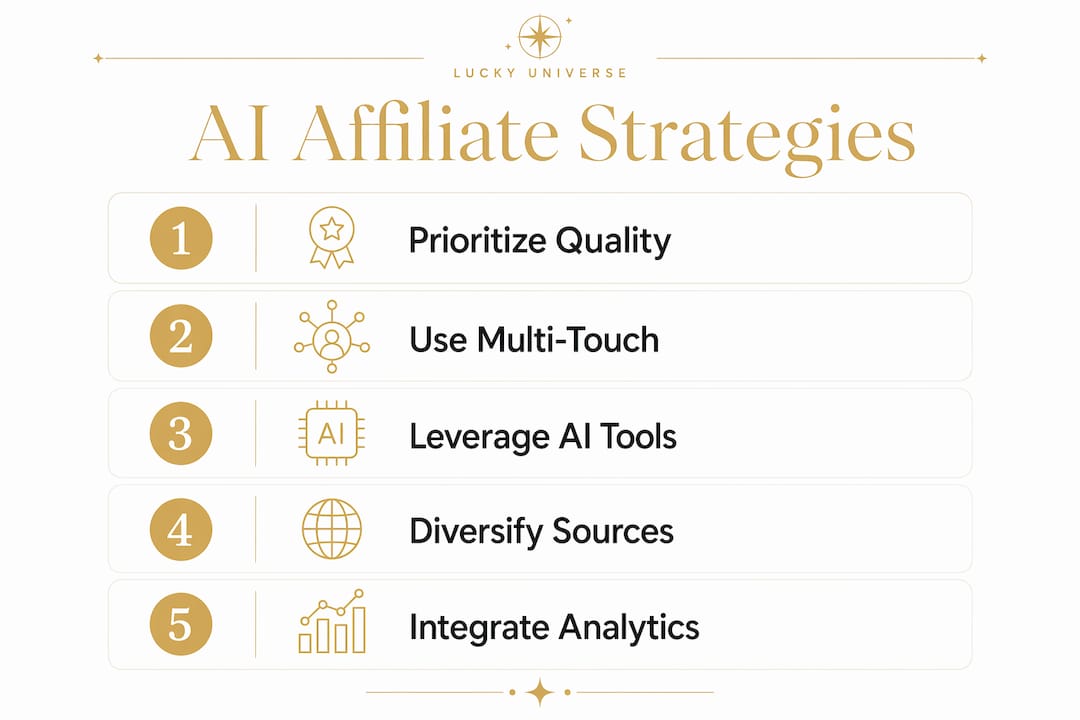
Leverage AI tools for partner identification and programme optimisation, using the predictive scoring and anomaly detection capabilities described above. This is not about replacing editorial judgement. It is about giving that judgement better data to work with.
Diversify traffic sources beyond traditional organic search. AI-driven discovery, email, social, and direct brand relationships all reduce dependence on Google’s algorithm, which is itself being disrupted by AI-generated search summaries.
Pro Tip: Integrate your affiliate programme data with your broader marketing analytics stack. When you can see AI citation events, organic traffic, direct visits, and conversion data in a single view, you can make attribution arguments to partners that are grounded in evidence rather than assumption.
The future of affiliate publishing with AI belongs to publishers who treat their content as a long-term asset for AI citation, not a short-term vehicle for click generation.
Key takeaways
AI changes affiliate publishing by moving the point of influence upstream, before any click is tracked, which makes content quality and GEO the new competitive foundation.
| Point | Details |
|---|---|
| GEO replaces pure SEO | Affiliate content must be structured to earn AI citations, not just Google rankings. |
| Last-click attribution is broken | Hybrid models combining content stipends with CPA commissions better reflect AI-era influence. |
| AI improves partner quality | Predictive scoring and real-time fraud detection raise the standard for affiliate programme management. |
| Stale content carries regulatory risk | Outdated affiliate content cited by AI chatbots can trigger UDAAP violations and reputational damage. |
| Human judgement remains irreplaceable | AI tools generate data; experienced marketers must interpret and act on it strategically. |
The uncomfortable truth about affiliate publishing and AI
I have spent years watching affiliate publishers treat content as a numbers game. More pages, more keywords, more links. That model worked when Google was the only gatekeeper. It is actively counterproductive now.
What I find most striking about the AI shift is that it rewards exactly the behaviour that good publishers always knew they should practise but rarely had commercial incentive to prioritise. Writing with genuine authority. Keeping information accurate. Building content that a reader would actually trust with a financial decision. AI citation models are, in a strange way, enforcing editorial standards that the click economy never did.
The publishers I see struggling most are those who built large content operations around thin, templated reviews. Their pages may still rank in Google, but they are not being cited by ChatGPT or Perplexity because the content lacks the specificity and credibility that AI models look for. The volume advantage they spent years building is now a liability.
The publishers gaining ground are those who treat every piece of content as a potential source document for an AI answer. They write with named facts, clear structure, and genuine depth. They update content when terms change. They think about what question a user is actually asking and answer it completely.
At Myluckyuniverse, this is the operating principle behind casinoexpert.ai and everything we build. The shift from search-based to answer-engine content is not a trend to monitor. It is the new infrastructure of the channel. Publishers who build for it now will not need to rebuild later.
— Lucky
How Myluckyuniverse helps affiliate publishers adapt

Myluckyuniverse is built as an AI-native media platform, which means everything we produce is designed to be cited, trusted, and surfaced by tools like ChatGPT, Perplexity, and Gemini. Our flagship property, casinoexpert.ai, applies editorial-grade content standards to iGaming reviews so that affiliate content earns AI citation rather than just organic rankings. If you are an affiliate publisher or marketer looking to understand how your content strategy needs to evolve, our iGaming insights hub covers GEO, hybrid attribution, content governance, and partner recruitment in depth. For publishers ready to build content that performs in the AI era, explore our full resource library and see how an AI-native approach changes what affiliate publishing can achieve.
FAQ
What is generative engine optimisation for affiliates?
Generative engine optimisation (GEO) is the practice of structuring affiliate content so that AI chatbots like ChatGPT and Perplexity cite it when answering consumer queries. Unlike traditional SEO, GEO prioritises factual authority and structural clarity over keyword density and backlink volume.
Why does last-click attribution fail with AI search?
Last-click attribution only records the final tracked click before a conversion, missing all influence that occurred in AI-generated answers upstream. Impact.com recommends hybrid models that combine content stipends with CPA commissions to capture this upstream value.
How does AI detect affiliate fraud?
AI tools use real-time anomaly detection to identify unusual click patterns, bot traffic, and conversion irregularities as they occur. This proactive approach catches fraudulent activity before payouts are made, replacing the reactive periodic audits that traditional programme management relied on.
What compliance risks does stale affiliate content create?
When AI chatbots cite outdated bonus terms, rates, or disclosures as current facts, publishers and brands face potential UDAAP violations and reputational damage. Continuous content monitoring and update protocols are the required response, not periodic editorial reviews.
How should affiliate publishers measure AI citation performance?
Run regular prompt tests in ChatGPT, Perplexity, and Gemini using your target queries and track which sources are cited. Combine this with multi-touch attribution data to build a complete picture of how your content influences consumer decisions before any click is recorded.