Insights
What is editorial AI augmentation in 2026?

Editorial AI augmentation is not about handing your content to a machine and walking away. It refers to a collaborative model where AI tools handle specific, well-defined tasks within an editorial workflow while human editors retain oversight, judgement, and accountability. The more accurate industry term is human-AI collaborative publishing, though “editorial AI augmentation” has become the shorthand most content creators and marketers actually use. This article breaks down what that model looks like in practice, why the human role is non-negotiable, and how you can implement it without sacrificing quality or reader trust.
Table of Contents
- Key takeaways
- What editorial AI augmentation actually means
- Why human judgement cannot be automated
- Tools and technologies powering AI editorial workflows
- Implementing AI augmentation responsibly
- Challenges and misconceptions to watch for
- My perspective: what I have actually learned
- Explore AI editorial tools with Myluckyuniverse
- FAQ
Key takeaways
| Point | Details |
|---|---|
| AI assists, humans decide | AI handles drafting and structuring; human editors retain final approval and fact verification. |
| The involvement spectrum matters | Publishing content that is more than 75% unedited AI output cannot honestly meet bylined editorial standards. |
| RAG reduces hallucinations | Retrieval-augmented generation grounds AI drafts in real data, improving accuracy across newsroom workflows. |
| Scaffolds beat finished drafts | Using AI to produce outlines rather than polished copy forces stronger human engagement and preserves editorial voice. |
| Disclosure builds trust | Clear AI use policies and named human bylines are critical to maintain reader trust and regulatory compliance. |
What editorial AI augmentation actually means
The simplest way to understand editorial AI augmentation is to picture a very capable research assistant who never sleeps, never gets bored, and occasionally makes things up with complete confidence. That last part is why you still need an editor in the room.
AI in editorial processes means AI tools assist with the mechanical and structural parts of content production while humans handle everything that requires judgement. Practically, that includes:
- Drafting and outlining: AI generates a structural draft or outline based on a brief, which the human editor then rewrites or substantially refines.
- Research summarisation: AI surfaces relevant sources, quotes, and data points for the editor to verify and select from.
- Grammar and style checks: Tools flag inconsistencies, passive constructions, or off-brand phrasing in real time.
- Transcription and tagging: AI converts audio interviews to text and suggests SEO metadata, which humans then review.
- Content structuring: AI recommends section order and heading hierarchies based on audience intent data.
The critical point is that human editors retain final judgement, fact verification, and publication approval at every stage. The AI involvement spectrum runs from 0% to 100%, and the baseline expectation for professionally bylined content sits between 10% and 50% AI contribution. Beyond 75% AI content published verbatim, you cannot honestly meet bylined editorial responsibility standards.
Why human judgement cannot be automated
This is where a lot of content teams get into trouble. They see AI drafting as the hard part and assume a quick edit at the end handles everything else. It does not.
AI cannot reliably verify facts or make editorial decisions about what is worth publishing. Those two functions require human editors operating separately from the drafting process. When you allow AI to draft first and then only lightly edit, you are letting the AI’s framing and priorities shape what the reader ultimately receives.
The risks of unchecked AI content go beyond occasional errors. They include:
- Hallucinations: AI confidently presents fabricated statistics, quotes, or historical details that appear plausible.
- Framing bias: AI tends toward generic, safe framing that strips out the editorial perspective that makes content genuinely useful.
- Structural predictability: Without human intervention, AI-drafted content often follows formulaic patterns that erode brand voice over time.
- Verification gaps: AI tools are not built to call sources, cross-reference proprietary data, or apply YMYL (Your Money or Your Life) editorial standards.
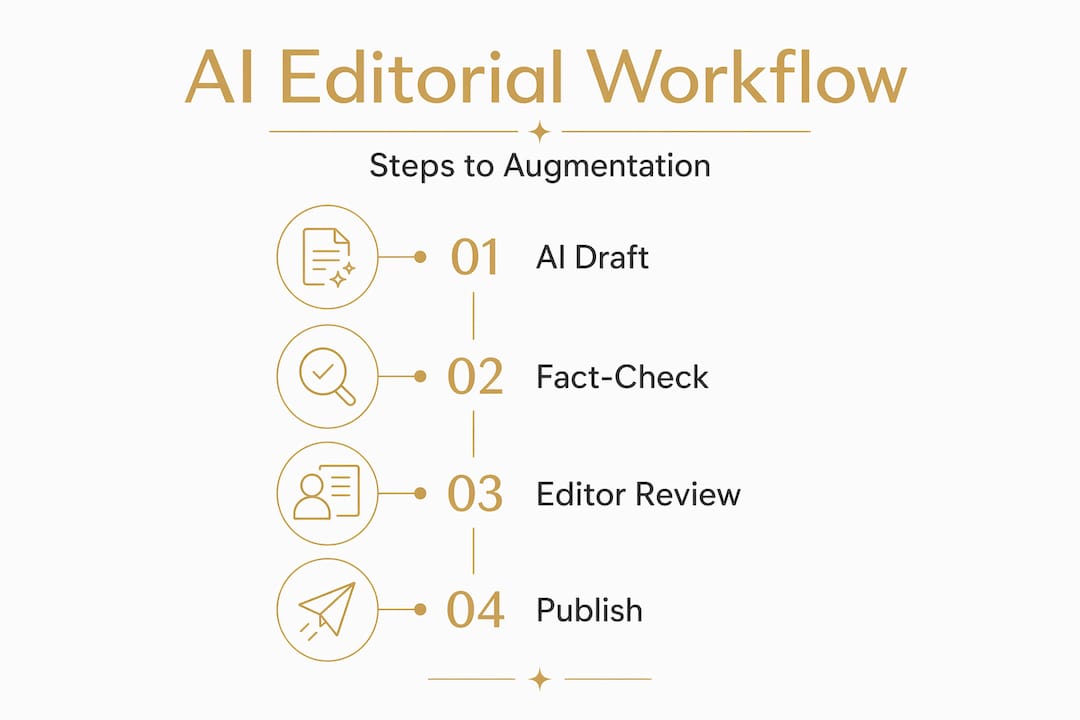
Pro Tip: Build a multi-stage checkpoint system where AI drafting, human fact-checking, and editorial approval are treated as three fully separate roles. Never let one person do all three in a single pass on the same piece.
Structured editorial workflows that codify tasks, quality gates, and role separation are the single most effective way to prevent these issues while still capturing the speed benefits AI offers.
Tools and technologies powering AI editorial workflows
Retrieval-augmented generation in the newsroom
Retrieval-augmented generation, commonly called RAG, is one of the most practical advances in AI publishing tools. Rather than generating content from the model’s training data alone, RAG acts as newsroom memory by pulling relevant internal documents, archival pieces, and verified data sources before producing a draft. The result is a draft that is grounded in actual information rather than plausible-sounding generalisations.

The practical benefit for content teams is significant. A gambling content operation using RAG can ground AI summaries in its own database of reviewed casino performance data, reducing both hallucinations and the time editors spend correcting factual errors.
AI headline and SEO support
The AI tool Guten, used by Reach plc, illustrates how AI editorial applications work at scale. About half of journalists at Reach Ireland use Guten to receive article idea recommendations, headline variations, and SEO tag suggestions. Humans review and approve each output. The AI does not publish anything.
Scale and scope in academic publishing
For an example of how large AI-assisted editorial has already become, consider that Springer Nature expanded AI-assisted peer review processes in 2025, supporting over 1.5 million papers using nearly 60 AI tools across manuscript screening and integrity checks. Human oversight was retained throughout. Growth of 25% was projected for 2026.
| Application | AI role | Human role |
|---|---|---|
| Draft production | Generates outline or structural draft | Rewrites, refines, and adds editorial voice |
| SEO and metadata | Suggests headlines and tags | Reviews and approves final selections |
| Fact gathering | Surfaces sources and relevant data | Verifies, selects, and contextualises |
| Peer or editorial review | Flags inconsistencies and integrity issues | Makes final acceptance or rejection decisions |
| Transcription | Converts audio or video to text | Edits for accuracy and context |
Implementing AI augmentation responsibly
Getting the benefits of AI-assisted writing without sliding into content farm territory comes down to clear process design. Here is a practical approach for content creators and marketers.
- Define roles before you pick tools. Decide which tasks belong to AI and which belong to humans before you start. Role confusion after the fact is where quality problems begin.
- Use AI for scaffolds, not finished copy. AI scaffolds rather than polished drafts force editors to engage genuinely with the content. When the AI provides only an outline and bullet points, the human writes the actual piece, reducing AI’s framing influence on the final product.
- Separate verification from drafting. Assign a dedicated fact-checking pass to someone who was not involved in the AI-assisted draft stage. This mirrors the multi-agent editorial pipeline model, where specialised roles prevent errors from compounding.
- Set a quality gate before publication. Every piece should pass a defined checklist: facts verified, brand voice confirmed, disclosure statement added, and a named human editor taking accountability.
- Write an AI use policy and share it. Your team needs written guidance on which AI tools are approved, what tasks they can be used for, and what review standards apply. Ambiguity here is how quality erosion starts.
- Disclose AI involvement clearly. Transparency and disclosure policies should detail which AI tools were used, what processes were applied, and who the accountable human editor is. This is not just ethical practice. It is increasingly a regulatory expectation in publishing.
Pro Tip: If you are working in a high-stakes vertical like finance, health, or iGaming, treat AI drafts as raw material only. The editorial credibility standards in these sectors require substantially more human intervention than general content marketing.
Challenges and misconceptions to watch for
A lot of content teams approach AI augmentation with one of two blind spots. Either they think AI will do the hard thinking for them, or they dismiss it entirely because one early experiment produced poor results. Both positions cause problems.
The most persistent misconception is equating AI editing with verification. Allowing AI to draft first and relying on a final human edit to fix everything is not editorial augmentation. It is outsourcing editorial judgement to a system that has none.
Other common challenges include:
- Reputation risk: Publishing AI-generated errors under a human byline erodes reader trust quickly, especially in fields where accuracy is the core value proposition.
- Over-automation creep: Teams that start using AI for outlines often drift toward using it for full drafts, then lightly edited drafts, and then near-verbatim AI copy. The slide is gradual and easy to miss without governance.
- Disclosure compliance: Regulations and platform standards around AI content disclosure are tightening. YMYL standards, in particular, are increasingly requiring credentialed human review to be documentable, not just implied.
“Editorial accountability must be built into the entire process, not just rely on final human review.” This principle, drawn from real-world AI workflow design, is the clearest test of whether your process is genuine augmentation or passive automation in disguise.
The distinction between understanding AI publishing at a structural level and actually practising it in daily workflows is where most teams fall short. Knowing the theory is not enough without documented processes and consistent enforcement.
My perspective: what I have actually learned
I have been watching publishers integrate AI tools for long enough to see the pattern clearly. The teams that win are not the ones with the most sophisticated AI stack. They are the ones who drew firm lines about what AI is for before anyone opened a single tool.
In my experience, the most dangerous moment in an AI editorial workflow is not the first draft. It is six months in, when the process feels routine and the quality gates get treated as formalities. That is when AI framing starts shaping your editorial voice without anyone noticing.
What I have found actually works is treating AI output the way a good editor treats a junior writer’s draft: read it for ideas, throw out the structure, and write the piece yourself. The AI gets credit for the research assist. The editor gets credit for the article.
The value of augmentation lies in improving context and reducing mechanical effort, not in replacing the thinking. The moment you stop thinking because the AI drafted something coherent-looking, you have stopped doing editorial work.
I also think the content industry underestimates how much reader trust is at stake. Audiences in high-stakes verticals, including iGaming, finance, and health, are increasingly sceptical. Giving them a polished AI summary with a human name attached is not transparency. It is the opposite.
— Lucky
Explore AI editorial tools with Myluckyuniverse

At Myluckyuniverse, we have spent over two decades at the intersection of editorial standards and digital content. We apply the same human-AI collaborative model described in this article to every piece of iGaming content we produce, because our readers make real decisions based on what we publish.
If you are ready to go further, our casino content marketing guide covers how to blend AI content creation with human editorial oversight in competitive verticals. You can also explore how to optimise content for AI search in 2026, including headline strategy, SEO tagging, and answer-engine formatting built for the tools your readers actually use.
FAQ
What does editorial AI augmentation mean?
Editorial AI augmentation is the practice of integrating AI tools into content workflows to assist with drafting, research, and structuring while human editors retain final oversight, verification, and publication authority.
How is AI augmentation different from automated content?
Automated content involves AI generating and publishing material with minimal human input. AI augmentation keeps humans in control of story selection, fact verification, and final voice, using AI only as a production aid.
What is the risk of over-relying on AI in editorial work?
AI cannot verify facts or apply editorial judgement, so over-reliance leads to hallucinations, generic framing, and gradual erosion of brand voice. Quality gates and role separation are required to prevent this.
What is retrieval-augmented generation in publishing?
Retrieval-augmented generation (RAG) grounds AI drafts in verified archival or internal data rather than model training data alone, significantly reducing hallucinations and improving factual accuracy across editorial workflows.
Do publishers need to disclose AI use to readers?
Yes. Transparency about AI involvement, including named human bylines and documented review processes, is increasingly expected by audiences and required under evolving content standards in YMYL verticals.