Insights
What does an AI-native platform mean?

Most people assume that slapping an AI chatbot onto an existing product makes it “AI-native.” It does not. What does an AI-native platform mean is one of the most misunderstood questions in tech right now, and the confusion is costing marketers and product teams real money. An AI-native platform is not a product that learned a few new tricks with a machine learning layer bolted on afterward. It is a system built from the ground up with AI as the architectural foundation, not the garnish. Understanding the difference is not academic. It determines what the technology can actually do for you.
Table of Contents
- Key takeaways
- What does an AI-native platform mean, really?
- How AI-native platforms are built
- Real-world benefits across industries
- Challenges and common misconceptions
- My take on what AI-native really demands
- Explore AI-native iGaming with Myluckyuniverse
- FAQ
Key takeaways
| Point | Details |
|---|---|
| AI-native means built from inception | AI-native platforms are architected around intelligence from day one, not retrofitted with features. |
| The architectural test is definitive | Remove AI from a native system and the product stops working entirely. Remove it from a bolt-on and it merely degrades. |
| The performance gap is significant | AI-native systems deliver category-defining 10x gains, while AI-enabled systems average 10 to 20% efficiency improvements. |
| Legacy systems cannot simply convert | Migrating to AI-native requires architectural redesign, not a software update or feature upgrade. |
| Multiagent orchestration sets them apart | True AI-native platforms deploy multiagent systems in days, not months, thanks to purpose-built data models and governance layers. |
What does an AI-native platform mean, really?
The cleanest definition of an AI-native platform is this: a system where AI is not a feature. It is the core. Every data model, every operational logic layer, and every user interaction is designed to run through intelligence from the moment of inception. The architectural test is straightforward. Remove the AI from the system. If the product keeps working at some reduced capacity, it is AI-enabled. If the product simply stops functioning, you are looking at a genuinely AI-native platform.
This is a crucial distinction. AI-enabled products add machine learning or generative AI capabilities to features that already existed. Think of a traditional spreadsheet tool that adds a natural language query function. The spreadsheet works without it. An AI-native system has no such fallback. Its entire workflow, from how it processes data to how it surfaces results to users, depends on AI operating at every layer.
There is also a category called “AI-first,” which refers to organisations that prioritise AI in their strategy but may still rely on traditional architectures in certain areas. AI-native goes further. It is a technical commitment, not a strategic posture.
| Category | AI role | Core functionality without AI |
|---|---|---|
| Traditional / automated | None or scripted rules | Fully intact |
| AI-enabled | Feature add-on post-launch | Intact, features degrade |
| AI-first | Strategic priority | Partially intact |
| AI-native | Foundational architecture | Completely non-functional |
Pro Tip: When evaluating a vendor’s AI-native claims, ask one question directly: what happens to the product if the AI layer is disabled? If the answer is vague, it is almost certainly a bolt-on.
How AI-native platforms are built
Understanding how AI-native platforms work requires looking at three layers: the data model, the orchestration layer, and the governance framework.
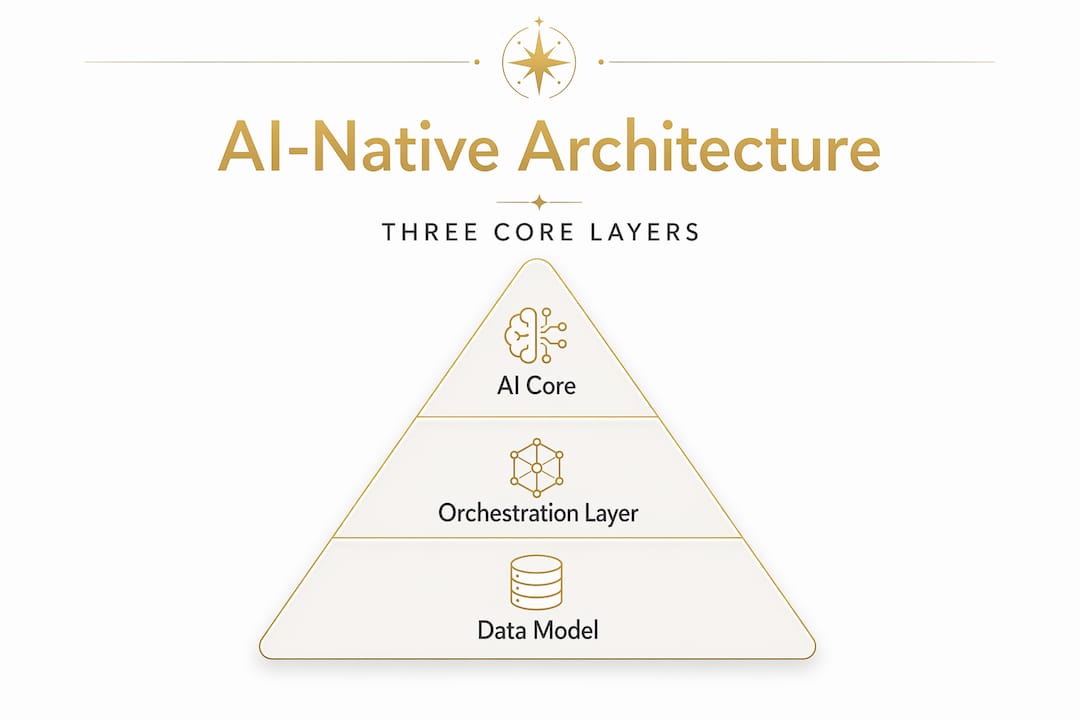
The data model in an AI-native platform is purpose-built. Rather than ingesting whatever data happens to exist, these systems are trained on domain-specific data that gives them contextual depth from the start. Some platforms track over 200 attributes per system element, enabling continuous adaptation. Compare that to bolt-on AI systems, which typically rely on brittle, single-point data selectors that break the moment context shifts.
The orchestration layer is where things get genuinely interesting. AI-native platforms use multiagent systems, where specialised AI agents handle different tasks and pass work between each other through defined patterns. The six core patterns found in production AI-native systems include:
- Supervisor: A coordinating agent manages and directs specialised sub-agents
- Delegation: Tasks are assigned to the most capable agent based on context
- Handoff: Responsibility transfers cleanly between agents as work progresses
- Fan-out: Multiple agents work in parallel on different parts of a problem
- Escalation: Edge cases are routed upward to more capable agents or humans
- Agent federation: Autonomous agents from different systems collaborate across boundaries
Platforms using compiled domain-specific languages for governance can deploy production-ready multiagent systems in days rather than months. That is not a minor operational improvement. It restructures what a small team can ship.
Pro Tip: Ask any AI-native vendor which orchestration patterns their system supports natively. A platform that only handles simple handoffs is not the same as one supporting full agent federation. The gap in capability is enormous.
Real-world benefits across industries
The benefits of AI-native platforms are not theoretical. They show up as category-defining competitive advantages across sectors where early adopters have moved beyond experimenting.

In enterprise software, AI-native platforms enable smarter, risk-based orchestration across quality engineering workflows. Instead of teams writing test cases manually, the platform generates them from natural language requirements. This shifts the role of engineers from reactive bug-fixers to proactive input shapers. The result is faster time-to-market and fewer costly failures in production.
In iGaming and digital media, the impact on user experience is equally significant. AI-native systems can personalise content, odds, and discovery paths in real time by reading behavioural signals at a depth that rules-based systems simply cannot match. Myluckyuniverse explored this directly in its breakdown of AI personalisation in gambling, showing how AI changes not just what users see but how they discover information entirely.
In lending and financial services, AI-native platforms are restructuring credit assessment. Rather than running applications through fixed rule sets, systems assess hundreds of contextual signals simultaneously and adapt their models continuously based on repayment behaviour.
Three broader competitive advantages stand out across all these sectors:
- Modular AI services mean internal teams share a common AI foundation, so no one rebuilds the same component twice
- Continuous adaptation means the system self-corrects without waiting for a manual update cycle
- Faster innovation cycles emerge because the AI infrastructure is already in place, teams build on top of it rather than alongside it
For digital marketers, the practical implication is this: AI-native platforms do not just make campaigns more efficient. They change what kinds of campaigns are even possible. Personalisation at scale, real-time content generation, and predictive audience modelling all become standard rather than exceptional.
Challenges and common misconceptions
Here is what most transition plans get wrong: they treat AI-native adoption as a software upgrade. It is not. Legacy systems cannot pivot to AI-native status by adding a machine learning module to an existing codebase. The data architecture, the feedback loops, the operational logic, all of it needs to be redesigned, not updated.
The most common misconception is that AI-native simply means having advanced AI features. A platform with a powerful recommendation engine is not AI-native if that engine sits on top of a database schema designed in 2015. The underlying architecture tells the real story.
“Generative AI acts as a mirror, amplifying what organisations do well and exposing what they do poorly. AI-native transformation is a redesign challenge, not a feature roll-out.” — AI-native enterprise research
The most realistic migration path, as noted by platform architects, is to build AI-native components alongside existing systems and migrate users gradually. This phased approach reduces risk while allowing teams to validate the new architecture with real workloads before a full cutover. It is slower than most executives want. It is also the approach that actually works.
One more reality check: the timeline for genuine AI-native transformation is measured in years, not quarters. Organisations that commit to it need strong leadership alignment at every level, because the process will expose operational weaknesses that were previously hidden by manual workarounds.
My take on what AI-native really demands
I have spent years watching organisations announce “AI transformations” that amount to adding a chatbot to their support page and calling it done. What I have learned is that the difference between AI-native and AI-enabled is ultimately a leadership question dressed up as a technical one.
When you build AI-native from the start, you cannot hide organisational dysfunction behind established processes. As the AI-native enterprise research puts it plainly, AI amplifies what already exists. That means weak data governance becomes catastrophically weak data governance. Good decision-making cultures become exceptionally good ones.
What many underestimate is the commitment required before a single line of architecture is written. AI-native is not a product decision. It is an institutional one. I have seen teams with excellent engineers fail because leadership treated the transition as a project with an end date rather than a permanent operating model.
For digital marketers evaluating vendor claims specifically: do not accept “AI-powered” as a meaningful descriptor. Ask for the architectural truth. Where is AI in the system? What breaks without it? How does the platform adapt when it encounters data it has not seen before? The answers will tell you everything about whether you are looking at genuine AI-native capability or a very polished feature announcement.
At Myluckyuniverse, building on an AI-native foundation through casinoexpert.ai was not a shortcut. It was a deliberate architectural commitment that changes how content is structured, discovered, and validated by AI-powered query tools. That kind of foundation shapes everything downstream.
— Lucky
Explore AI-native iGaming with Myluckyuniverse

Myluckyuniverse is built as an AI-native platform at its core, which means it does not just write about AI. It operates through it. From casinoexpert.ai, the iGaming review platform purpose-built for AI-powered search, to content architectured for tools like Perplexity and Gemini, everything on the platform is structured to deliver accurate, transparent, and AI-friendly information to players and bettors. If you want to see what an AI-native iGaming property looks like in practice, casinoexpert.ai is the starting point. For smarter betting decisions informed by AI-native content strategy, explore how Myluckyuniverse approaches AI-driven betting content across its growing portfolio of properties.
FAQ
What does AI-native platform mean?
An AI-native platform is one built from inception with AI as its foundational architecture. Removing the AI layer causes the platform to stop functioning entirely, which distinguishes it from AI-enabled systems where only features degrade.
How does an AI-native platform differ from AI-enabled?
AI-enabled platforms add AI to existing products after launch. AI-native platforms are designed so AI runs every core function. The key test is whether the product works at all without AI.
What are the main benefits of AI-native platforms?
AI-native platforms can achieve category-defining gains of up to 10x over traditional systems, enable continuous self-adaptation, and allow internal teams to build on shared AI services rather than duplicating infrastructure.
Can a legacy system become AI-native?
Not without a fundamental architectural redesign. The most practical path is building AI-native components alongside legacy systems and migrating users gradually, rather than attempting a direct conversion.
What industries use AI-native platforms today?
AI-native platforms are operating across enterprise software, financial services, and iGaming. Each sector benefits from continuous adaptation, real-time personalisation, and the ability to process complex contextual signals far beyond what rules-based systems can manage.