Insights
How to segment iGaming audiences for campaigns

Audience segmentation in iGaming marketing is the practice of grouping players by behaviour, lifecycle stage, and value to deliver targeted campaigns that drive measurable engagement and conversion. When you segment iGaming audience for campaigns with precision, you stop wasting budget on players who will never convert and start speaking directly to those who will. The difference between a generic blast and a lifecycle-matched message is not cosmetic. It determines whether a dormant player reactivates or churns permanently. This guide covers the frameworks, tools, and compliance practices iGaming marketers need to build segmentation that actually performs in 2026.
What are the key audience segments in iGaming and how to define them?
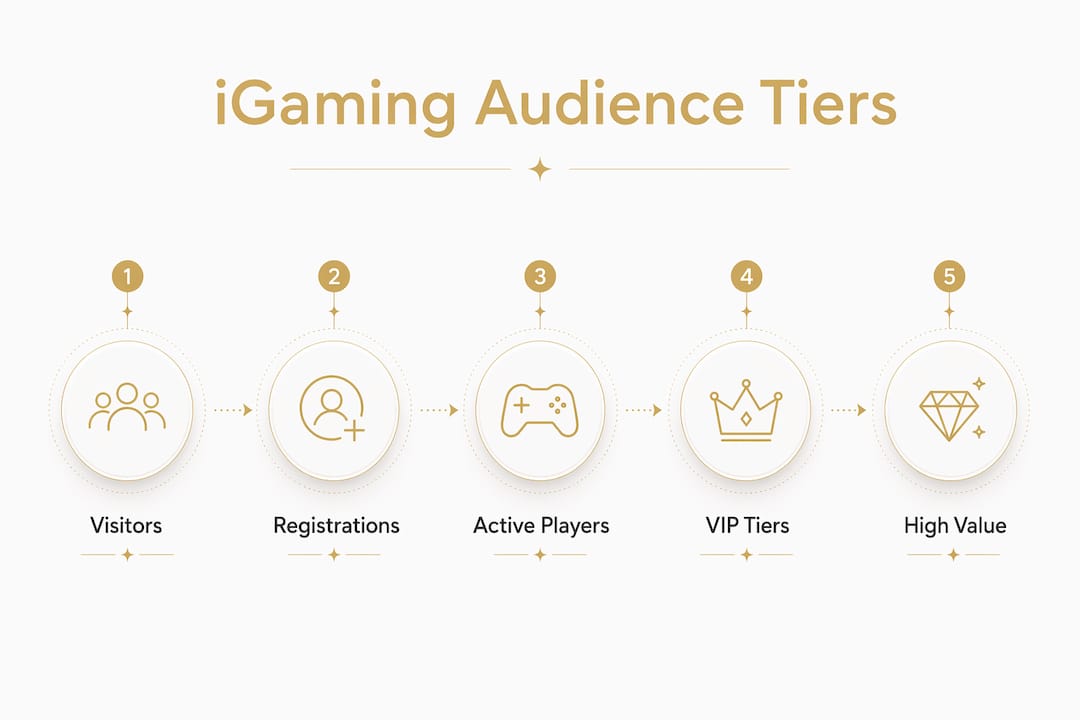
The most actionable iGaming segments combine lifecycle stage, value tiers, and recent activity thresholds to align messaging and reduce bonus waste. Lifecycle segmentation is the starting point for any serious iGaming campaign structure. Each stage carries a distinct intent signal, and the messaging that works for a first-time depositor will actively repel a VIP.
The standard lifecycle segments and their recommended time windows are:
- Website visitors: 7 to 30 days. Retarget with brand awareness and registration incentives.
- Registration abandoners: 1 to 14 days. Urgency-led creative with a low-friction registration prompt.
- Registered non-depositors: 1 to 7 days. Deposit bonus offers with clear terms and a single call to action.
- First-time depositors: 1 to 30 days. Onboarding sequences focused on game discovery and second-deposit incentives.
- Active players: Ongoing. Retention messaging tied to wagering patterns and preferred game categories.
- Dormant players: 30 to 90 days. Win-back campaigns with personalised offers based on historical deposit behaviour.
- VIP and high-value players: Ongoing. Dedicated account management touchpoints, exclusive events, and high-limit offers.
Value-based segmentation layers on top of lifecycle. VIP tiers are typically defined by total deposit thresholds, with high-value players often classified at deposits exceeding $5,000. Predicted lifetime value (LTV) models, built from early wagering patterns, allow you to identify future VIPs before they reach that threshold and treat them accordingly from the first deposit.
| Segment | Definition | Strategic messaging approach |
|---|---|---|
| Registration abandoners | Visited registration page, did not complete | Urgency creative, simplified sign-up prompt |
| Non-depositors | Registered but no deposit within 7 days | Welcome bonus, clear deposit steps |
| First-time depositors | Deposited once within 30 days | Onboarding flow, second-deposit incentive |
| Dormant players | No activity for 30 to 90 days | Personalised win-back, relevant game offer |
| VIP players | High cumulative deposits or predicted LTV | Exclusive rewards, personal account contact |

Pro Tip: Avoid defining dormancy at 90 days for all players. High-frequency bettors who go quiet for 14 days are already at risk. Calibrate your inactivity window to each player’s typical session cadence, not a blanket calendar rule.
How do lookalike audiences and signal-based targeting work in iGaming?
Advanced prospecting in iGaming uses value-based seed definitions and multi-tier lookalikes to reduce cost per acquisition by 20 to 40%. The quality of your seed audience is the single biggest variable in lookalike performance. A seed list built from all registered users will produce a broad, low-intent audience. A seed list built from VIPs with deposits exceeding $5,000 will produce a far tighter match.
Here is the multi-tier testing structure that consistently outperforms single-tier approaches on Meta:
- 1% lookalike: Tightest match to your seed. Use for highest-value prospecting with premium creative and offers.
- 1 to 3% lookalike: Broader reach while maintaining reasonable signal quality. Test against the 1% tier to compare CPA.
- 3 to 5% lookalike: Volume-focused prospecting. Useful for brand awareness campaigns where reach matters more than precision.
Seed layering adds demographic and behavioural filters on top of the lookalike base. For example, a 1% lookalike of recent converters, filtered by age 25 to 44 and interest in sports betting, narrows the audience to a far more qualified pool. High-quality, recent seed data is what separates operators who scale profitably from those who burn budget on unqualified traffic.
Signal-based targeting is gaining ground as third-party cookie deprecation continues. Platforms like Meta’s Conversions API allow you to pass server-side events directly, improving signal fidelity even when browser-level tracking is blocked. For iGaming operators, this means your deposit and registration events can still power lookalike and retargeting audiences with accuracy.
Pro Tip: Refresh your seed lists at least monthly. A seed list built on converters from six months ago reflects a different player cohort than your current high-value base. Stale seeds produce stale audiences and rising CPAs.
How does real-time CRM integration improve behaviour-based segmentation?
Static segments degrade performance because player intent changes daily. Behaviour-based segments improve retention when updated in real time, but most operators are still running weekly or monthly batch refreshes that leave money on the table.
The technical shift that makes real-time segmentation possible is event-driven architecture. Platforms using tools like Apache Kafka stream player events, such as deposits, game launches, and withdrawals, directly into a customer data platform (CDP). Real-time journeys reduce latency from roughly 24 hours to approximately 50 milliseconds, enabling campaign triggers that fire the moment a behavioural threshold is crossed.
What this looks like in practice:
- A player makes their first deposit at 9:14 PM. By 9:14 PM and 50 milliseconds, they are removed from the non-depositor segment and entered into the onboarding flow.
- A player who deposited 13 days ago shows no session activity. An inactivity trigger fires at day 14, launching a personalised win-back message before they reach the dormant threshold.
- A player’s wagering volume crosses a predicted LTV threshold. They are automatically upgraded to a VIP-track communication sequence without any manual intervention.
Operational requirements for this level of segmentation include verified event instrumentation, a CDP or equivalent data pipeline, and campaign tooling that accepts real-time audience updates. The typical adoption timeline for operators moving from legacy PAM-based campaigns to event-driven CRM is three to six months, depending on existing data infrastructure. You can explore how AI personalises player experiences in more depth to understand the technology layer behind these triggers.
Pro Tip: Do not replicate your legacy PAM campaign logic inside a new CRM platform. The architecture is different. Legacy PAM systems were built for batch processing. Rebuilding batch logic in a real-time system wastes the capability and often produces duplicate messaging errors.
What compliance rules apply to geo and demographic targeting in iGaming?
Compliance failure in geo-targeting is the fastest way to lose a Meta ad account permanently. Exclusion-based geo targeting caused permanent account suspension in documented iGaming cases, with operators losing accumulated audience data and optimisation history that took years to build.
The core compliance requirements for iGaming campaigns on Meta are:
- Positive-list geo targeting only. Never rely on exclusions to keep ads out of restricted jurisdictions. List only the approved markets you are licensed to operate in.
- Age gating at the ad level. Meta requires gambling advertisers to set minimum age targeting of 18 or higher, and higher in markets where local law demands it.
- IP verification at the landing page. Geo targeting at the ad platform level is not sufficient. Implement IP-based jurisdiction checks on your landing pages to block users from restricted regions even if an ad is served incorrectly.
- Business asset separation. Run compliant and non-compliant market campaigns from separate Meta Business Manager accounts. A violation in one account should not cascade to your primary account.
Compliance-first ad operations create a competitive moat in regulated iGaming markets by maintaining stable accounts and accumulated audience intelligence that non-compliant operators lose when suspended.
The ROAS impact of remediation is significant. Operators who rebuild on a compliant foundation after suspension consistently report improved campaign performance once the account accumulates clean signal data, because the audience intelligence is no longer contaminated by out-of-jurisdiction impressions.
Common segmentation mistakes and how to fix them
Poor event instrumentation quality degrades lookalike seed quality and retention triggers, making this the most underestimated problem in iGaming segmentation. Marketers invest in CRM platforms and audience strategy while the underlying event data feeding those systems is incomplete, duplicated, or misfired.
The most common segmentation mistakes and their fixes:
- Segmentation theatre. Building 15 audience segments but only running creative for three of them. Every segment you define must have a corresponding campaign or it is wasted infrastructure. Audit your active segments quarterly and retire those without dedicated messaging.
- Imbalanced retargeting budgets. Concentrating spend on first-time depositor retargeting while ignoring dormant reactivation. Dormant players represent a high-LTV opportunity because acquisition cost is already sunk. Allocate a defined percentage of your retargeting budget to win-back campaigns.
- Mismatched creative and bonus terms. Linking campaign creative and bonus terms tightly to segment status reduces bonus waste and improves conversion. A dormant player receiving a first-deposit welcome offer is a compliance and UX failure. Segment status must gate which offers are eligible.
- Single-channel segmentation. Segments built for Meta campaigns that are not replicated in email, SMS, or push notification channels create inconsistent player experiences. Unified segmentation across channels produces measurably better retention outcomes.
Retention tools like BGaming Quests demonstrate how daily-mission mechanics can be tied directly to lifecycle progression, rewarding players for activity that aligns with their current segment status without inflating bonus costs. The principle applies broadly: incentives should match where the player sits in their lifecycle, not where you wish they were.
Pro Tip: Refresh your segment definitions at least quarterly. Player behaviour shifts seasonally, and a dormancy window that was accurate in Q1 may misclassify players in Q4 when wagering patterns change around major sporting events.
Key takeaways
Effective iGaming campaign segmentation requires lifecycle-matched messaging, real-time data infrastructure, and compliance-first geo-targeting to protect account health and maximise return on ad spend.
| Point | Details |
|---|---|
| Lifecycle segmentation is the foundation | Define segments from visitors through VIPs with specific time windows and tailored messaging for each stage. |
| Lookalike quality depends on seed quality | Use VIP and recent-converter seed lists, refresh monthly, and test across 1%, 1 to 3%, and 3 to 5% tiers. |
| Real-time CRM reduces latency to milliseconds | Event-driven architectures fire campaign triggers within 50ms of a behavioural event, replacing 24-hour batch delays. |
| Compliance protects accumulated audience data | Positive-list geo targeting and IP verification at the landing page prevent account suspension and data loss. |
| Creative must match segment status | Mismatched offers and bonus terms increase waste and reduce conversion across every lifecycle stage. |
Why real-time segmentation is the only strategy worth building toward
I have watched iGaming marketing teams spend months building elaborate segment taxonomies inside CRM platforms, then connect those platforms to batch data pipelines that update once a day. The taxonomy is sophisticated. The execution is 24 hours behind the player. That gap is where retention budgets go to die.
The operators I have seen outperform their markets consistently are not the ones with the most segments. They are the ones whose segments update the moment a player does something meaningful. A deposit, a withdrawal, a session that ends without a second game launch. These are the signals that matter, and they matter in the minute they happen, not the following morning.
What I find genuinely underappreciated is the compliance angle. Most marketing teams treat geo-targeting compliance as a legal department problem. The operators who treat it as a marketing advantage are the ones who maintain stable Meta accounts for years while competitors cycle through suspensions and rebuilds. Every suspension resets your audience intelligence. Compliance is not a constraint on performance. It is the condition that makes sustained performance possible.
The next frontier is predictive segmentation using machine learning to identify future VIPs from their first three sessions. The data signals are already there in wagering patterns, game selection, and session frequency. The operators building those models now will have a structural advantage that is very difficult to replicate quickly. Explore casino CRM segmentation strategies to understand how behaviour-triggered lifecycle communications are already being applied by leading operators.
— Lucky
Take your iGaming segmentation further with Myluckyuniverse
Myluckyuniverse publishes editorial-grade analysis on iGaming marketing, CRM strategy, and audience targeting built specifically for marketing professionals who need depth, not generics.

Whether you are building your first lifecycle segmentation framework or auditing an existing CRM architecture for performance gaps, the Myluckyuniverse content library covers the practical mechanics that move campaign results. From casino content marketing best practices to advanced audience targeting frameworks, the platform is structured for professionals who make decisions based on evidence. Visit Myluckyuniverse to explore the full resource library and stay ahead of the 2026 iGaming marketing curve.
FAQ
What does it mean to segment an iGaming audience for campaigns?
Segmenting an iGaming audience means grouping players by lifecycle stage, behaviour, and value so each campaign delivers messaging matched to where the player is in their relationship with the operator. The goal is to replace generic broadcasts with targeted communications that improve conversion and reduce bonus waste.
How often should iGaming audience segments be refreshed?
Behaviour-based segments should update in real time using event-driven CRM architecture, while segment definitions and time windows should be reviewed at least quarterly to account for seasonal shifts in player behaviour.
What is the best seed audience for iGaming lookalike campaigns?
VIP players with deposits exceeding $5,000 and recent converters from the past 30 days produce the highest-quality lookalike audiences. Refresh seed lists monthly to reflect your current high-value player cohort rather than historical data.
Why do iGaming advertisers get banned on Meta?
The most common cause is exclusion-based geo targeting, where operators exclude restricted jurisdictions rather than building a positive list of approved markets. Meta requires gambling advertisers to use positive-list targeting and age gating, and violations result in permanent account suspension.
What is the difference between static and real-time segmentation in iGaming?
Static segmentation updates player groups on a batch schedule, often daily or weekly, while real-time segmentation fires campaign triggers within milliseconds of a behavioural event using event-streaming infrastructure like Apache Kafka connected to a customer data platform.