Insights
Why AI search changes content discovery in 2026

AI search is defined as a retrieval system that synthesises direct answers from indexed content rather than returning ranked lists of links. This shift is why AI search changes content discovery so fundamentally. Platforms like Google Gemini, Perplexity, and ChatGPT no longer send users to browse ten blue links. They read, interpret, and summarise sources on the user’s behalf. For content creators, digital marketers, and tech enthusiasts, this is not a minor update. It is a structural change to how audiences find, consume, and credit information online.
Why AI search changes how content gets found
The technical term for what powers most AI search tools is retrieval-augmented generation, or RAG. A RAG system pulls relevant content from indexed sources, then feeds it into a large language model to generate a synthesised answer. Google AI Mode, Perplexity, and Claude all use variations of this architecture. The result is that your content is no longer just ranked. It is read, extracted, and paraphrased.
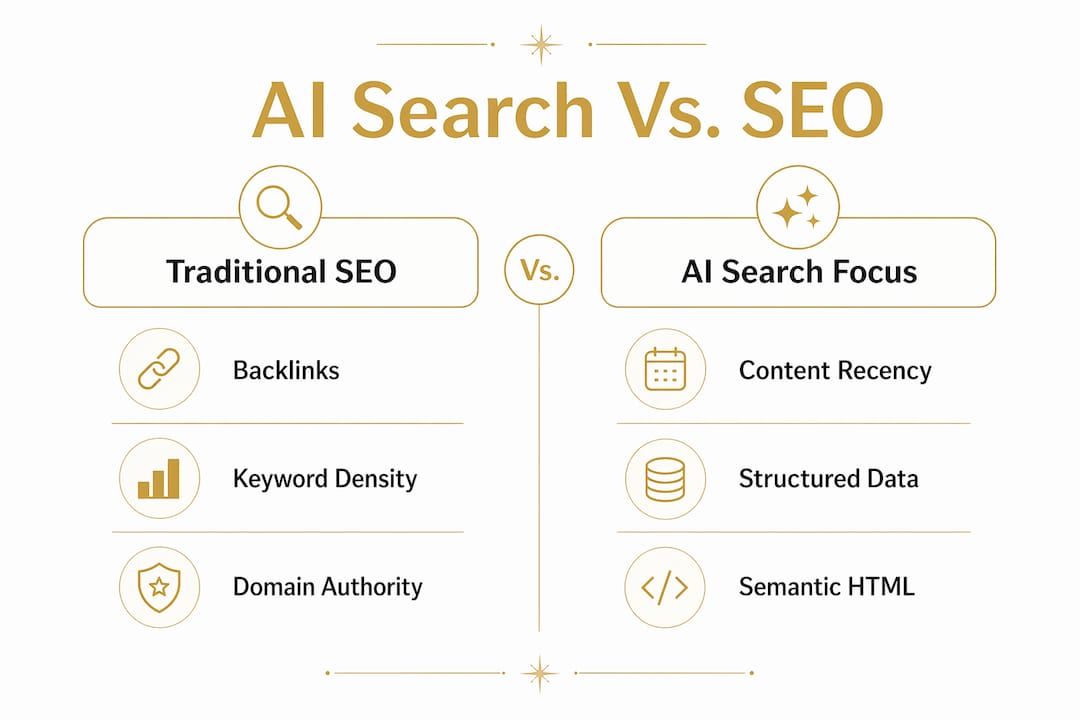
Traditional SEO rewarded pages that earned high rankings through backlinks, keyword density, and domain authority. AI search adds a new layer. The model must be able to extract a clear, usable answer from your page. If your content buries its key claim in paragraph seven, the model may skip it entirely.

AI search summaries are now triggered for 51.5% of real-user queries. That means more than half of all searches now surface a synthesised answer above the organic results. The implication is direct: the majority of users may never scroll to your link.
Content recency also carries more weight than it did under traditional SEO. Content updated within 90 days is 3.4 times more likely to be cited in AI-generated answers. That is a significant multiplier, and it forces a publishing cadence that many teams have not yet adopted.
Pro Tip: Treat your most important pages like living documents. Schedule quarterly reviews to update statistics, examples, and dates. Freshness is now a citation signal, not just a ranking signal.
Structured data and semantic HTML are no longer optional extras. AI search favours content that resembles a well-organised knowledge base, with schema.org markup and clean heading hierarchies that allow instant data extraction. Tools like Google Search Console and schema validators from Schema.org can help you audit your current markup.
How does AI search alter user behaviour?
The way people phrase searches has changed measurably. AI Mode queries are on average three times longer and more complex than traditional keyword searches. Users are offloading the synthesis work to the AI, which means they arrive with richer, more specific intent. A query that once read “best casino bonuses” now reads “which Canadian online casinos offer no-wagering bonuses for slots in 2026.”
This shift has four concrete effects on content discovery:
- Short, generic pages lose relevance. AI systems reward depth and specificity. A 300-word overview page cannot satisfy a complex, intent-heavy query.
- Personalisation deepens. AI tools like Perplexity and Google Gemini tailor answers based on prior queries and user context. Two people asking the same question may receive different source citations.
- Browsing behaviour declines. Users receive a complete answer without clicking through. Page views drop, but citation prominence rises.
- Content must be structured for extraction. Due to AI synthesising answers directly, user visits to source pages fall. Content should be built for AI extraction, not only for human reading.
The economic consequence is real. Brands cited in AI summaries see a 35% higher organic click-through rate and a 91% higher paid CTR compared to brands appearing only in traditional organic links. Being cited is now worth more than ranking fifth.
How should content creators adapt to ai-driven discovery?
Adapting to AI in content discovery does not require abandoning SEO. There is no separate pathway for AI optimisation. Content must still rank traditionally to be cited by AI search modes like Google Gemini. Think of AI optimisation as advanced SEO with sharper emphases.
Here is where the emphasis shifts:
Query mapping over keyword volume. Effective AI content strategies focus on mapping natural-language queries rather than chasing keyword volume. Build content around the full question a user would ask, not just the two-word phrase they used to type.
Positional placement matters. AI models exhibit strong positional bias, favouring content placed at the beginning or end of documents. Put your core claim and key facts in the first two paragraphs. Do not save the punchline for a conclusion.
Schema markup is a citation signal. Implementing schema.org markup for articles, FAQs, and how-to content tells AI systems exactly what your page contains. Platforms like Contensis and WordPress both support schema plugins that automate much of this work. Myluckyuniverse covers this in detail in its guide to schema markup for iGaming.
Freshness is non-negotiable. With content updated within 90 days being 3.4 times more likely to earn a citation, a static content library is a liability. Build update cycles into your editorial calendar.
Pro Tip: Write your H2 headings as literal user questions. AI systems are trained on natural language. A heading like “What is the best no-deposit bonus in Canada?” is far more likely to be extracted as a direct answer than “No-Deposit Bonus Overview.”
| Strategy | Traditional SEO Focus | AI Search Focus |
|---|---|---|
| Keyword targeting | Exact-match keyword density | Natural-language query mapping |
| Content structure | Keyword-rich headings | Semantic HTML with schema markup |
| Freshness | Annual or ad hoc updates | Quarterly or more frequent updates |
| Placement of key claims | Anywhere in the document | First and last sections of the page |
| Success metric | Organic ranking position | Citation frequency in AI summaries |
Traditional discovery vs. ai-assisted discovery: what changes?
The contrast between the two models is sharper than most marketers realise.
| Factor | Traditional Search | AI-Assisted Discovery |
|---|---|---|
| User interaction | Browses a list of links | Receives a synthesised answer |
| Traffic model | Click-through to source page | Citation within AI response |
| Ranking signals | Backlinks, keyword match, authority | Semantic clarity, recency, structured data |
| Brand visibility | Tied to ranking position | Tied to citation prominence |
| Content format | Optimised for human reading | Optimised for machine extraction |
| Paid search impact | Independent of organic | 91% higher CTR when organically cited |
The economic shift is the most disruptive element. AI-driven discovery reduces referral traffic but increases the importance of citation prominence within third-party AI systems. Publishers who built their revenue model on page views are now operating in a fundamentally different environment.
The benefits of AI search for users are clear: faster answers, less browsing fatigue, and more personalised results. For content creators, the benefit is access to a new form of visibility that does not depend on a user clicking a link. A citation in a Perplexity or Gemini answer reaches the user at the exact moment of intent. That is a powerful position to hold.
The risk is equally clear. Content that is not structured for extraction, not updated regularly, and not semantically precise will simply be invisible. The middle ground of “decent content that ranks okay” is disappearing. AI systems cite the best-structured, most authoritative, most current source available.
Key takeaways
AI search fundamentally shifts content discovery from link-based ranking to direct answer synthesis, making structured, fresh, and semantically precise content the primary driver of visibility.
| Point | Details |
|---|---|
| AI summaries dominate queries | Over half of all searches now trigger AI-generated answers above organic results. |
| Freshness multiplies citation odds | Content updated within 90 days is 3.4x more likely to be cited by AI search tools. |
| Positional placement drives extraction | Place your core claim in the first two paragraphs to align with AI positional bias. |
| Citation beats ranking for CTR | Brands cited in AI summaries see 35% higher organic CTR than those in traditional links only. |
| SEO and AI optimisation are the same | Content must rank traditionally first; AI citation follows from strong SEO fundamentals. |
The part most marketers are getting wrong
I have spent years watching the iGaming content space react to algorithm changes with panic and gimmicks. The response to AI search is following the same pattern. Teams are rushing to produce “AI-optimised” content as if it were a separate discipline, complete with new templates and prompt-engineering tricks that have no grounding in how retrieval systems actually work.
The uncomfortable truth is that AI search rewards the same things good editorial has always rewarded: clarity, authority, accuracy, and structure. What has changed is the precision required. A vague paragraph that a human reader might charitably interpret will not be extracted by a language model. The model needs a clean subject-verb-object claim it can lift and use.
What I have found actually works is treating every page like a knowledge base entry. Lead with the answer. Use descriptive headings that mirror real questions. Update the page when the facts change. Add schema markup so the machine knows what it is reading. None of this is exotic. All of it requires discipline.
The bigger strategic risk I see is over-reliance on AI citation as a traffic channel. Citation prominence is valuable, but it does not build an owned audience. The smartest content operations I have observed are using AI search visibility to earn first-party data: email subscribers, registered users, direct return visits. They treat AI platforms as a top-of-funnel discovery layer, not a destination. That balance is where the real long-term value sits.
For anyone building in the iGaming space specifically, the stakes are higher. Regulatory scrutiny, affiliate compliance, and brand trust all depend on content that is accurate and source-transparent. AI search amplifies the best content and buries the rest. That is actually good news if you are willing to do the work.
— Lucky
Explore more AI search insights at Myluckyuniverse
Myluckyuniverse publishes editorial-grade research and practical guides at the intersection of AI search and iGaming content strategy. If this article raised questions about how to structure your own content for AI-driven discovery, the Myluckyuniverse insights blog covers everything from schema markup implementation to answer engine optimisation for betting and casino content.
The platform’s guide on AI content credibility scoring is particularly useful for teams building content that needs to earn trust from both AI systems and real users. For a broader view of how the iGaming content model is evolving, the iGaming content strategy guide for 2026 lays out the full picture. Visit Myluckyuniverse to explore the complete resource library.
FAQ
What is AI search and how does it differ from traditional search?
AI search uses retrieval-augmented generation to synthesise direct answers from indexed content, rather than returning a ranked list of links. Traditional search engines like Google’s classic interface rank pages; AI search tools like Gemini and Perplexity read and summarise them.
Why do AI search engines favour recently updated content?
Content updated within 90 days is 3.4 times more likely to be cited in AI-generated answers. AI systems prioritise recency because fresh content is more likely to reflect current facts, which protects the accuracy of synthesised answers.
Does AI optimisation replace traditional SEO?
No. There is no separate pathway for AI optimisation. Content must rank through traditional SEO mechanisms before AI search modes like Google Gemini will cite it. AI optimisation is advanced SEO with a stronger emphasis on semantic clarity and structured data.
How does AI search affect click-through rates for brands?
Brands cited in AI search summaries see a 35% higher organic click-through rate and a 91% higher paid CTR compared to brands appearing only in traditional organic results. Citation prominence is now a stronger performance signal than ranking position alone.
What content format works best for ai-assisted discovery?
Content structured like a knowledge base, with semantic HTML, schema.org markup, question-based headings, and key claims placed at the start of the document, performs best. AI models favour content positioned at the beginning or end of a document due to positional bias in retrieval systems.