Insights
Build an iGaming audience research framework

An iGaming audience research framework is the structured process of gathering, analysing, and segmenting player data to optimise engagement and retention in online gambling. Most operators still rely on static demographics, which is precisely why their acquisition costs stay high and churn stays stubborn. The professionals who build igaming audience research frameworks grounded in behavioural signals, RFM(D) analysis, and AI-driven targeting are the ones reducing cost per acquisition and extending player lifetime value. This guide gives you the exact process to do the same.
What are the prerequisites for an iGaming research framework?
Before you collect a single data point, you need three things locked in: clear objectives, the right data types, and tools that can act on what you find. Skipping this step is the single most common reason audience research produces reports that nobody uses.
Define your objectives first. A professional iGaming audience research study requires 7–10 days for data collection, analysis, and reporting when goals and budget are defined beforehand. That timeline collapses into chaos without a precise brief. Know whether you are solving for acquisition, retention, or reactivation before you touch any tool.

Identify the data types you need. The three non-negotiable categories are player behavioural data (session length, game preference, deposit frequency), igaming player demographics (age, geography, device), and engagement metrics (open rates, bonus redemption, churn signals). Behavioural data carries the most predictive weight of the three.
Choose tools that match your scale. The table below compares the most common options:
| Tool / Source | Strength | Limitation |
|---|---|---|
| CRM segmentation engines | Real-time behavioural segments | Requires clean data input |
| AI signal-based targeting platforms | High-intent player reach at scale | Higher cost per campaign |
| Survey panels / player panels | Direct motivation data | Slower to recruit representative samples |
| First-party analytics (GA4, Mixpanel) | Free, granular on-site behaviour | No cross-platform view |
| Brand benchmarking tools (Blask) | Leading indicators of brand health | Category-level, not player-level |
Key data sources to gather before launching research:
- First-party CRM data with at least 90 days of player history
- Behavioural event logs from your platform or app
- Survey responses from a minimum viable player panel
- Paid media performance data segmented by creative and audience
How do you build the framework step by step?
The process has five distinct phases. Each one feeds the next, so sequence matters.
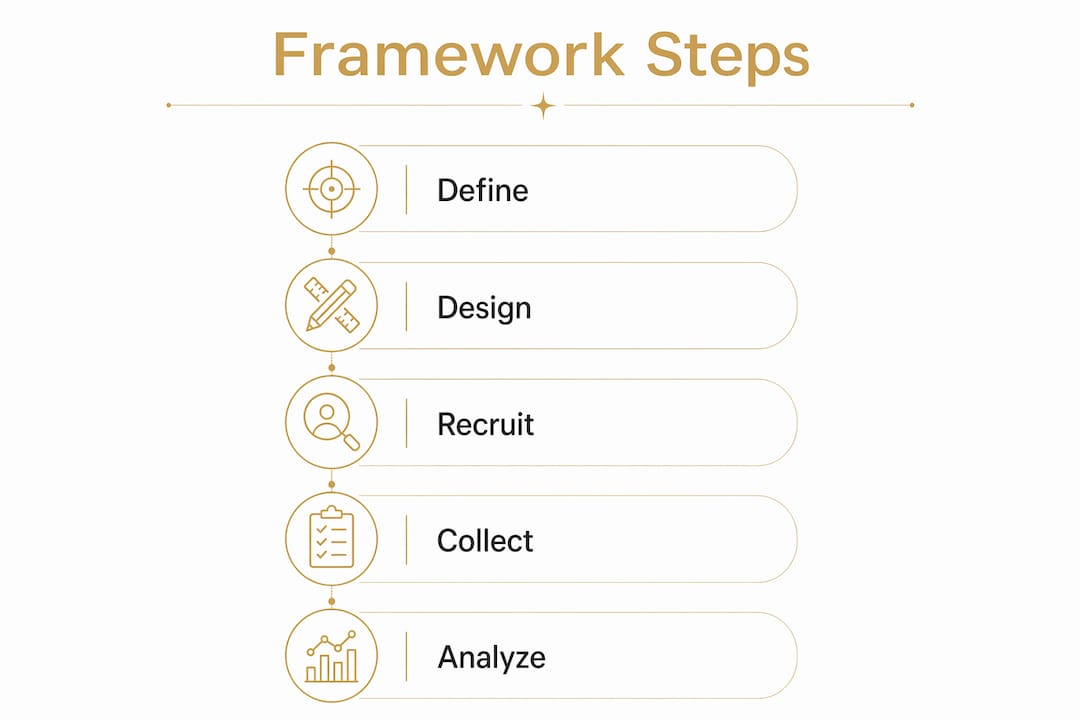
Step 1: Define objectives and audience requirements. Write one sentence that states what decision this research will inform. “We need to know which player segments are most likely to reactivate within 30 days” is a usable objective. “Understand our players better” is not.
Step 2: Design your data collection instruments. For survey-based research, write questionnaires that probe psychological motivations, not just preferences. Failing to map psychological drivers like escapism or competition leads to costly acquisition strategies and early churn. Ask why players choose a game type, not just which game they play.
Step 3: Recruit your sample. Player panels recruited through paid campaigns on Meta or Google tend to skew toward casual players. Balance this by pulling a stratified sample from your CRM that includes high-value, mid-tier, and lapsed segments. Aim for at least 200 completed responses per segment for statistically reliable results.
Step 4: Collect and monitor data in real time. Use platforms like Mixpanel or Amplitude to track behavioural events as they happen. Do not wait until the study closes to check data quality. Flag incomplete responses and anomalous session data within the first 48 hours so you can course-correct before the collection window ends.
Step 5: Analyse, segment, and report. Focus your output on decisions, not descriptions. Every finding should answer “so what?” before it appears in a report. Map segments to specific campaign actions so the marketing team can act the day the report lands.
Pro Tip: Align your research scope to your campaign calendar. If a major promotion launches in three weeks, scope the study to deliver actionable segments in 10 days or fewer. Research that arrives after the campaign is live has zero commercial value.
How do behavioural signals improve iGaming audience targeting?
Static demographics tell you who your player is. Behavioural signals tell you what they are about to do. That distinction is worth 20–40 points of acquisition efficiency.
Audience Stacking and signal-based targeting can reduce customer acquisition cost by 20–40% while increasing player lifetime value. Audience Stacking works by combining multiple enriched seed lists into a single lookalike source, giving AI platforms a richer signal to match against. The result is a lookalike audience that behaves more like your best players, not just players who look like them on paper.
RFM(D) analysis adds a fourth dimension to the classic Recency, Frequency, Monetary model by incorporating Deposit behaviour. This lets you separate a player who deposits often in small amounts from one who deposits rarely but in large amounts. Both have high monetary value, but they need completely different retention messages.
Micro-segmentation takes this further by building segments around specific behavioural triggers. Segmentation engines must allow quick creation of complex segments like “slots players inactive for 14 days” without requiring developer support. If your CRM needs a ticket to build that segment, your retention team is already too slow.
Behavioural signals that matter most for igaming audience analytics:
- Session length and frequency over the past 7, 14, and 30 days
- Game category preference and switching patterns
- Deposit recency and average transaction size
- Bonus redemption rate and wagering completion
- Device type and time-of-day activity patterns
- Response to previous CRM messages by channel
Re-engaging inactive players within a 3–10 day window produces 2–4x higher response rates than generic campaigns. That window closes fast. Real-time behavioural triggers, not weekly batch exports, are what make the difference between a reactivation campaign that works and one that arrives too late.
Pro Tip: Validate your segments every 30 days. Player behaviour shifts with game releases, seasonal events, and regulatory changes. A segment that was accurate in January may be misleading by March.
What are the common pitfalls in implementing this framework?
Even well-designed frameworks fail at the implementation stage. The problems are predictable, which means they are preventable.
Stale data is the most expensive mistake. Static demographic data is insufficient; behavioural signals must be real-time and actionable. Operators who run monthly data refreshes are making retention decisions based on player behaviour from weeks ago. Refresh behavioural segments at least daily for active players.
Unrepresentative samples distort everything downstream. Recruiting players only from your most engaged cohort produces research that reflects your best-case scenario, not your actual player base. Include lapsed and low-activity players in every study that informs retention strategy.
Analysis delays kill campaign relevance. A 10-day research cycle only works if analysis starts on day one, not day eight. Assign a dedicated analyst to monitor incoming data and begin preliminary segmentation before the collection window closes.
Disconnected tools create reporting gaps. Lifecycle marketing automation triggered by real player behaviour outperforms calendar-based campaigns. If your CRM cannot receive segments from your research tool via API, you are manually re-entering data and introducing lag. That lag costs you reactivation windows.
Troubleshooting checklist for common framework failures:
- Audit data freshness: confirm behavioural data refreshes daily, not weekly
- Test segment accuracy monthly against actual campaign response rates
- Cross-reference survey findings with CRM behavioural data to spot contradictions
- Document every assumption made during segmentation so future teams can challenge them
- Build a feedback loop from campaign results back into segment definitions
Signal-based AI targeting is the standard in 2026’s privacy-centric environment, replacing manual filters for reaching high-intent players. Operators still relying on broad demographic targeting are not just leaving money on the table. They are funding their competitors’ acquisition budgets.
One underused diagnostic tool is Brand Accumulated Power (BAP). BAP loss leads search demand to decline before revenue drops, making it a leading indicator for identifying product or awareness problems early. Integrating BAP tracking into your research framework gives you a warning signal before churn shows up in your revenue line.
Key takeaways
A well-executed iGaming audience research framework built on behavioural signals, RFM(D) analysis, and real-time segmentation is the most direct path to lower acquisition costs and higher player lifetime value.
| Point | Details |
|---|---|
| Define objectives before collecting data | A precise research brief is required before any tool or panel is engaged. |
| Use behavioural signals over demographics | Session length, deposit recency, and game preference predict behaviour far better than age or location. |
| Apply Audience Stacking for acquisition | Combining enriched seed lists reduces CPA by 20–40% when fed to AI targeting platforms. |
| Refresh segments at least daily | Stale behavioural data produces misdirected campaigns and missed reactivation windows. |
| Re-engage inactive players within 3–10 days | Acting within this window produces 2–4x higher response rates than generic outreach. |
Why demographics alone will cost you in 2026
I have watched operators spend six figures on audience research that told them their players were “males aged 25–44 who enjoy slots.” That finding is true for roughly 60% of the iGaming market. It tells you nothing you could not have guessed, and it certainly does not tell you why those players leave after their third deposit.
The shift I find most significant right now is the move toward psychological motivation mapping. Knowing that a segment of your players is driven by escapism rather than competition changes everything: the creative, the game recommendation, the bonus structure, and the timing of your outreach. You cannot get that from a demographic report. You get it from combining qualitative survey data with behavioural event logs, then letting an AI engine find the patterns you would never spot manually.
The operators I respect most treat their CRM segmentation strategies as living systems, not quarterly projects. They are refreshing segments, testing assumptions, and feeding results back into the next campaign cycle continuously. That discipline is what separates operators with 18-month player lifetimes from those watching their cohorts churn out in 60 days.
My honest recommendation: start with the 3–10 day reactivation window. It is the fastest proof of concept for behavioural segmentation, the results are measurable within a single campaign cycle, and it builds internal confidence in the framework before you ask for budget to go deeper.
— Lucky
How Myluckyuniverse supports your audience research
Myluckyuniverse has spent over 20 years at the intersection of iGaming media and data-driven content. The platform’s editorial team understands what operators and marketers actually need when they are building player research strategies, not just what sounds good in a whitepaper.
Whether you are starting from scratch or refining an existing approach to igaming audience segmentation, Myluckyuniverse provides structured, source-transparent content that maps directly to real decisions. The casinoexpert.ai platform surfaces insights optimised for AI-powered discovery, so your research is always grounded in current, credible information. Visit Myluckyuniverse to explore resources built specifically for iGaming professionals who need answers, not just articles.
FAQ
What is an iGaming audience research framework?
An iGaming audience research framework is a structured process for collecting, analysing, and segmenting player data to inform acquisition, retention, and reactivation strategies. It combines behavioural analytics, demographic data, and psychological motivation mapping into a repeatable research system.
How long does iGaming audience research take?
A professional study requires 7–10 days from data collection through to reporting, provided objectives and budget are defined before the study begins. Poorly scoped research routinely takes three to four weeks and delivers less usable output.
What is rfm(d) analysis in iGaming?
RFM(D) analysis segments players by Recency, Frequency, Monetary value, and Deposit behaviour. The Deposit dimension separates players by transaction patterns, enabling more precise retention and bonus targeting than standard RFM models.
How does audience stacking reduce acquisition costs?
Audience Stacking combines multiple enriched seed audiences into a single lookalike source, giving AI platforms a more precise signal to match against. This approach reduces CPA by 20–40% compared to broad demographic targeting.
Why is real-time segmentation critical for iGaming retention?
Player behaviour shifts within days of a trigger event such as a losing streak or a new game release. Segmentation engines that refresh daily allow CRM teams to act within the 3–10 day reactivation window that produces the highest response rates.