Insights
Why first-party data matters in media: 2026 guide

First-party data is information collected directly from your own audience through owned channels, and it is the most reliable foundation for media targeting, campaign measurement, and privacy compliance available today. As third-party cookies disappear and AI-driven ad platforms grow more sophisticated, understanding why first-party data matters in media has shifted from a competitive advantage to an operational requirement. Platforms like StackAdapt, industry bodies like IAB, and data infrastructure leaders like Databricks all point to the same conclusion: media companies that own and activate their audience data outperform those that rent it.
What are the key benefits of first-party data in media campaigns?
First-party data delivers measurable performance gains that third-party data simply cannot match. Improved targeting accuracy is cited as the primary benefit by 43% of B2C marketers. That figure reflects a fundamental shift in how media professionals think about audience quality over audience volume.
The first-party data benefits extend well beyond targeting. Here is where the gains show up most clearly in campaign performance:
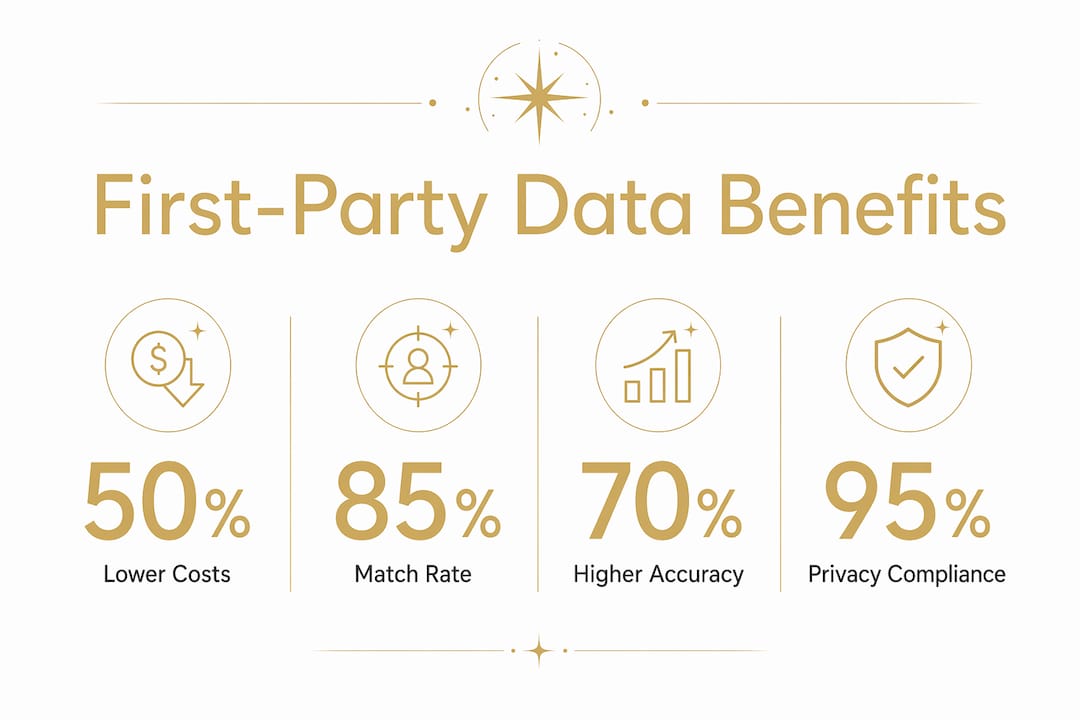
- Lower acquisition costs. Leveraging first-party data can reduce customer acquisition costs by up to 50% compared to relying on third-party data. That saving comes from reaching people who have already signalled intent through direct interaction with your brand.
- Stronger attribution. When your data originates from your own CRM, website, or app, you can trace the full customer path. Attribution becomes a factual record rather than a probabilistic estimate.
- Privacy compliance by design. First-party data is collected with explicit consent. That makes it compliant with PIPEDA in Canada, GDPR in Europe, and CCPA in California without requiring retroactive fixes.
- Personalisation at scale. Tactics like dynamic creative optimisation and behavioural retargeting depend on knowing what a user actually did, not what a modelled lookalike might do.
Pro Tip: Build suppression lists from your CRM data before launching any paid campaign. Excluding already-converted users from acquisition targeting is one of the fastest ways to improve return on ad spend without changing your creative or bidding strategy.
The importance of first-party data becomes clearest when you compare campaign results. A media team running retargeting against a validated first-party segment consistently outperforms one running against a third-party audience segment on both click-through rate and conversion rate. The data is simply cleaner.

How does first-party data improve media buying and sales?
Media sales have fundamentally changed. The conversation has moved from inventory volume to audience quality, and sales teams with granular audience insights win more RFPs than those leading with reach numbers alone. Buyers now expect validated attribution and data fluency as a baseline, not a differentiator.
The shift plays out in four concrete ways for media buying and sales teams:
- RFP competitiveness. Advertisers evaluate media partners on the depth of their audience data. A publisher who can demonstrate verified behavioural segments wins the brief over one offering only demographic estimates.
- Advertiser retention. When a media company can show a brand exactly which audience segments drove conversions, that relationship deepens. Retention follows proof.
- AI platform performance. AI-powered platforms favour publisher-owned first-party data, improving revenue potential for media companies with richer owned data ecosystems. The algorithm rewards signal quality.
- Retail media growth. Retail media spend in the US is projected to reach $69.33 billion in 2026, driven almost entirely by platforms using authenticated first-party audiences. That number shows where advertiser budgets are flowing.
“Buyers expect validated attribution and data fluency rather than just inventory volume.” — Databricks Blog
The agentic advertising era accelerates this dynamic further. AI systems allocating ad spend in real time require deterministic, high-integrity signals. A media company feeding those systems with permissioned first-party data gets better placements and better pricing. One feeding them with modelled or aggregated third-party signals gets deprioritised. Understanding how media buying works in this environment is now inseparable from understanding your data infrastructure.
What technical challenges do media companies face with first-party data?
Collecting first-party data is straightforward. Activating it effectively is not. The most common barrier is fragmentation.
| Challenge | Impact | Solution |
|---|---|---|
| Fragmented tech stacks | Low match rates across platforms, reducing monetisation value | Unify data in a Customer Data Platform (CDP) |
| Inconsistent data formats | Segments break when pushed to activation platforms | Standardise identifiers before ingestion |
| Privacy governance gaps | Risk of non-compliance and buyer distrust | Implement consent management and data lineage tracking |
| No suppression strategy | Wasted spend on converted users, lower ROAS | Build CRM-based suppression lists for all paid channels |
| Value exchange failure | Trust deficit and audience churn | Deliver clear personalisation in return for data collection |
Fragmented tech stacks cause low match rates, reducing the value of first-party data monetisation across the board. That problem is not a data quality issue. It is an architecture issue, and it requires a CDP to resolve.
The suppression gap is particularly underestimated. First-party CRM data enables effective audience suppression, which reduces wasted ad spend and improves return on ad spend. Most media teams focus on acquisition targeting and ignore the efficiency gains available from simply not advertising to people who already converted.
Pro Tip: Before integrating your first-party data with any demand-side platform or programmatic stack, run a data hygiene audit. Deduplicate records, standardise email formats, and validate phone numbers. Clean data at the source prevents match rate failures downstream.
The trust dimension matters as much as the technical one. Failing to deliver value in exchange for audience data leads to a trust deficit and customer churn. Collecting data without giving users a tangible benefit, whether that is personalised content, relevant offers, or a better experience, erodes the very audience relationship that makes first-party data valuable.
How can media professionals implement first-party data strategies?
Effective first-party data usage follows a clear sequence. Skipping steps is the most common reason implementations fail.
- Audit and unify. Map every data source your organisation owns: CRM records, website behaviour, app events, email engagement, subscription data. Pull them into a single CDP before attempting any activation.
- Standardise identifiers. Choose a primary identifier, typically a hashed email or a first-party cookie, and map all other data to it. This is what enables cross-channel matching.
- Build suppression lists first. Before launching any paid campaign, export your converted customer list and suppress it across all paid channels. This single step often improves ROAS by double digits.
- Activate across channels. Push validated segments to programmatic platforms, connected TV, email, and paid social simultaneously. Cross-channel activation multiplies the value of each segment.
- Close the loop with measurement. Feed conversion data back into your CDP after each campaign. This creates a feedback loop that improves segmentation accuracy over time.
The table below shows how first-party data activation compares to third-party data across key performance dimensions:
| Dimension | First-Party Data | Third-Party Data |
|---|---|---|
| Targeting accuracy | High (direct behavioural signal) | Moderate (modelled or aggregated) |
| Privacy compliance | Built-in (consent-based collection) | Requires ongoing verification |
| Match rates | High when unified in a CDP | Variable, often below 40% |
| Attribution quality | Deterministic | Probabilistic |
| Cost over time | Decreasing (owned asset) | Increasing (licensed or purchased) |
AI-native activation stacks like those used by publishers on StackAdapt or similar demand-side platforms perform significantly better when fed clean, unified first-party segments. Predictive segmentation, automated bidding, and lookalike modelling all depend on the quality of the seed data. For iGaming media specifically, audience segmentation using first-party data produces measurably better campaign outcomes than any third-party alternative.
What does first-party measurement actually change? A worked example
Everything above is about collecting and activating first-party data. The harder problem is trusting it, and the failure mode is not the one most media teams plan for. It is rarely missing data. It is querying the wrong table and getting a confident, precise, wrong answer out of a system you own.
In August 2026 we measured the lifetime value of our own referred-player book: 2,932 players tracked from each player’s first-play date across report-years 2020 to 2026. We measured it three times, from three sources that all sat inside our own infrastructure, and got three irreconcilable answers.
| Measurement source | Value per acquired player | Verdict |
|---|---|---|
| Platform-reported conversions inside a 54-day attribution window | About one-eighth of the correct year-0 figure | Wrong — window truncation. The window closes long before most value accrues, so it prices a multi-year asset on its first two months. |
| A live “active players” mirror table | About 17x the correct six-year figure | Wrong — survivorship. The mirror held only currently-active players: 251 rows, 8.6% of the 2,932 actually acquired. Every churned player silently left the denominator. |
| The full acquisition ledger, keyed on first-play date | Indexed 1.00 at year 0, rising to 4.58 by year 6 and still accruing | Correct. Every acquired record stays in the denominator whether or not it is still active, and value is attributed to the cohort that produced it. |
The two flawed readings differ from each other by more than 600x. Both came out of first-party systems. Neither involved a third-party cookie, a data broker, or a modelled lookalike. The entire error was source selection and keying.
That is the part vendor material tends to skip, and it turns the CDP argument earlier in this article from an efficiency point into a correctness point. Unification is not primarily about match rates; it is about having one defensible denominator. Two controls catch both failures for the cost of a single query each:
- Reconcile row counts against the system of record before trusting any aggregate. A table with 251 rows cannot describe a book of 2,932 acquisitions, and that discrepancy is visible immediately. Treat any table whose population is defined by current state — active users, live subscribers, open sessions — as a survivorship trap the moment it is read as history.
- Key cohorts on acquisition date, not activity date. Activity-date keying moves a record between reporting periods every time the customer returns, which makes retention look like acquisition and hides the accrual curve completely.
For media buying specifically, the window-truncation finding is the expensive one. If the platform-reported view sees roughly a fifth of eventual value inside the acquisition year and under half by the end of year one, then every channel judged on in-window return on ad spend is being judged at a fraction of its real return — and the channels that look worst are frequently just the ones with the slowest-maturing cohorts. The fix is not a cleverer attribution model. It is maintaining the first-party ledger independently of the platform’s view, using the platform’s numbers to rank channels against each other and the ledger to set the budget that ranking then allocates.
Two caveats bound how far this transfers. It is one commission-side book in one vertical, so the absolute multiples will not carry across to other markets or product mixes. And the six-year curve was still rising when we measured it, which makes even the correct figure a floor rather than a ceiling. The transferable findings are the two failure modes and the two controls, not the numbers.
Key takeaways
First-party data is the single most reliable asset a media company can build, and organisations that unify, govern, and activate it effectively will outperform those that rely on third-party signals in every measurable dimension.
| Point | Details |
|---|---|
| Cost efficiency | First-party data can lower customer acquisition costs by up to 50% versus third-party reliance. |
| Sales competitiveness | Media teams with validated audience insights win more RFPs and retain advertisers longer. |
| Technical foundation | Unifying data in a CDP before activation is non-negotiable for achieving high match rates. |
| Suppression strategy | Excluding converted users from paid campaigns is one of the fastest ROAS improvements available. |
| Value exchange | Audiences must receive clear personalisation benefits in return for sharing their data, or trust erodes. |
| Trust your denominator | First-party systems produce wrong answers too. Survivorship and attribution-window truncation read more than 600x apart on the same 2,932-player book — reconcile row counts and key cohorts on acquisition date. |
First-party data is the ledger AI advertising runs on
I have watched media companies treat first-party data as a compliance checkbox for years. That framing is wrong, and it is expensive. First-party data is not a legal obligation you satisfy once. It is an auditable ledger for AI allocation engines that determines where programmatic budgets flow in real time.
The media companies winning in 2026 are not the ones with the largest data sets. They are the ones with the cleanest, best-governed, most consistently activated data sets. I have seen publishers with modest audience sizes outperform larger competitors in programmatic auctions purely because their first-party signals were deterministic and their consent records were clean.
The adoption curve is accelerating. 71% of brands, agencies, and publishers are growing or planning to grow their first-party data sets. That means the gap between data-rich and data-poor media companies is widening every quarter. Waiting for a better moment to invest in your data infrastructure is a strategy for falling behind.
My strongest advice: stop treating data collection as the goal. Collection is just the beginning. The value lives in activation, suppression, measurement, and the feedback loops that make each campaign smarter than the last. Build the governance layer first, then the activation layer. The revenue follows the infrastructure, not the other way around.
— Lucky
How we apply this at Lucky Universe
Myluckyuniverse operates at the intersection of AI-native media and iGaming, which means first-party data is not a theoretical concept here. It is the operational foundation of every campaign, every audience segment, and every content decision the platform makes.

The worked example above is not an illustration; it is how our own measurement stack is built and audited. Related material covers how AI personalises experiences from owned data signals, and how casino CRM segmentation should be structured once you accept that value is a percentile problem rather than an average one.
Recommended
Frequently asked
Quick answers.
- What is first-party data in media?
- First-party data is information collected directly from your own audience through owned channels such as websites, apps, CRM systems, and email lists. It is consent-based, accurate, and does not depend on third-party intermediaries.
- Why is first-party data better than third-party data?
- First-party data delivers higher targeting accuracy, built-in privacy compliance, and deterministic attribution compared to third-party data. It also costs less over time because it is an owned asset rather than a licensed one.
- How does first-party data impact media buying?
- Media buyers using first-party audience segments win more RFPs, achieve better match rates on programmatic platforms, and produce stronger attribution reports. AI-driven ad platforms also prioritise publishers with high-integrity first-party signals.
- What are the biggest challenges of first-party data?
- Fragmented tech stacks and low match rates are the most common barriers. Unifying data in a Customer Data Platform before activation resolves most technical issues, while a clear value exchange strategy addresses audience trust and consent challenges.
- How do I start building a first-party data strategy?
- Audit all owned data sources, unify them in a CDP, standardise your primary identifier, and build suppression lists before launching any paid campaigns. Activate across programmatic, connected TV, and email channels simultaneously for maximum segment value.
- Can first-party data still give you the wrong answer?
- Yes, and usually for one of two reasons. Survivorship: querying a table whose population is defined by current state — active users, live subscribers — drops churned records from the denominator and inflates per-user value. Window truncation: reading platform-reported conversions inside a fixed attribution window prices a multi-year asset on its first few weeks. Measured three ways on our own 2,932-player book in August 2026, those two errors produced readings more than 600x apart from each other, both from internal systems. The controls are cheap: reconcile row counts against the system of record, and key cohorts on acquisition date rather than activity date.
- How long does it take for acquired-customer value to fully materialise?
- Longer than most attribution windows allow for. In a six-year cohort measurement of 2,932 acquired players, only about 22% of eventual six-year value was visible by the end of the acquisition year and about 45% by the end of year one, with the curve still rising in year six. Any channel judged purely on in-window return on ad spend is therefore being judged on a fraction of its actual return.