Insights
How media buying works in gambling: 2026 guide

Media buying in gambling is the deliberate acquisition of advertising space using models such as cost per acquisition (CPA) and revenue share (RevShare) to recruit players within a tightly regulated environment. Known formally as paid media procurement, this practice sits at the intersection of performance marketing, compliance law, and audience science. The global iGaming market exceeds $101 billion in annual revenue, which means the competition for player attention is fierce and the cost of a poorly structured campaign is significant. Understanding how media buying works in gambling gives marketing professionals the framework to spend efficiently, stay compliant, and outperform rivals who rely on guesswork.
What are the main media buying models and channels used in gambling advertising?
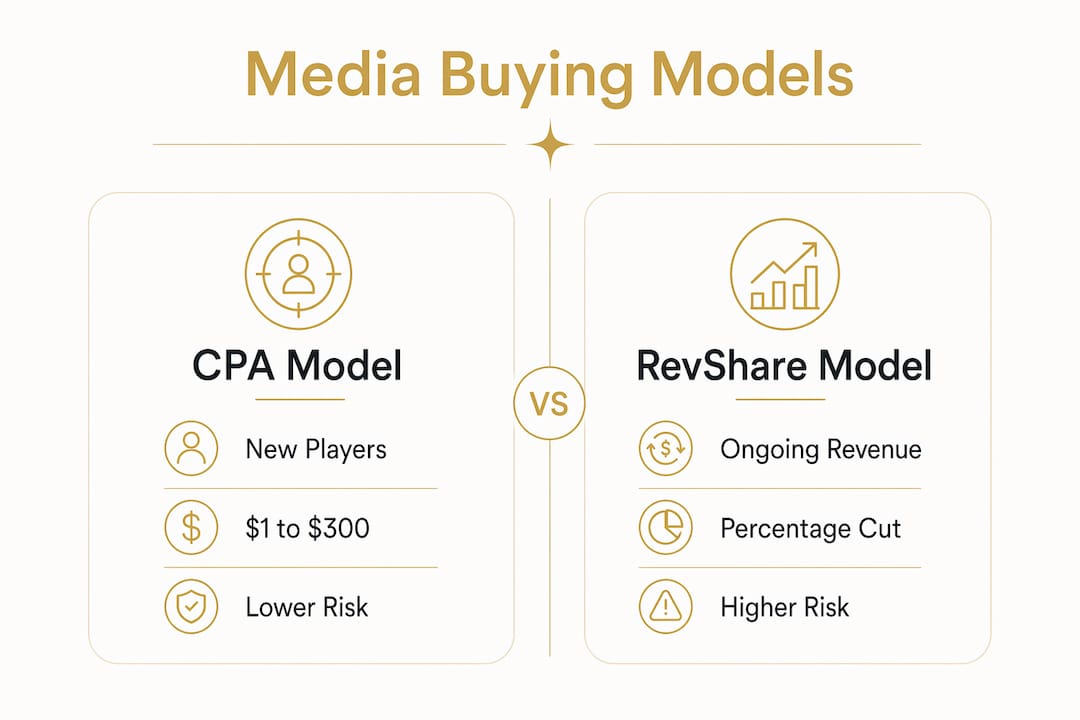
CPA and RevShare are the two foundational acquisition models that define how gambling advertisers purchase media and compensate traffic sources. CPA payouts range from $1 to $300 per first deposit, depending on the market, the operator’s brand strength, and the player’s projected lifetime value. RevShare sits around 40 to 50%, meaning the traffic source earns a percentage of net gaming revenue generated by referred players for the life of those accounts. A hybrid model combines both: a lower upfront CPA with a reduced ongoing RevShare, which balances immediate cash flow for affiliates against long-term upside for operators.
The channel mix in gambling media buying is broader than most verticals. Each channel carries distinct cost structures, compliance requirements, and audience profiles.
- Programmatic display: Automated real-time bidding on ad exchanges, reaching players across news sites, sports portals, and entertainment platforms. Cost-efficient at scale but requires precise geo-targeting and brand-safety controls.
- Paid social (Meta/Facebook, Snapchat): High targeting granularity by interest, behaviour, and lookalike audiences. Requires pre-approval from the platform and adherence to strict creative guidelines.
- Affiliate networks: Performance-based partnerships where affiliates drive traffic in exchange for CPA or RevShare. Networks like Income Access and Affilka specialise in iGaming.
- Native advertising: Sponsored content placements on Taboola and Outbrain that blend with editorial feeds, effective for softer acquisition funnels.
- Push notifications: Direct-to-device messages with high open rates, used heavily for sports betting promotions around live events.
- App-install campaigns (Apple Search Ads, Google App Campaigns): Store-search and store-placement bidding priced per install. The highest-intent inventory in the vertical, because the query is typed inside the store itself, and the most heavily gated, because the platform selling the ad also approves the product being advertised.
| Model | Best for | Typical cost | Risk profile |
|---|---|---|---|
| CPA | New player acquisition | $1 to $300 per deposit | Low for operator, higher for affiliate |
| RevShare | Long-term player value | 40 to 50% of net revenue | Shared between operator and affiliate |
| Hybrid | Balanced campaigns | Negotiated per deal | Moderate for both parties |
| CPM (programmatic) | Brand awareness | $2 to $15 per thousand impressions | Higher for operator |
| CPI (app install) | Mobile app acquisition | Auction-set per install, paid before any deposit | Operator carries the full cost pre-conversion |
Understanding the iGaming partnership models behind each channel helps you negotiate better terms and allocate budget where it generates the strongest return.
The app-install channel and Apple’s 5.3.4 constraint
Most gambling media-buying guides stop at web channels, which leaves out where a large share of real-money acquisition now lands. App-install campaigns sell store placements priced per install rather than per deposit, which moves the risk entirely onto the buyer: you pay when the app lands on the device, and whether it becomes a funded account is your problem, not the platform’s.
What separates this channel from every other one is that the platform selling you the media is also the gatekeeper for the product. Apple’s App Store Review Guidelines state that apps offering real money gaming “must have necessary licensing and permissions in the locations where the app is used, must be geo-restricted to those locations, and must be free on the App Store” (guideline 5.3.4). Guideline 5.3.3 separately bars using in-app purchase to buy credit or currency for real money gaming of any kind.
Three operational consequences follow:
- Ad geo and app geo must match exactly. A campaign serving in a storefront your licence does not cover is worse than wasted spend. It is evidence that the app was available in a territory where it should have been geo-restricted.
- Monetisation sits outside the app. Because the app must be free and cannot sell gaming credit through in-app purchase, deposits run on your own rails. Your install-to-deposit measurement therefore crosses a boundary the store’s own attribution does not follow, and reconciling the two is a build, not a setting.
- Casino branding alone can land you in the 5.3.4 bucket. Review outcomes through 2026 have applied the real-money-gaming test to apps that accept no wagers at all but carry casino branding and link out to licensed operators. Treat review time as a scheduled input to any launch-dated media plan, not a formality after the creative is signed off.
How do regulatory and platform compliance requirements shape gambling media buying?
Compliance is not a secondary concern in gambling media buying. It is the primary constraint that determines which channels, creatives, and audiences are available to you. Regulatory frameworks vary significantly by jurisdiction, and platform rules add another layer on top of national law.
In the UK, the Advertising Standards Authority (ASA) enforces licence conditions that forbid ads suggesting gambling as a financial solution or appealing to minors. Operators must demonstrate that their media buying targets only eligible adults, which requires documented audience controls and creative review processes. The UK framework focuses explicitly on harm prevention rather than marketing best practice, which changes how media buyers must frame their briefs to creative teams.
Australian rules impose a different set of constraints. Time-of-day restrictions and mandatory disclaimers such as “Chances are you’re about to lose” must appear in all wagering creatives. Ads during live sports broadcasts face delayed placement requirements, which directly affects programmatic bidding strategies for sports betting operators targeting Australian audiences.
In Canada, provincial regulators like the Alcohol and Gaming Commission of Ontario (AGCO) set advertising standards that prohibit targeting minors and require responsible gambling messaging in all paid placements. Media buyers operating across multiple provinces must account for variation in rules between regulated markets like Ontario and grey-market provinces.
Platform-specific rules add further complexity:
- Meta/Facebook: Requires operators to apply for gambling advertising permission per ad account, restricted to approved jurisdictions, with age-gating set to 18 or 25 depending on the market.
- Google Ads: Gambling advertisers must hold a Google-certified gambling licence for each target country and comply with landing page requirements including responsible gambling links.
- Snapchat and TikTok: Both platforms restrict gambling ads significantly, with TikTok prohibiting most iGaming promotions outright in many markets.
Pro Tip: Set up a compliance calendar that tracks regulatory review dates for each jurisdiction you operate in. Platform policies update independently of national law, so a quarterly audit of both your ad account settings and your creative library prevents costly violations.
How does automation and data-driven optimisation enhance media buying for gambling?
Automation transforms gambling media buying from a manual, offer-by-offer process into a scalable system that updates creatives in real time. The core principle is treating your ad inventory the way an e-commerce retailer treats a product catalogue: dynamic, continuously refreshed, and event-driven.

The workflow on Meta platforms illustrates this clearly. Data feeds and Facebook Pixel event mappings allow operators to push live odds, bonus offers, and promotional content directly into ad creatives without rebuilding campaigns manually. Key funnel events tracked through the Pixel include Page View, Complete Registration, View Content, Add To Cart, and Purchase. Each event feeds the algorithm with signals that improve delivery to users most likely to convert, reducing wasted spend.
Here is a practical automation workflow for a sports betting operator running Meta campaigns:
- Connect your offer feed to a dynamic creative template using a tool like Hunch or Smartly.io. The feed pulls live odds and promotions from your platform API.
- Map Pixel events to each stage of the player journey: Page View on the landing page, Complete Registration after sign-up, and Purchase on first deposit.
- Set automated rules to pause ad sets when cost per registration exceeds your CPA target, and to scale budget on ad sets delivering below-target CPA.
- Schedule creative refreshes at least twice daily for live sports events, where odds and offers change by the hour.
- Review performance dashboards each morning using Meta Ads Manager alongside your internal CRM data to reconcile attributed conversions with actual depositing players.
Deploying 1,000 or more offers daily without manual processes is achievable through this approach, and it directly improves relevance scores, which reduces cost per click and improves delivery. Explore how AI integration in gambling content can further extend these automation capabilities across your broader marketing stack.
Pro Tip: Do not rely solely on Meta’s attributed conversion data. Cross-reference every campaign’s reported registrations and deposits against your CRM’s first-party records. Discrepancies above 15% usually signal pixel misfires or attribution window mismatches that inflate reported ROI.
What audience targeting challenges are unique to gambling media buying?
Audience targeting in gambling is more complex than in most other verticals because the platforms’ own delivery algorithms introduce biases that operators did not choose and may not notice. A University of Cambridge 2026 study found that gambling ads reached young men 2.3 times more than women on Meta platforms, even when no explicit gender targeting was applied. This skew occurs because the algorithm optimises for engagement, and young men historically engage more with gambling content, creating a self-reinforcing loop.
This finding has direct operational consequences. If your intended audience is broad adults aged 25 to 54, but delivery is concentrating on men aged 18 to 30, you are simultaneously missing your target and disproportionately reaching a high-risk demographic. Responsible media buyers build measurement guardrails to monitor actual audience reach rather than relying on intended targeting settings alone.
Practical strategies to address these challenges include:
- Audience delivery reporting: Pull demographic breakdowns from Meta Ads Manager weekly and compare actual age and gender distribution against your intended targets.
- Bid adjustments by demographic: Use bid multipliers to reduce delivery to over-represented groups and increase bids for under-served segments.
- Exclusion lists: Build custom audiences of existing customers, self-excluded players, and users who have engaged with responsible gambling content, then exclude them from acquisition campaigns.
- Third-party measurement: Tools like Nielsen Digital Ad Ratings or DoubleVerify provide independent verification of who actually saw your ads, separate from platform-reported data.
Platform delivery can skew ads toward vulnerable demographics unintentionally. Responsible media buyers build measurement guardrails to monitor real audience reach rather than just intended targeting.
The brand safety considerations in iGaming extend directly into media buying. Placement controls, content category exclusions, and audience verification are not optional refinements. They are the difference between a compliant campaign and a regulatory investigation.
Key takeaways
Effective gambling media buying requires the disciplined combination of performance models, compliance controls, automation workflows, and audience verification to generate sustainable player acquisition at scale.
| Point | Details |
|---|---|
| CPA and RevShare drive spend | Choose the model that matches your cash flow needs and player lifetime value projections. |
| Compliance is a primary constraint | Platform rules and national regulations define which channels, creatives, and audiences are available. |
| Automation scales offer delivery | Dynamic creative feeds and Pixel event tracking allow operators to run thousands of offers daily without manual rebuilds. |
| Delivery algorithms introduce bias | Monitor actual audience demographics weekly; platform delivery skews toward young men even without explicit targeting. |
| Geo-targeting errors carry high risk | Missing geo-restrictions or mandatory disclaimers can trigger account suspension across an entire ad account. |
| App-install media is gated by the store, not just the regulator | Apple guideline 5.3.4 requires licensing per territory, geo-restriction to those territories, and a free app before you can buy installs at all. |
What I have learned running gambling media campaigns
After two decades working at the intersection of iGaming and digital media, the single most underestimated risk I see is the gap between what operators intend to target and what the platform actually delivers. Most teams set their audience parameters, approve the creative, and assume the campaign runs as planned. It rarely does.
Geo-restriction errors and missing disclaimers are the most common compliance failures I encounter, and they are almost always avoidable with a pre-launch checklist. The operators who avoid account suspensions are not the ones with the best legal teams. They are the ones who treat compliance as an operational system rather than a legal review.
The other pattern I find consistently true: the teams that win on paid social are the ones who have operationalised their creative process. They are not producing one campaign per month. They are running dynamic feeds that update offers automatically, mapping every Pixel event to a specific business outcome, and reviewing delivery data daily. The casino content marketing strategies that perform best in 2026 treat media buying as a living system, not a set-and-forget channel.
My honest recommendation: audit your audience delivery data before you audit your creative. The creative is visible. The delivery bias is not.
— Lucky
How Myluckyuniverse supports your gambling media buying

Myluckyuniverse brings over 20 years of iGaming industry experience to the media buying challenges that gambling marketers face in 2026. Whether you are building your first paid social campaign for a new casino brand or optimising a multi-channel acquisition programme across regulated markets, the editorial and strategic resources at Myluckyuniverse are built to give you a competitive edge. The platform’s AI-native approach means you get structured, transparent guidance on compliance frameworks, acquisition models, and automation workflows that reflect how the industry actually operates. Explore the full resource library to find the specific strategies that match your market, your budget, and your regulatory environment.
FAQ
What is the difference between CPA and RevShare in gambling media buying?
CPA pays a fixed amount per depositing player, typically $1 to $300, while RevShare pays a percentage of net gaming revenue, commonly 40 to 50%, for the lifetime of referred players. CPA suits operators who want predictable acquisition costs; RevShare suits traffic sources confident in player quality.
How do gambling advertisers get approved on Meta/Facebook?
Operators must apply for gambling advertising permission through Meta’s ad account settings, provide proof of a valid gambling licence for each target jurisdiction, and configure age-gating to the minimum required by that market. Approval is granted per account, not per campaign.
Why do gambling ads reach more young men than other demographics?
Meta’s delivery algorithm optimises for engagement signals, and young men historically engage more with gambling content. A 2026 Cambridge study found this skew reaches 2.3 times more young men than women even without explicit gender targeting.
What happens if geo-targeting is set up incorrectly in a gambling campaign?
Missing or incorrect geo-restrictions can expose ads to jurisdictions where the operator holds no licence, triggering platform policy violations and potential account suspension. A 2026 Meta iGaming case study confirmed that geo-restriction errors are among the leading causes of broad account violations.
Can gambling operators buy app-install ads for real money gaming apps?
Yes, where the app itself qualifies. Apple’s guideline 5.3.4 requires real money gaming apps to hold the necessary licensing and permissions for every location the app is used in, to be geo-restricted to those locations, and to be free on the App Store. Guideline 5.3.3 prohibits selling gaming credit or currency through in-app purchase. Ad targeting must be confined to exactly the territories the licence covers.
What automation tools are used in gambling media buying?
Platforms like Hunch and Smartly.io connect live offer feeds to dynamic creative templates on Meta, enabling operators to update odds and promotions automatically. Combined with Facebook Pixel event tracking, these tools allow campaigns to optimise delivery toward depositing players without manual creative rebuilds.