Insights
Compare AI tools for iGaming research in 2026

Selecting the right AI research tools for iGaming operations is defined by how well each platform handles citation accuracy, compliance integration, and real-time data grounding. When you compare AI tools for iGaming research, the decision directly shapes how quickly your team identifies regulatory changes, evaluates vendors, and spots market opportunities. Platforms like Perplexity, Claude, and Gemini each occupy distinct positions in this space, and AI systems now structure evaluation criteria and produce comparative outputs that influence vendor discovery before operators ever contact a supplier directly. This guide gives you the criteria to choose with confidence.
What key features differentiate AI tools for iGaming research?
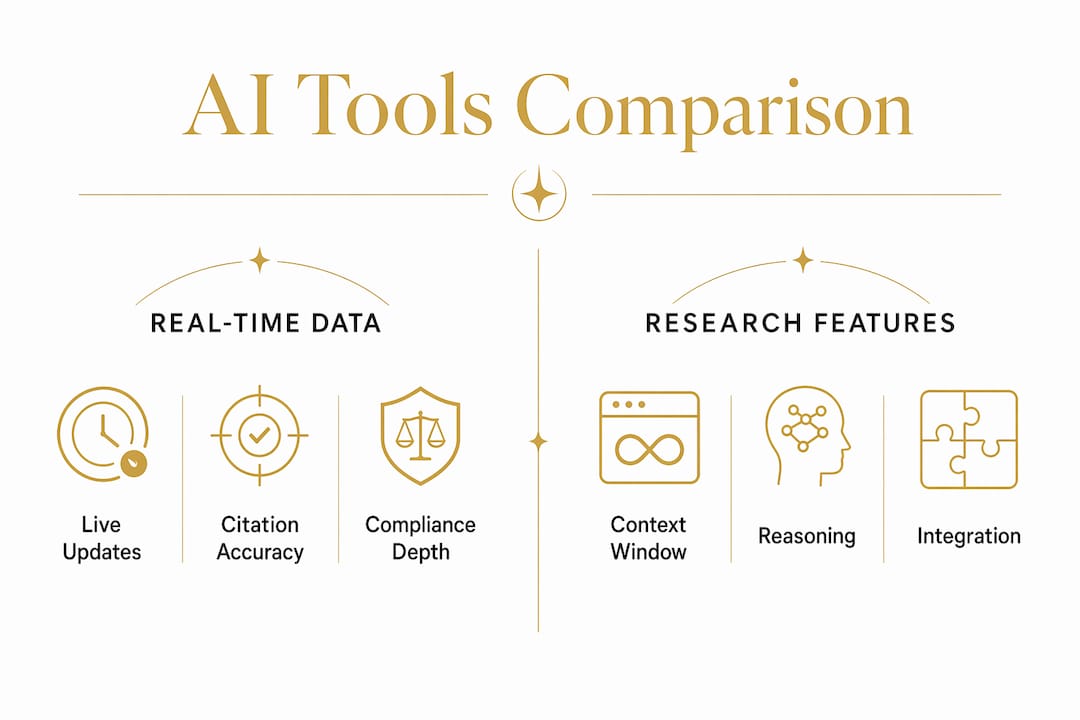
The single most important differentiator among AI research platforms is whether they ground their outputs in real-time web data or rely on static parametric knowledge. For iGaming, where regulatory updates and market shifts happen weekly, this distinction is not academic. It determines whether your compliance team is working from current information or outdated assumptions.

Real-time web grounding and citation accuracy separate Perplexity from tools like standard ChatGPT. Perplexity Sonar Pro leads major AI platforms in citation accuracy with a 37% error rate, the lowest among tested tools. That figure sounds high in isolation, but it is significantly better than parametric models that cannot access live sources at all and simply generate plausible-sounding text without verification.
Key differentiators to assess when you evaluate any platform:
- Citation grounding: Does the tool link every claim to a retrievable source, or does it produce narrative summaries without attribution?
- Real-time web access: Can it pull live regulatory updates from bodies like Spelinspektionen, or is it limited to its training cutoff?
- Multi-model orchestration: Does it allow you to route queries through multiple reasoning engines for cross-validation?
- Timeout and reliability configuration: The Sonar deep research API requires a 300-second timeout setting to avoid silent failure during complex multi-search queries. Default client timeouts will cause tasks to fail without any error message.
- Compliance API integration: Can the tool connect to regulated-market infrastructure like Spelpaus for self-exclusion verification?
- Token and query costs: Complex research queries carry compounding costs across citation tokens, reasoning tokens, and search calls.
Pro Tip: Before committing to any platform, run a live compliance query against a jurisdiction you operate in. If the tool cannot return a source-linked answer referencing current regulatory language, it is not suitable for compliance research regardless of its general capabilities.
Claude and Gemini offer stronger reasoning depth and longer context windows, which makes them better suited for synthesising large regulatory documents or cross-referencing multiple market reports. Perplexity’s advantage is freshness. The most effective iGaming research setups use both.
How to evaluate AI tool reliability for iGaming compliance
Reliability in iGaming research is not just about uptime. It is about whether a tool produces outputs that hold up under regulatory scrutiny. A single citation hallucination in a compliance report can lead to a missed self-exclusion check or a failed audit.
Use this structured evaluation sequence when assessing any AI platform for compliance research:
- Map natural language requirements to API-level outputs. AI tools that translate natural-language rules into distinct technical check types are more useful than those offering narrative summaries. Sweden’s updated Spelpaus regulations, effective August 1, 2026, require distinct API credentials and separate pathways for self-exclusion checks at registration, login, and marketing touchpoints. A tool that summarises this as “check self-exclusion status” fails the operator. A tool that identifies three separate credential-based API calls passes.
- Test timeout resilience explicitly. Configure your client timeout to 300 seconds for deep research tasks and document whether the tool completes, fails gracefully, or fails silently. Silent failures are the most dangerous in production environments.
- Benchmark citation hallucination rates. Run 20 identical compliance queries across your shortlisted tools and manually verify each cited source. Track the percentage of fabricated or misattributed citations per tool.
- Assess calibration profiles. A well-calibrated tool expresses uncertainty when it lacks current data rather than generating confident-sounding but unverifiable claims.
“For compliance research, AI tools that translate natural-language rules into distinct technical check types are more useful than those offering narrative summaries.” — Spelpaus compliance research insight
The operational impact of poor reliability is measurable. AI fraud detection and personalisation tools can reduce manual reviews by about 60% when properly configured, but that efficiency gain disappears entirely if the underlying research outputs feeding those tools contain errors.
What is AI visibility and why does it matter for tool selection?
AI visibility is defined as the frequency and prominence with which a brand or platform appears in AI-generated answers to relevant operator queries. This concept sits at the intersection of content strategy and tool evaluation, and most iGaming operators have not yet accounted for it in their research workflows.
The practical stakes are significant. An AI visibility audit found only 6 of 19 iGaming game aggregators consistently appear in AI tool answers to operator queries. Top aggregators like SOFTSWISS and EveryMatrix appear across all queries. The remaining 13 are effectively invisible to any operator using AI tools to shortlist vendors. This is the “champions vs. ghosts” dynamic that now defines B2B discovery in iGaming.
| Visibility category | Characteristics | Research implication |
|---|---|---|
| Champions | Appear in all or most AI queries | Consistently shortlisted by operators using AI research tools |
| Occasional mentions | Appear in some queries | Shortlisted only when query framing favours their niche |
| Ghosts | Absent from AI answers | Invisible to AI-assisted operator research regardless of actual quality |
For operators evaluating AI tools, this matters in two directions. First, the AI platform you choose determines which vendors and solutions you discover. A tool with limited web grounding will surface only the most prominent brands. Second, AI search acts as a simulation layer that shapes buying decisions before vendors are contacted directly. Your research tool is not neutral. It has a built-in visibility bias.
Generative Engine Optimisation (GEO) is the practice of structuring content so it appears in AI-generated answers, distinct from traditional SEO. Understanding GEO helps you assess whether the AI tools you use are drawing from a representative pool of sources or a narrow set of well-optimised publishers. For more on optimising content for AI search, Myluckyuniverse has published a detailed breakdown of what works in 2026.
Pro Tip: When auditing an AI tool’s vendor coverage, run the same query five times with slight phrasing variations. If the same three vendors appear every time regardless of query framing, the tool has a narrow citation pool that will limit your research scope.
How do pricing models compare across leading AI research tools?
Cost comparison for AI research tools in iGaming requires separating three distinct expense categories: token costs per query, implementation and integration costs, and ongoing operational overhead.
Perplexity’s deep research mode carries compounding costs. A single complex query draws on citation tokens, reasoning tokens, and multiple search calls simultaneously. Operating Perplexity deep research continuously requires explicit budgeting across all three cost types, with complex queries running approximately $0.82 each. At scale, that adds up quickly for a research team running dozens of compliance or market queries daily.
Integration costs vary dramatically depending on whether you choose a general-purpose CRM platform or an iGaming-native solution. Salesforce Marketing Cloud requires 3 to 6 months and €150,000 or more for iGaming-specific implementation. iGaming-native platforms start with pre-built industry models that reduce both time and cost significantly. For operators comparing CRM segmentation tools alongside AI research platforms, this cost gap is material.
Key cost considerations when building your evaluation budget:
- Batch vs. real-time execution: Batch processing reduces per-query costs but introduces latency that is unacceptable for live compliance checks.
- API call volume: Compliance-heavy operations in regulated markets like Sweden or the UK will generate significantly higher query volumes than general market research.
- Model switching costs: Multi-model workflows that route queries through Perplexity for grounding and Claude for reasoning incur costs on both platforms simultaneously.
What are best practices for comparing AI tools effectively?
Structured evaluation produces better decisions than informal testing. The following process applies whether you are assessing platforms for the first time or re-evaluating your current stack against newer options.
- Build a standardised prompt set. Create 15 to 20 prompts covering market analysis, compliance queries, and vendor evaluation scenarios. Use the same prompts across every tool you test. Evaluating with consistent prompts reflecting real-world operator queries and jurisdiction-specific compliance issues produces accurate benchmarking results.
- Run multi-model orchestration tests. A multi-model workflow combining Perplexity for citation grounding and Claude or Gemini for reasoning depth is the most reliable approach for high-stakes iGaming research. Test this combination explicitly rather than evaluating each tool in isolation.
- Conduct AI visibility audits quarterly. The vendor landscape changes. A tool that surfaced the right aggregators six months ago may now reflect a different distribution of sources. Regular re-audits catch drift before it affects your research quality.
- Manually validate citations for high-stakes decisions. Automated research outputs should never feed directly into compliance filings or regulatory submissions without human review. Build a manual verification step into your workflow for any output that will influence a regulated decision.
- Monitor compliance integration performance continuously. For markets with active regulatory changes, such as Sweden’s 2026 Spelpaus updates, set up automated alerts that flag when your AI tool’s outputs diverge from the current regulatory text.
Pro Tip: Ask each AI tool directly: “Which iGaming compliance platforms do operators in Sweden use for Spelpaus integration?” The specificity and accuracy of the answer tells you more about the tool’s regulatory knowledge depth than any benchmark score.
Understanding how to integrate AI into gambling content is the practical complement to tool evaluation. The best tool selection process is worthless if the outputs are not structured for use in your actual research workflows.
Key takeaways
Selecting the right AI research platform for iGaming requires evaluating citation accuracy, compliance integration depth, timeout configuration, and AI visibility bias as a combined set of criteria rather than individual features.
| Point | Details |
|---|---|
| Citation accuracy matters most | Perplexity Sonar Pro leads with the lowest error rate; always verify sources for compliance outputs. |
| Timeout configuration is non-negotiable | Set client timeouts to 300 seconds for deep research APIs to prevent silent task failures. |
| AI visibility shapes what you discover | Only 6 of 19 iGaming aggregators appear consistently in AI answers; your tool’s citation pool limits your research scope. |
| Multi-model workflows outperform single tools | Combine Perplexity for grounding with Claude or Gemini for reasoning to improve output reliability. |
| Compliance integration requires API-level specificity | Tools that produce narrative summaries of regulations are insufficient for markets like Sweden with credential-based API requirements. |
What I’ve learned about AI tool comparisons in iGaming
The most common mistake I see operators make is evaluating AI tools on general capability rather than iGaming-specific performance. A tool that scores well on general reasoning benchmarks can still fail completely when asked to map Spelinspektionen’s 2026 self-exclusion requirements to distinct API calls. General intelligence does not substitute for domain-specific grounding.
The second mistake is treating AI tool selection as a one-time decision. The platforms themselves are changing faster than most operators update their research stacks. Perplexity’s citation architecture in 2026 is materially different from what it was 18 months ago. Claude’s context window and reasoning capabilities have expanded significantly. If you evaluated these tools once and moved on, you are likely working with an outdated picture.
What I find genuinely underappreciated is the AI visibility dimension. Operators spend considerable effort optimising their own brand presence for traditional search, but very few have audited which vendors their chosen AI tools actually surface. The tool you use to research the market is itself a filter. That filter has biases built into its training data and citation pool. Knowing those biases is part of responsible research practice.
The operators who get the most from AI research tools in 2026 are those who treat the evaluation process as ongoing rather than terminal. They run regular visibility audits, test new model releases against their standard prompt sets, and maintain a multi-model workflow rather than betting everything on a single platform.
— Lucky
Explore AI-powered iGaming research with Myluckyuniverse
Myluckyuniverse is built specifically for the intersection of AI technology and iGaming intelligence. If you are working through how to structure your research stack, evaluate compliance tools, or improve your brand’s visibility in AI-generated operator queries, the platform offers editorial-grade analysis grounded in real industry data. The team behind Myluckyuniverse brings over 20 years of iGaming experience to every piece of content, with a focus on structured, source-transparent insights that hold up under scrutiny. Visit Myluckyuniverse to explore resources built for operators who take research seriously.
FAQ
What is the most accurate AI tool for iGaming compliance research?
Perplexity Sonar Pro currently leads in citation accuracy with a 37% error rate, the lowest among tested platforms. For compliance research specifically, pair it with Claude or Gemini for deeper regulatory document analysis.
How do I configure AI tools to avoid research failures?
Set your client timeout to 300 seconds when using deep research APIs like Perplexity’s Sonar model. Default timeout settings cause complex multi-search queries to fail silently without returning an error.
Why do some iGaming vendors never appear in AI research results?
Only 6 of 19 iGaming game aggregators appear consistently in AI-generated answers to operator queries. Vendors absent from AI citation pools are effectively invisible to operators using AI tools for vendor shortlisting, regardless of their actual product quality.
What does AI visibility mean for iGaming operators?
AI visibility refers to how frequently a brand appears in AI-generated answers to relevant operator queries. It functions as a pre-contact discovery layer, shaping which vendors operators consider before making direct contact.
Is a multi-model AI workflow worth the added cost?
For high-stakes iGaming research, yes. Combining Perplexity for real-time citation grounding with Claude or Gemini for reasoning depth produces more reliable outputs than any single platform alone, particularly for compliance and vendor evaluation tasks.