Insights
How structured content helps bettors make smarter decisions

Most online bettors don’t lose because of bad luck. They lose because they made decisions based on bad information. Visit any popular gambling forum and you’ll find players citing conflicting bonus terms, outdated payout rates, and reviews written by anonymous accounts with obvious agendas. The sheer volume of gambling content online has never been higher, yet the quality and organisation of that content has barely improved. Structure is the silent advantage separating trusted iGaming guidance from the noise, and understanding it will change how you evaluate every gambling resource you ever read.
Table of Contents
- The chaos of unstructured gambling advice
- What makes content structured and why it matters
- Structured vs. unstructured: Side-by-side comparison
- How bettors benefit: Real-world applications
- The uncomfortable truth about gambling content structure
- Discover structured betting insights with Lucky Universe
- Frequently asked questions
Key Takeaways
| Point | Details |
|---|---|
| Structure reduces confusion | Well-organised betting advice makes it much easier to find the facts you need to bet smarter. |
| Schema markup boosts trust | Rich search results create confidence in reviews, odds, and payouts before you click. |
| Player-focused details win | Content that tackles real questions like withdrawal timelines helps avoid costly mistakes. |
| Rich results drive clicks | Sites with structured data see more players choosing them thanks to enhanced SERP snippets. |
The chaos of unstructured gambling advice
Picture this: you’re trying to compare wagering requirements between two online casinos. You open three tabs. One site buries the information inside a 4,000-word wall of text. Another lists numbers with no context about which games count toward the rollover. The third hasn’t updated its terms since 2023. You’ve spent 20 minutes and you still aren’t confident in your answer.
This is the daily reality for millions of bettors, and it has serious consequences:
- Outdated bonus terms lead players to claim offers that no longer apply, wasting time and real money on invalid promotions.
- Conflicting odds information creates confusion around expected value calculations, pushing bettors toward worse deals.
- Buried game rules cause players to misunderstand volatility or RTP (return to player, the percentage a game pays back over time), resulting in bankroll decisions based on false assumptions.
- Vague review structures make it nearly impossible to compare casinos side by side without reading every word from start to finish.
“The most dangerous gambling content isn’t the obviously false kind. It’s the content that’s 80% accurate but missing the 20% that actually matters for your decision.”
The problem compounds when you factor in player trust. When a site fails to deliver clear, reliable information once, most players leave and never return. Trust signals in online gambling are critical precisely because trust, once lost, is nearly impossible to rebuild. Platforms that invest in structured, organised content formats have a measurable advantage here. In fact, platforms with advanced data structures see a 31% reduction in player churn, because users can find what they need quickly and leave feeling informed rather than frustrated.
Unstructured content doesn’t just waste your time. It actively costs you money, because the mistakes you make from incomplete information come out of your bankroll.
What makes content structured and why it matters
Structured editorial content in iGaming is content deliberately organised so that specific types of information are always in predictable places, labelled correctly, and formatted for quick comparison and confident decision-making.
Think of it this way. A structured casino review will always show you licensing information in the same section, bonus terms in a clearly marked block, and payout timelines broken out from general withdrawal information. You don’t hunt. You navigate.

The technical backbone of truly structured content is schema markup. Schema markup is a standardised code layer added to a webpage that tells search engines and AI tools exactly what kind of content they’re reading. For iGaming, this means tagging a piece of content as a review, a FAQ, a game guide, or a comparison table, which allows it to display as a rich result in search. Rich results are the expanded listings you see in Google with star ratings, FAQ dropdowns, or structured highlights pulled directly from the page. Schema markup for iGaming isn’t just an SEO trick. It’s a clarity signal to both machines and humans that this content has been organised with intent.
Here’s how the different types of structured content elements serve bettors:
| Content element | What it does for you | Example in iGaming |
|---|---|---|
| Schema markup | Surfaces key data in search results | Star ratings on casino reviews |
| Clear section headers | Lets you skip to relevant info fast | ”Withdrawal timelines” as its own heading |
| Structured comparison tables | Shows differences at a glance | Bonus terms side by side |
| FAQ sections | Answers common frictions directly | ”What ID is needed for KYC verification?” |
| Author provenance labels | Confirms who wrote and reviewed content | ”Reviewed by a licensed gambling analyst” |
When schema markup enables rich SERP features, it displays reviews, FAQs, and game details directly in the search listing, improving click-through rates significantly. But the real benefit for you as a bettor is that the structured content underneath those rich results is far more reliable and useful than the unformatted alternatives.
Pro Tip: When evaluating a gambling content site, check whether their reviews use consistent section headers across all their articles. Consistent structure is one of the clearest indicators that the content was created with editorial standards, not just to fill a page.
If you want to see this in practice, the editorial insights for gambling published by content-focused iGaming platforms often reveal the difference between structured and unstructured approaches at a glance.
Structured vs. unstructured: Side-by-side comparison
Let’s make this concrete. Suppose you’re searching for the payout rate on a specific slot game. You land on two different pages at roughly the same time.
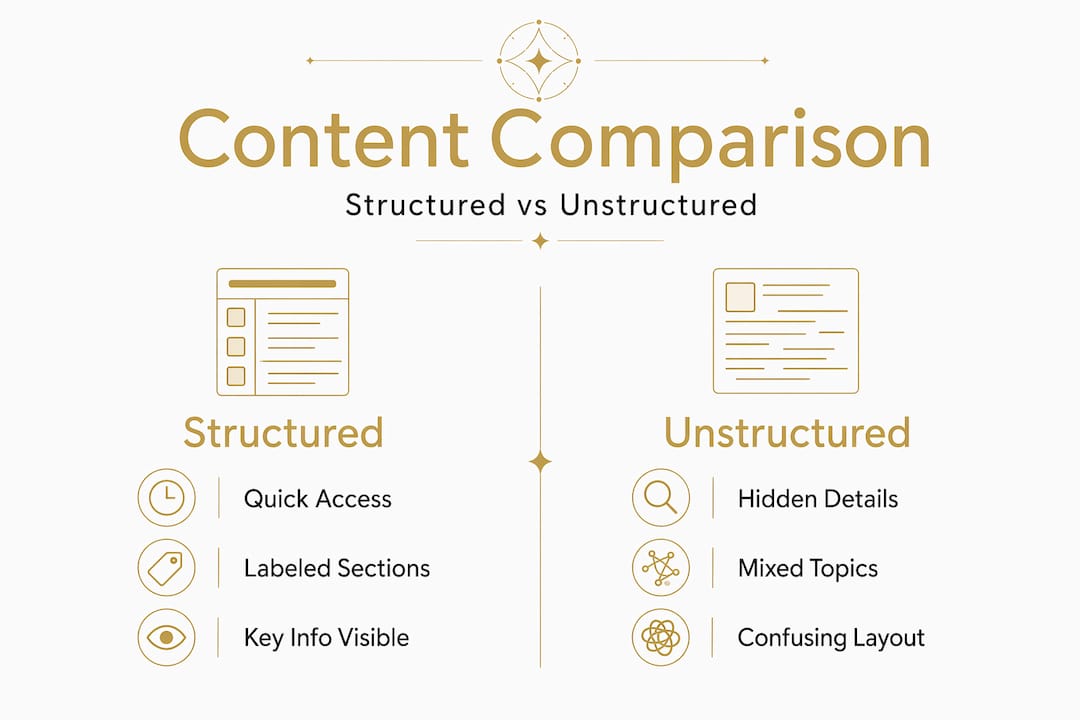
Site A (unstructured): A 3,500-word article with the game’s RTP mentioned once, in passing, in the eighth paragraph, alongside promotional language encouraging you to “try it today.” There’s no table, no section header labelled “payout information,” and the date of the article is nowhere visible.
Site B (structured): A review with a clearly labelled “Game details” table at the top, listing RTP, volatility, minimum bet, and maximum win in a single view. The review date and the author are both shown. A FAQ at the bottom answers “Is this RTP verified by a third-party auditor?”
The difference in your decision speed and confidence is not subtle. It’s enormous.
| Feature | Structured content | Unstructured content |
|---|---|---|
| Findability | Key data surfaced immediately | Buried inside long prose |
| Trust signals | Author, date, sources visible | Often anonymous and undated |
| Comparison ease | Tables allow quick scanning | Requires reading everything |
| Time to answer | Under 60 seconds | Often 5 to 15 minutes |
| AI readability | Correctly interpreted by AI tools | Misread or ignored by AI |
| Search visibility | Rich results with schema | Plain blue link only |
Schema markup clarifies content type, including whether it’s a review, a guide, or a comparison, and establishes author provenance so AI tools and search engines can confidently select and surface the content. This matters enormously in 2026, when a growing number of bettors use AI assistants to answer gambling questions before they ever visit a website.
Studies consistently show that users make fast decisions. When you factor in casino content best practices and the speed at which bettors scan search results, structured content has a decisive advantage. Winning a bettor’s attention in the first few seconds isn’t just a marketing goal. It’s how trust is established before they’ve even read a word.
How bettors benefit: Real-world applications
Understanding structure in theory is useful. Applying it in your actual betting decisions is where the value lives. Here’s a practical framework for using structured content to protect your bankroll and improve your outcomes.
1. Finding trustworthy reviews
When evaluating a casino review, look for these structural markers: a clearly labelled licensing section, a separate bonus terms block, a dedicated withdrawal and banking section, and a visible author name with credentials. If these elements are missing or scattered, treat the review as incomplete regardless of how glowing its conclusions are.
2. Comparing bonus terms accurately
Wagering requirements, game restrictions, and time limits are three entirely separate variables. Structured bonus comparisons break these out independently. If a site presents all three inside a single paragraph, you’re likely to misread the actual value of the offer. Always look for tabular breakdowns before claiming any welcome bonus.
3. Verifying payout timelines
Withdrawal speed is one of the most complained-about aspects of online gambling, and it’s almost always due to information being buried or presented ambiguously. Structured content addresses this in its own dedicated section, ideally including minimum and maximum withdrawal amounts, processing times by method, and any KYC (Know Your Customer, the identity verification process) requirements that could delay your payout.
4. Evaluating responsible gaming resources
Structured content platforms include responsible gaming information as a clearly labelled, findable section, not as an afterthought. This signals editorial intent and regulatory awareness, both of which reflect positively on the reliability of everything else the site publishes.
5. Using AI-assisted tools effectively
AI in gambling content is transforming how bettors research decisions. AI tools perform significantly better on structured content because they can extract labelled information reliably. If you’re using an AI assistant to research casino options, structured content sites will yield far more accurate and useful summaries than unstructured alternatives.
Pro Tip: Watch specifically for whether a site addresses friction points like KYC verification delays, dispute resolution processes, or bonus cancellation rules in their structured content. Avoiding self-review schema and focusing on real player frictions is a marker of genuinely trustworthy editorial practice. Generic FAQs are easy to spot and almost always indicate a site prioritising SEO over your actual needs.
The uncomfortable truth about gambling content structure
Here is something the industry rarely admits out loud: the vast majority of gambling content is built as a checklist, not as a resource. Someone decides a review needs to cover games, bonuses, payment methods, customer support, and licensing, and then each box gets a few paragraphs filled in. The result technically covers the topics, but it’s assembled without any regard for the questions real players actually ask, the friction points they genuinely encounter, or the decisions they actually need to make.
We’ve spent over 20 years watching this pattern repeat itself. Sites launch with decent structures, then gradually let content decay as volume goals replace quality standards. The schema markup gets applied superficially. The FAQ sections become padding. The review templates stop evolving when player behaviour evolves. What looked like structured content at launch becomes an impersonation of structure over time.
The real differentiator isn’t having a table or a schema tag. It’s building content around a player’s actual decision journey. What do you need to know before you deposit? What should you verify before you withdraw? What are the realistic scenarios where a bonus offer goes wrong? This kind of player-centric framing produces content where every structural element serves a purpose, rather than a checklist that signals quality without delivering it.
At Lucky Universe, the entire editorial model is built around this principle. Our AI-native iGaming content approach means every article is structured not just for search visibility, but for the actual decisions bettors face. That distinction is the difference between content that looks trustworthy and content that actually earns trust over time.
Discover structured betting insights with Lucky Universe
If you’ve read this far, you already understand that better information produces better decisions, and that structure is what separates reliable guidance from noise.

Lucky Universe was built specifically to solve this problem for bettors. Every guide, review, and comparison we publish is designed around clear editorial standards, transparent sourcing, and schema-structured formatting that works equally well whether you’re reading on a screen or querying through an AI assistant. Our editorial hub covers everything from bonus analysis to responsible gaming resources, all structured for clarity and speed. Explore our library of trusted betting insights and see what it feels like to research your next gaming decision with confidence.
Frequently asked questions
What is structured editorial content in gambling?
Structured editorial content organises guides, reviews, and data with clear sections, schema markup, and rich search features so you can make decisions faster and with more confidence.
How does structure help me avoid bad betting info?
It surfaces key details like odds and payout rules in predictable, labelled locations, making it far easier to identify trusted advice and spot content that is outdated or incomplete. Platforms with strong data structures see reduced churn precisely because players find reliable answers without frustration.
What mistakes do gambling sites make with structure?
Many sites apply generic FAQs or use incorrect schema markup, both of which damage trust and search performance. Look specifically for sites that address real player friction points like KYC verification and withdrawal delays, rather than filler questions.
Does structured content help with search rankings?
Yes. Schema markup improves click-through rates by displaying relevant details like reviews and FAQs directly in search results, making it easier for players to identify and reach reliable guides before they even click.