Insights
Why content localization drives conversions in iGaming

Content localization is defined as the process of adapting digital content to match the language, cultural norms, payment expectations, and trust signals of a specific market. In iGaming, why content localization drives conversions is not a theoretical question. It is a measurable business outcome. Localized content reduces cognitive friction, enabling faster decisions and higher trust at every stage of the player journey. Platforms using tools like Lokalise and frameworks from providers like RWS have documented revenue increases of 20 to 50% when localization is executed with precision. This guide breaks down the mechanisms, the metrics, and the practical steps that matter most.
Why does content localization drive conversions for iGaming users?
The standard industry term for what most marketers call “content localization” is transcreation when it involves cultural adaptation beyond translation, and localisation when it covers the full technical and linguistic stack. Both apply in iGaming, where a player registering from Indonesia and one from Sweden face entirely different trust thresholds, payment expectations, and regulatory contexts.
Mental translation is the hidden conversion killer. When a player reads a bonus offer written in English but thinks in Bahasa Indonesia, they spend cognitive energy converting the message rather than acting on it. That extra friction is enough to trigger doubt and abandonment. Native-language content removes this barrier, allowing users to process offers with confidence and speed.
Trust signals are also culturally specific. A UK player expects to see a UKGC licence badge prominently displayed. A Brazilian player looks for Pix as a payment option and Portuguese-language customer support. When these signals are absent or misaligned, the player’s confidence drops before they ever reach the deposit screen. Poor translation reduces trust in 71% of users, according to Lokalise’s 2026 data. That is not a marginal effect. It is a majority of your potential depositors walking away.
- Language clarity: Native-language copy reduces misunderstanding and increases confidence at decision points.
- Cultural relevance: Promotions framed around local events, sports, or cultural moments outperform generic global campaigns.
- Regulatory alignment: Displaying the correct local licence and responsible gambling messaging builds immediate credibility.
- Support accessibility: Offering live chat in the player’s language reduces pre-deposit hesitation significantly.
Pro Tip: When auditing your localization gaps, start with your registration and deposit flows. These are the highest-friction points in the iGaming funnel, and even minor language mismatches here cost you real depositors.
Understanding how trust signals shape player behaviour is the foundation of any effective localisation strategy in this sector.
What localization elements deliver the biggest conversion lifts?
Translation is the floor, not the ceiling. The operators who see the largest conversion gains treat localization as a full UX discipline, not a language exercise.
A 2026 case study measuring outcomes across Indonesia, Malaysia, and Singapore found that localising checkout flows including payment method copy, form field labels, and error messages produced a 40% average conversion uplift and reduced cart abandonment by more than 50%. The intervention was not a new product or a bigger bonus. It was precise adaptation of the decision-critical interface. That result should reframe how iGaming marketing teams allocate their localization budget.
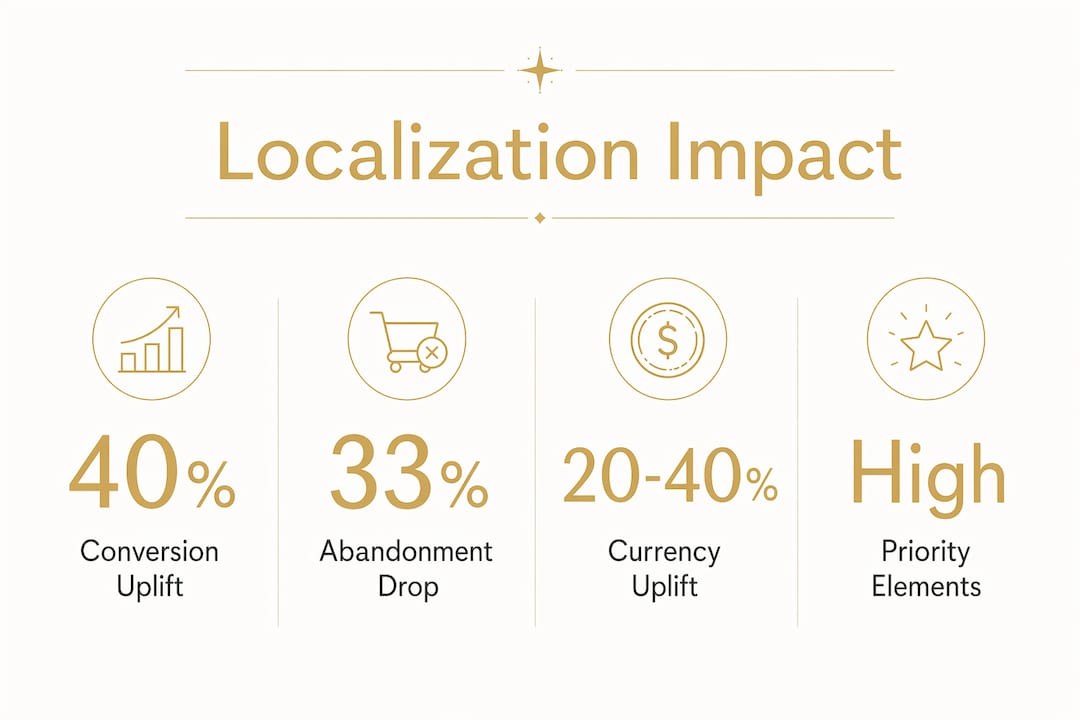
Pricing certainty is equally powerful. 33% of international shoppers abandon when presented with USD-only pricing. In iGaming, the equivalent is displaying deposit amounts in a currency the player does not use daily. Showing MYR to a Malaysian player instead of USD removes a calculation step and a trust gap simultaneously. Research confirms that local currency display, transparent withdrawal timelines, and clear bonus terms in the player’s language drive 20 to 40% conversion increases, often outperforming translation quality alone.
| Localization element | Conversion impact | Priority level |
|---|---|---|
| Local currency display | 20–40% uplift | Critical |
| Native-language checkout copy | Up to 40% uplift | Critical |
| Local payment methods (e.g., Pix, GrabPay) | Reduces abandonment by 50%+ | Critical |
| Culturally relevant bonus framing | 10–25% uplift | High |
| Localised responsible gambling messaging | Trust signal, reduces regulatory risk | High |
| Translated FAQs and support content | Reduces pre-deposit hesitation | Medium |

Pro Tip: Certainty beats perfection. A slightly imperfect translation that shows local currency, local payment options, and clear withdrawal terms will outconvert a beautifully written English page every time. Prioritise certainty signals first.
Effective iGaming content strategy treats these localization elements as conversion infrastructure, not cosmetic additions.
How can marketing teams measure localization ROI in iGaming?
Attribution is the most common excuse for under-investing in localization. “We can’t prove it drove the conversion” is a measurement problem, not a localization problem. The solution is to measure funnel efficiency by locale rather than trying to isolate localization as a single variable in a multi-touch attribution model.
A 2026 framework from SimpleLocalize recommends measuring ROI holistically across four economic metrics: conversion rate by locale, revenue per visitor by locale, retention and lifetime value by locale, and market expansion velocity. Each metric tells a different part of the story. Conversion rate shows immediate impact. Revenue per visitor captures whether localised users spend more. Retention and LTV reveal whether localization builds loyalty or just drives one-time deposits. Expansion velocity measures how quickly a new market reaches profitability after localization investment.
VeraContent’s 2026 measurement guide adds a practical layer: compare funnel conversion rates on localised landing pages against the source-language equivalent, and monitor support ticket volume by locale as a proxy for content clarity. A spike in support contacts from a specific market often signals a localization gap before it shows up in conversion data.
Here is a practical measurement sequence for iGaming operators:
- Establish a locale baseline. Before launching localization, record conversion rate, deposit rate, and average deposit value for each target market using your existing English or source-language content.
- Deploy localization in phases. Start with checkout and payment flows, then expand to landing pages, promotions, and support content. This phased approach lets you isolate the impact of each layer.
- Run locale-versus-locale comparisons. Compare localised markets against comparable non-localised markets on the same metrics over 30, 60, and 90-day windows.
- Track retention separately. Localization’s value compounds over time through improved retention and expansion velocity. A 90-day retention comparison will show effects that a 30-day conversion report misses entirely.
- Monitor support volume. Declining support contacts from a newly localised market is a strong signal that content clarity has improved, even before conversion data confirms it.
What practical steps should iGaming businesses take to embed localization?
Localization delivers the highest returns when it is built into product and marketing development from the start, not bolted on after launch. RWS’s 2026 guide identifies early integration as the single biggest factor in reducing rework costs and accelerating time-to-market in new regions. For iGaming operators targeting multiple regulated markets simultaneously, this is not optional. It is a structural advantage.
- Audit decision-critical UX first. Registration forms, deposit screens, bonus claim flows, and withdrawal pages are where localization gaps cost you the most. Audit these before any other content.
- Partner with iGaming-experienced localization specialists. Generic translation agencies do not understand responsible gambling terminology, regulatory copy requirements, or the cultural nuance of sports betting markets. Work with specialists who do.
- Build a localisation style guide per market. Document tone, terminology, and cultural references for each target locale. This prevents inconsistency as your content scales and ensures that new campaigns inherit the right voice.
- Integrate localization into your CMS and product workflow. Platforms like Lokalise connect directly to content management systems, allowing marketing and product teams to push localisation updates without creating separate workflows.
- Test continuously, not once. Player behaviour and regulatory requirements shift. What converts in Malaysia today may need adjustment after a regulatory update or a cultural moment. Treat localization as a living system.
Pro Tip: When entering a new regulated market, localise your responsible gambling and terms content before your promotional content. Regulators notice, and players trust operators who get compliance copy right in their language.
Segmenting iGaming audiences by locale before building campaigns is the fastest way to identify which markets need the deepest localization investment and which are already converting well.
Key takeaways
Content localization drives conversions in iGaming by removing cognitive friction, building cultural trust, and delivering certainty signals that translate directly into deposits and registrations.
| Point | Details |
|---|---|
| Localization beats translation | Adapting checkout UX, currency, and payment methods drives up to 40% more conversions than language translation alone. |
| Certainty signals convert | Local currency display and transparent withdrawal terms lift conversions by 20 to 40%, often more than copy quality. |
| Measure by locale | Track conversion rate, revenue per visitor, and retention separately for each localised market to capture full ROI. |
| Integrate early | Building localization into product development from the start reduces rework and accelerates market entry. |
| Trust is culturally specific | Displaying the right licence, payment options, and support language for each market is a direct conversion lever. |
Localization is the competitive moat most iGaming operators ignore
I have watched operators spend six figures on paid acquisition into Southeast Asian markets while running English-only deposit flows. The traffic arrives, looks at the page, and leaves. The localization gap does not show up in the acquisition report. It shows up in the deposit conversion rate, which everyone blames on “market quality.”
The uncomfortable truth is that most iGaming localization failures are not language failures. They are certainty failures. Players do not abandon because they cannot read the page. They abandon because they cannot see their local payment method, cannot confirm the withdrawal timeline in a currency they understand, or cannot find a support option in their language. These are solvable problems, and they are cheaper to fix than the acquisition costs being wasted around them.
The operators I have seen build durable market positions in regulated markets like Brazil, Japan, and the Netherlands share one trait: they treated localization as growth infrastructure before those markets were profitable. They built the trust architecture first, then scaled acquisition. The result is lower cost-per-depositor, higher retention, and a brand reputation that compounds over time.
AI-driven personalisation is making this more urgent, not less. As platforms like casinoexpert.ai and AI-native discovery tools become the primary way players find and evaluate operators, AI-personalised content that is also culturally localised will outperform generic content by a widening margin. The operators investing in localisation infrastructure now are building the data and content assets that will feed those systems most effectively.
Localization is not overhead. It is the conversion rate optimisation strategy with the highest ceiling in international iGaming.
— Lucky
How Myluckyuniverse can support your localization strategy
Myluckyuniverse brings over 20 years of iGaming industry experience to content strategy, localisation planning, and conversion-focused editorial production. The team understands the cultural nuance, regulatory requirements, and trust signals that move players from browse to deposit across regulated markets worldwide.

Whether you are entering a new regulated market or auditing an existing localisation programme for conversion gaps, Myluckyuniverse delivers structured, data-informed content that players trust and regulators respect. Explore the full range of iGaming content solutions at Myluckyuniverse and find out how localisation-led strategy translates into measurable revenue growth for your operation.
FAQ
What is content localization in iGaming?
Content localization in iGaming is the process of adapting platform content, including bonus copy, payment interfaces, and support materials, to match the language, cultural expectations, and regulatory requirements of a specific market. It goes well beyond translation to include currency display, local payment methods, and culturally relevant messaging.
How much can localization increase conversion rates?
Localising checkout flows, payment copy, and form fields has produced 40% conversion uplifts in documented iGaming and e-commerce case studies. Local currency display and transparent pricing clarity add a further 20 to 40% improvement over translation-only approaches.
Does localization improve player retention, not just conversions?
Yes. Localization’s value compounds through improved retention and lifetime value, with benefits that extend well beyond the initial deposit conversion. Players who experience culturally aligned content are more likely to return and less likely to churn after a single session.
Which localization elements should iGaming operators prioritise first?
Operators should prioritise decision-critical UX elements: deposit and withdrawal flows, local payment method display, currency formatting, and responsible gambling copy in the player’s language. These elements have the highest direct impact on conversion and regulatory compliance simultaneously.
How do you measure localization ROI accurately?
Measure localization ROI by comparing funnel conversion rates on localised pages against source-language equivalents, tracking revenue per visitor and retention by locale, and monitoring support ticket volume as a proxy for content clarity. A 90-day measurement window captures retention effects that shorter windows miss.