Insights
How iGaming content strategy works in 2026

An iGaming content strategy is a structured system that combines commercial pillar pages, semantically linked satellite content, and technical SEO to attract, engage, and retain online gambling players. Understanding how iGaming content strategy works means recognising that generic blog posts no longer move the needle. AI Overviews now capture 30–50% of informational click-through rates in iGaming, pushing organic value almost entirely onto commercial-intent pages. Operators still running 2022-era content lose 40–70% of organic traffic in 2026. The brands winning today build authority through cluster architecture, EEAT signals, semantic mapping, and community-first content that players actually trust.
How iGaming content strategy works: pillar pages and cluster architecture
The foundation of any effective iGaming content strategy is the cluster model. A pillar page sits at the centre of a topic and acts as the commercial hub. Satellite pages orbit it, each covering a specific sub-topic in depth and feeding link equity back to the pillar.
Pillar pages in iGaming must be commercial category pages of at least 3,000 words, supported by four to six satellite pages each running 2,000 to 2,500 words. This is not a stylistic preference. It is a structural requirement for topical authority. A “best online slots” pillar, for example, should be supported by satellites covering slot volatility, RTP explained, free spins mechanics, and provider comparisons.

Internal linking density matters just as much as word count. The recommended standard is three to five internal links per 1,000 words. This density signals to search engines that your content forms a coherent knowledge network rather than a collection of isolated pages.
Key structural requirements for iGaming content clusters:
- Pillar pages must be conversion-oriented, not purely informational
- Each satellite must target a distinct long-tail query within the pillar’s topic
- Internal links should use descriptive anchor text tied to the satellite’s primary keyword
- Every cluster should map to one commercial intent (slots, live casino, sports betting, etc.)
Pro Tip: Map your clusters before writing a single word. A cluster map is a spreadsheet that lists the pillar, each satellite, the target keyword for each page, and the planned internal link structure. Teams that skip this step produce content that competes with itself.
| Cluster element | Specification |
|---|---|
| Pillar page length | 3,000+ words, commercial category focus |
| Satellite page length | 2,000–2,500 words per page |
| Satellites per pillar | 4–6 pages |
| Internal link density | 3–5 links per 1,000 words |
How does EEAT affect iGaming content rankings in 2026?
EEAT (Experience, Expertise, Authoritativeness, Trustworthiness) is the most important ranking predictor in iGaming. EEAT now outweighs traditional link-building and domain authority as a ranking signal. Google treats gambling content as Your Money or Your Life (YMYL) material, which means the bar for credibility is higher than in most other verticals.
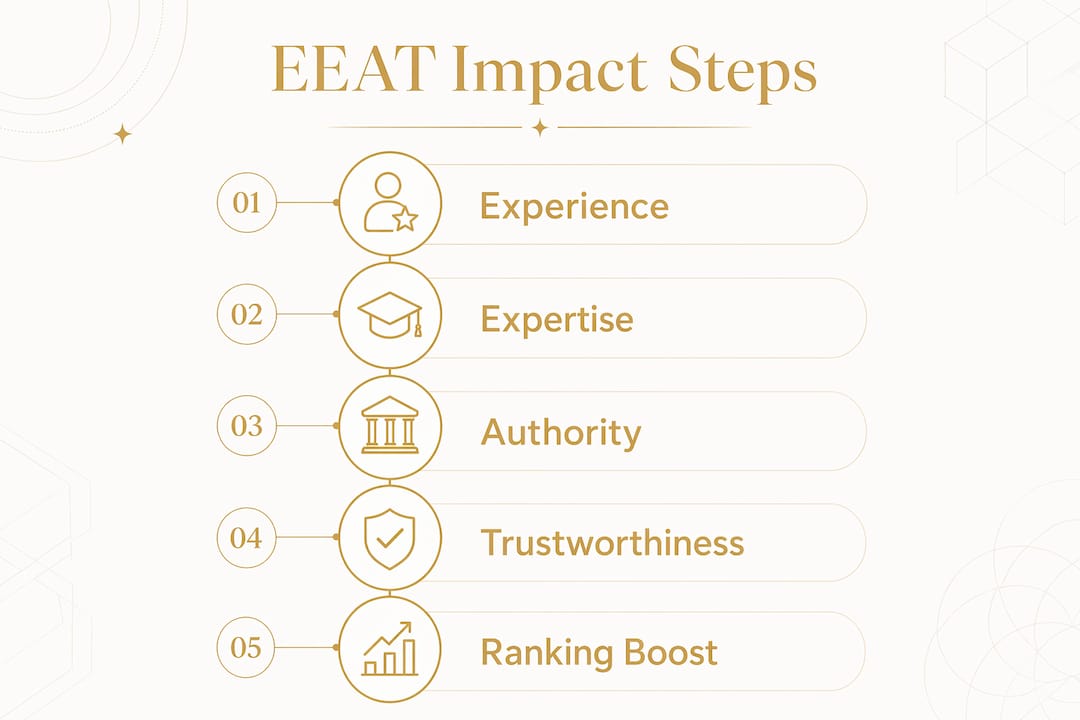
Named, verifiable authors are non-negotiable. Each piece of editorial content should carry a byline from a real person with a documented background in gambling media, casino operations, or regulatory affairs. Two to three such authors on your platform is the minimum threshold. An author bio page with a photo, LinkedIn profile, and publication history is not optional. It is the evidence Google’s quality raters look for.
Compliance signals matter beyond legal obligation. Visible licence information, age-gate mechanisms, and responsible gambling links (to organisations like GamCare or BeGambleAware) all contribute to trustworthiness scores. Credible named authors with gambling-sector experience combined with explicit compliance signals create a content environment that both players and search engines treat as authoritative.
EEAT compliance checklist for iGaming content:
- Named author with verifiable gambling industry credentials on every article
- Author bio pages with photo, professional history, and external profile links
- Licence number and jurisdiction displayed in the site footer and relevant pages
- Responsible gambling section with links to GamCare, BeGambleAware, or equivalent
- Age verification and geo-restriction notices where legally required
Pro Tip: Build a dedicated “About our experts” page that lists every contributing author, their credentials, and links to their published work elsewhere. This single page can dramatically improve how Google’s quality raters assess your site’s overall expertise.
For a deeper look at how author credibility connects to search performance, the Myluckyuniverse guide on answer engine optimisation covers this intersection in practical detail.
What role does semantic content mapping play in iGaming SEO?
Entity-based SEO is the practice of building content around interconnected concepts rather than isolated keywords. In iGaming, this means connecting topics like game mechanics, responsible gambling, payment methods, and regulatory frameworks into a coherent semantic network. Semantic clustering around five to seven core entities gives search engines a clear picture of your platform’s topical scope.
Structured data from schema.org is the technical layer that makes this network machine-readable. Article schema with “authoranddatePublished` fields is the baseline for editorial content. For casino reviews, use Review schema sourced from genuine third-party user feedback. Self-assigned review stars in structured data trigger manual penalties. The rule is simple: only mark up what you can independently verify.
Internal linking functions as a semantic connector, not just a navigation tool. When a satellite page on “blackjack strategy” links to your pillar on “live casino games” using anchor text like “live blackjack tables,” you are teaching the search engine the relationship between those two concepts. This is how structured content helps players make smarter decisions while simultaneously building your authority graph.
How to build a semantic iGaming content map:
- Identify five to seven core entities for your platform (e.g., slots, live casino, sports betting, bonuses, responsible gambling, payment methods, licensing).
- For each entity, list the sub-concepts and related queries that a knowledgeable player would search.
- Assign each sub-concept to either a pillar or a satellite page.
- Map the internal links between pages, ensuring every satellite connects to its pillar and to at least one adjacent entity.
- Apply Article or Review schema to every published page, using only verifiable data in the markup.
Semantic entity comparison:
| Approach | SEO outcome |
|---|---|
| Keyword-only content | Targets isolated queries, misses topical depth |
| Entity-based semantic mapping | Builds authority across interconnected topics |
| Structured data without entity mapping | Improves snippet appearance but lacks depth signals |
| Full semantic cluster with schema | Maximum topical authority and search visibility |
How does a UGC-style tone improve iGaming player engagement?
iGaming content marketing is shifting toward empathetic, community-driven content that builds authentic trust rather than simply promoting games. User-generated content (UGC) tone means writing the way a knowledgeable player would talk to a friend. It replaces corporate copy with direct, honest language that acknowledges player concerns, explains mechanics clearly, and respects the reader’s intelligence.
Mini-guides are the most effective format for this approach. A 600-word guide titled “What does RTP actually mean for your session?” outperforms a 2,000-word keyword-stuffed article on “best slot RTP” because it answers a specific question with genuine clarity. Players bookmark it, share it, and return to it. Search engines reward the dwell time and return visits.
Community-first content goes further. Interactive Q&A sections, player story features, and comment threads where real users discuss strategy create a feedback loop that generic content cannot replicate. This approach also generates natural long-tail keyword coverage without any additional production effort. For teams thinking about how to segment iGaming audiences before producing community content, audience segmentation is the logical first step.
Pro Tip: Audit your five highest-traffic pages and rewrite the introduction of each in a conversational, first-person plural tone (“Here’s what we found when we tested this slot…”). Track dwell time over 30 days. The improvement will justify a full-site tone refresh.
What is the ideal workflow for developing an iGaming content strategy?
A 30-day iGaming SEO onboarding roadmap with four structured phases produces measurably better outcomes than ad hoc content production. Skipping or compressing any phase consistently leads to underperformance. The phases are not arbitrary. Each one builds the foundation the next phase requires.
-
Discovery and audit (Days 1–7). Conduct a full technical SEO audit, competitor gap analysis, and keyword universe mapping. Identify which existing pages have ranking potential and which are cannibalising each other. Document the current cluster structure, or the absence of one.
-
Strategic plan and cluster mapping (Days 8–14). Finalise the cluster architecture. Assign pillar and satellite roles to existing and planned pages. Write detailed content briefs for every new page, including target keyword, word count, internal link targets, schema type, and author assignment.
-
Content production (Days 15–21). Produce pillar and satellite content according to briefs. Apply schema markup during production, not as an afterthought. Submit author bios and compliance pages for review alongside editorial content.
-
Launch and tracking (Days 22–30). Publish in cluster order, pillar first. Set up rank tracking for every target keyword. Monitor Core Web Vitals, particularly Largest Contentful Paint on slot demo pages, where click-to-play iframe implementation is the standard fix for LCP scores above 2.5 seconds.
Pro Tip: Schedule a content refresh calendar on Day 30, not later. Refreshing at least 30% of evergreen content quarterly prevents silent ranking decay as bonuses, payment methods, and regulations change.
Key takeaways
An effective iGaming content strategy requires commercial pillar pages, EEAT-verified authorship, semantic entity mapping, and a UGC-style tone working together as a single system.
| Point | Details |
|---|---|
| Cluster architecture is non-negotiable | Build commercial pillar pages of 3,000+ words supported by four to six satellites each. |
| EEAT outweighs link-building in 2026 | Named, verifiable authors with gambling credentials are the primary ranking differentiator. |
| Semantic mapping builds topical authority | Cluster content around five to seven core entities and connect them with structured internal links. |
| UGC tone drives retention | Conversational, empathetic content outperforms keyword-stuffed copy for dwell time and return visits. |
| A 30-day roadmap prevents costly errors | Skipping the discovery and audit phase consistently produces lower organic traffic gains. |
What I’ve learned building iGaming content systems from the ground up
The biggest mistake I see iGaming teams make is treating content strategy as a production problem rather than an architecture problem. They hire writers, assign topics, and publish at volume. Six months later, they have 200 pages competing with each other for the same three keywords and no cluster structure holding any of it together.
The second mistake is treating EEAT as a compliance checkbox. Slapping a name on an article is not the same as building genuine author credibility. The platforms that rank consistently in 2026 have authors who appear in industry publications, speak at conferences like iGaming Super Show, and have documented histories that Google’s quality raters can independently verify. That takes time to build, but there is no shortcut that works.
What actually moves rankings is the combination of structural discipline and authentic voice. The casino content marketing best practices that Myluckyuniverse documents consistently show that platforms writing honestly about game mechanics, odds, and responsible gambling outperform those writing purely to rank. Players recognise the difference immediately. So does Google.
The quarterly content refresh is the most underrated tactic in this industry. A page that ranked well in January on a specific bonus offer becomes a liability by April if the offer has changed and the content has not. Stale content does not just stop ranking. It actively erodes trust when players arrive and find outdated information.
Build the architecture first. Hire credible authors second. Write for players third. Refresh relentlessly. That is the system.
— Lucky
How Myluckyuniverse supports your iGaming content strategy
Myluckyuniverse is built specifically for iGaming professionals who need structured, authoritative, and AI-optimised content that performs in 2026’s search environment. The platform combines 20+ years of industry experience with an AI-native editorial approach, producing content that satisfies both Google’s EEAT requirements and the answer-engine standards of ChatGPT, Perplexity, and Claude.
Whether you are building a content cluster from scratch, refreshing a stale archive, or establishing author credibility for a new iGaming brand, Myluckyuniverse offers the editorial depth and technical SEO expertise to get it done. Explore the full range of content strategy resources and iGaming content insights at Myluckyuniverse to see how the platform can support your next content build.
FAQ
What is an iGaming content strategy?
An iGaming content strategy is a structured plan that combines commercial pillar pages, satellite content clusters, EEAT-verified authorship, and semantic SEO to attract and retain online gambling players through organic search.
How many satellite pages does an iGaming pillar need?
Each pillar page should be supported by four to six satellite pages, each running 2,000 to 2,500 words, with three to five internal links per 1,000 words connecting the cluster.
Why does EEAT matter more than backlinks in iGaming?
Google classifies gambling content as YMYL material, meaning quality raters scrutinise author credentials and compliance signals more heavily than in other verticals. Named, verifiable authors with gambling-sector experience now outweigh domain authority as a ranking factor.
How often should iGaming content be updated?
Refreshing at least 30% of evergreen content quarterly is the recommended standard. Bonus terms, payment methods, and regulatory requirements change frequently, and stale content causes silent ranking decay even when the original quality was high.
What schema markup should iGaming sites use?
Editorial content should use Article schema with author and datePublished fields. Review schema requires third-party sourced ratings. Self-assigned review stars in structured data trigger manual penalties from Google.