Insights
Multi-channel iGaming strategy: a 2026 guide for operators

A multi-channel iGaming strategy is the coordinated use of multiple distinct acquisition, communication, and engagement platforms to build sustainable player relationships across the entire gaming lifecycle. The industry term for this approach is cross-channel marketing, though iGaming professionals increasingly use “multi-channel strategy” to describe the full ecosystem of touchpoints from Apple Search Ads and Google UAC through to SMS re-engagement and editorial PR. Understanding what is multi-channel igaming strategy means recognising that no single channel delivers acquisition, retention, and lifetime value on its own. Operators who treat each channel as a distinct product surface with a measurable role consistently outperform those who concentrate spend in one place.
What is a multi-channel iGaming strategy and why does it matter?
A multi-channel iGaming strategy is defined as the deliberate orchestration of diverse communication and acquisition channels to reach players at every stage of their lifecycle. Relying on a single traffic source is increasingly unsustainable due to volatile platform policies and rising costs. That instability forces operators to build diversified ecosystems where the failure of one channel does not collapse the entire acquisition funnel.
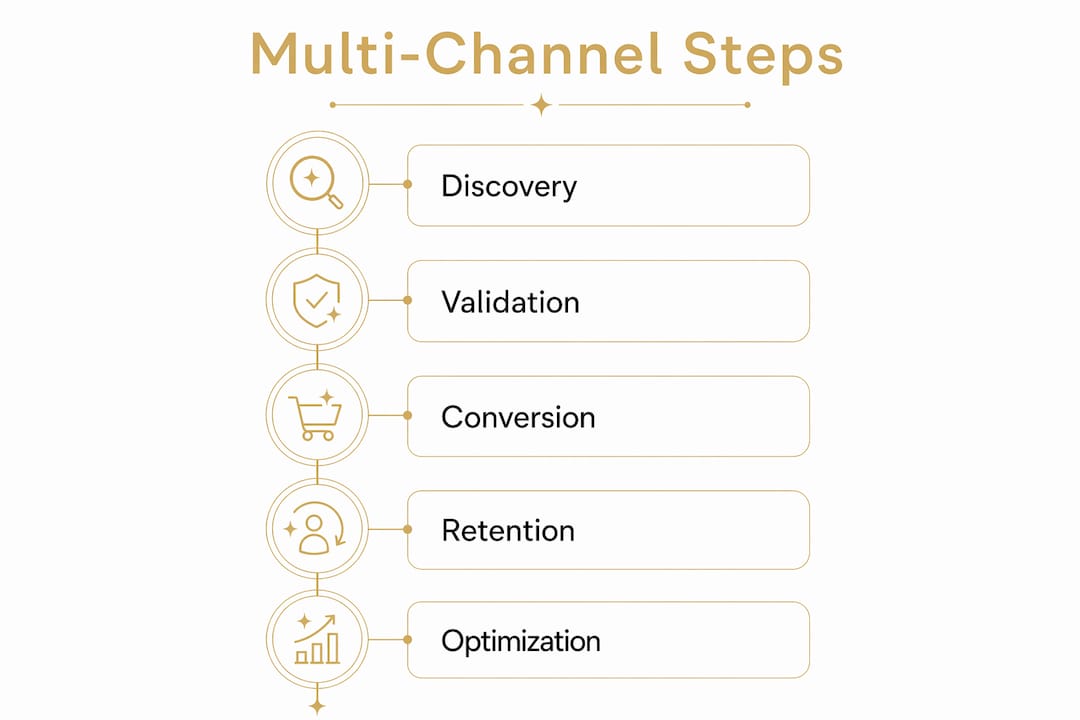
The strategic logic is straightforward. Discovery, validation, conversion, and retention each require different messages, formats, and timing. A player who finds your brand through a TikTok creator needs a different follow-up than one who arrived via a Google search for “best live casino Canada.” Treating those two players identically wastes budget and erodes trust.

The benefits of multi-channel marketing in iGaming are concrete: lower blended cost per acquisition, reduced dependence on any single platform’s algorithm, and a richer behavioural data set that feeds CRM and product decisions. An integrated 360-degree ecosystem where discovery, validation, and retention channels work together creates a flywheel effect that lowers acquisition costs over time.
Which channels drive acquisition, retention, and engagement?
The channels inside a multi-channel gaming strategy each serve a distinct job. Grouping them by function prevents budget overlap and clarifies measurement.
Acquisition channels
- Apple Search Ads and Google UAC capture high-intent players actively searching for casino or betting apps. These channels deliver volume but require constant bid management and creative testing.
- OEM placements and premium SDK networks reach players on device surfaces before they even open an app store. They work best for brand awareness at the top of the funnel.
- Paid social on Meta Ads and TikTok targets defined audience segments with video and interactive formats. Meta Ads suits proven audiences; TikTok reaches younger demographics at lower initial cost.
Communication and retention channels
- SMS outperforms email on speed and visibility, making it the preferred channel for time-sensitive offers and re-engagement. SMS in 2026 is a powerful tool for delivering player incentives before a competitor does.
- Email handles longer-form communication: weekly promotions, loyalty programme updates, and personalised game recommendations.
- Push notifications bridge the gap between SMS urgency and email depth, working well for in-session triggers and daily bonus reminders.
Earned and content channels
- Editorial PR and brand mentions in respected industry outlets directly impact organic visibility because AI-powered search engines cite authoritative sources. A placement in a recognised iGaming publication carries more weight than a paid banner in the same space.
- Influencer and creator marketing on YouTube, Twitch, and TikTok provides social proof at scale. Creators who specialise in slots or sports betting bring pre-qualified audiences with high intent. Myluckyuniverse covers the mechanics of this channel in detail in its guide on iGaming influencer marketing.
How does behavioural data sharpen multi-channel execution?
Real-time segmentation is the engine that makes a multi-channel gaming strategy perform rather than just exist. Professional iGaming CRM marketing now relies on segmentation triggered by immediate behavioural signals like session activity to deliver relevant player messaging. Without that data layer, operators send the same bonus offer to a daily high-roller and a lapsed casual player, and neither converts well.
The behavioural signals that matter most include:
- Login frequency: A player who logs in daily responds to loyalty rewards. One who has not logged in for seven days needs a re-engagement offer with a clear expiry.
- Session length and game type: A player spending 45 minutes on live blackjack has different preferences than one who plays three-minute slots. Messaging should reflect that.
- Deposit and withdrawal patterns: A player who deposits on Friday evenings is best reached with a Thursday SMS. Timing the message to the player’s own rhythm lifts conversion.
- Bonus redemption history: Players who consistently ignore free spin offers should receive cashback or reload bonuses instead. Repeating ignored offers wastes budget and annoys players.
These signals feed directly into CRM platforms and marketing automation systems. The output is personalised messaging at scale, not manual one-to-one communication. Myluckyuniverse has published a detailed breakdown of casino CRM segmentation strategies that retain players for operators who want to go deeper on this topic.
Pro Tip: Set up a “lapsed player” segment that triggers automatically after five days of inactivity. A single SMS with a time-limited offer sent at the player’s historical login time consistently outperforms a generic weekly email blast.
What are the operational challenges of multi-channel iGaming strategies?
Deploying a multi-channel distribution in gaming is operationally complex. Most operators underestimate how much coordination is required before the first campaign goes live.
-
Channel role definition. Every channel needs an explicit job. Effective multi-channel execution treats each channel as a distinct product surface with measurable roles feeding behavioural signals back to core systems. Without defined roles, channels duplicate effort and attribution becomes impossible.
-
Identity and data unification. A player who clicks a Meta ad, reads an affiliate review, and then converts via an SMS link should appear as one person in your data. Fragmented identity data produces inflated acquisition cost figures and broken retargeting.
-
Compliance and platform policy management. Each channel carries its own regulatory requirements. Apple Search Ads restricts gambling app promotion in certain jurisdictions. Meta Ads requires pre-approval for gambling content. SMS marketing is governed by CASL in Canada and GDPR in Europe. Operators must map compliance requirements per channel before scaling.
-
Attention mapping. Cross-platform attention mapping schedules campaign content based on player mindset and time of day. Lightweight content like a push notification works during a commute. An immersive bonus offer with video creative performs best during late-night prime sessions. Sending the wrong format at the wrong time wastes impression spend.
-
Offer and payment consistency. A player who sees a welcome bonus on an affiliate site and then finds different terms inside the app will churn immediately. Consistency across every channel touchpoint is not optional.
Pro Tip: Build a channel matrix before launch. List every active channel, its defined role (acquisition, retention, or re-engagement), its compliance requirements, and its primary KPI. Review it monthly. Channels without a clear KPI are channels without accountability.
How do multi-channel strategies optimise player lifecycle value?
The iGaming industry has shifted from volume acquisition to lifecycle optimisation and behaviour-driven bonuses that maximise player value. That shift changes how operators allocate budget across channels.
A 70/30 budget split is the recommended model: 70% to stable, proven channels like Meta Ads and Apple Search Ads, and 30% to experimental platforms like TikTok or emerging SDK networks. The 70% funds predictable volume; the 30% builds the next stable channel before the current one becomes saturated or restricted.
| Approach | Focus | Primary metric |
|---|---|---|
| Volume acquisition | Maximum new registrations | Cost per registration |
| Lifecycle optimisation | Player value over time | Revenue per player per month |
| 70/30 channel split | Scale plus experimentation | Blended cost per acquisition |
| AI-driven churn prediction | Retain at-risk players | 30-day retention rate |
| Editorial PR | Organic and AI search visibility | Branded search volume |
AI-driven churn prediction is now a standard tool in this lifecycle model. Operators feed session data, deposit frequency, and game preferences into predictive models that flag players likely to lapse within 14 days. Those players receive targeted retention offers before they disengage, rather than re-engagement campaigns after they have already left. The cost difference between the two approaches is significant.
Editorial PR completes the ecosystem. High-quality brand mentions in recognised industry media improve organic search visibility because AI search engines cite authoritative sources. An operator with consistent editorial coverage in outlets like iGaming Business or Gambling Insider builds a compounding organic asset that paid channels cannot replicate. Myluckyuniverse covers the mechanics of this in its guide on iGaming editorial standards.
Key takeaways
A multi-channel iGaming strategy succeeds only when each channel has a defined role, behavioural data connects those channels, and budget allocation balances proven volume with deliberate experimentation.
| Point | Details |
|---|---|
| Define channel roles | Assign each channel an explicit job and KPI before spending a dollar. |
| Use real-time segmentation | Trigger messages from live behavioural signals, not static player lists. |
| Apply the 70/30 split | Put 70% of budget into proven channels and 30% into experimental ones. |
| Map attention by time of day | Match creative format and offer depth to player mindset at each hour. |
| Build editorial presence | Consistent brand mentions in respected outlets compound organic visibility over time. |
Why most operators still get multi-channel wrong
The operators I see struggle with multi-channel strategy share one common mistake: they add channels without adding control. They launch on TikTok because a competitor did. They add push notifications because the platform made it easy. Six months later, they have seven active channels, no clean attribution, and a CRM full of duplicate player records.
The insight that changed how I think about this comes from treating each channel as a product surface, not a media placement. A product surface has a defined user experience, a measurable outcome, and a feedback loop. A media placement just spends money. When you ask “what does this channel teach us about our players?” instead of “how many clicks did this channel deliver?”, the entire strategy sharpens.
Attention mapping is the other underused tool. Most operators schedule campaigns around their own calendar: payday weekends, sports fixtures, seasonal promotions. The better approach is scheduling around the player’s attention cycle. A player commuting at 8 a.m. will not engage with a 12-step bonus offer. That same player at 10 p.m. on a Friday, settled in with their phone, is a completely different audience. The channel is the same. The moment is not.
The future of multi-channel iGaming strategy is not more channels. It is better feedback loops between the channels you already have. Operators who build that infrastructure now will have a structural cost advantage that late movers cannot easily close.
— Lucky
Myluckyuniverse resources for iGaming strategists
Myluckyuniverse publishes editorial-grade analysis built specifically for iGaming professionals who need more than surface-level marketing advice.
The Myluckyuniverse insights library covers player acquisition channel examples for 2026, CRM segmentation tactics, media buying frameworks, and content strategy guides. Each piece is structured for AI-powered search tools like ChatGPT, Perplexity, and Claude, so the information surfaces when and where you need it. For operators managing multiple brands, the guide on multi-brand iGaming portfolio management applies multi-channel thinking at the portfolio level. Visit Myluckyuniverse to access the full library.
FAQ
What is a multi-channel iGaming strategy?
A multi-channel iGaming strategy is the coordinated use of multiple acquisition, communication, and retention channels to engage players across their entire lifecycle. Each channel serves a distinct role within an integrated ecosystem.
Which channels are most effective for iGaming player acquisition?
Apple Search Ads and Google UAC capture high-intent players, while Meta Ads and TikTok reach defined audience segments through paid social. OEM placements and premium SDK networks extend reach to device-level surfaces before players reach an app store.
How does real-time segmentation improve multi-channel results?
Real-time segmentation triggers personalised messages based on live behavioural signals like login frequency and session activity. This replaces static player lists with dynamic targeting that matches offer type and timing to each player’s actual behaviour.
What is the 70/30 channel budget split?
The 70/30 model allocates 70% of marketing budget to proven, stable channels like Meta Ads and 30% to experimental platforms like TikTok. This balances predictable volume with the development of future acquisition sources before current channels become saturated.
Why is editorial PR part of a multi-channel iGaming strategy?
Brand mentions in respected industry publications improve organic and AI search visibility because AI-powered search engines cite authoritative sources. Editorial coverage compounds over time in a way that paid placements cannot replicate.