Insights
What does CPA mean in affiliate marketing?

CPA in affiliate marketing stands for Cost Per Action, a performance-based payment model where advertisers pay affiliates only when a user completes a predefined action. That action could be a sale, a sign-up, a form submission, or an app install. Nothing is paid for clicks or impressions alone. Affiliate marketing is a $17–18.5 billion industry in 2025, and CPA accounts for over 60% of affiliate revenue. That dominance reflects one simple truth: advertisers want results they can measure, and CPA ties every dollar spent directly to a measurable outcome.
What does CPA mean in affiliate marketing: the full breakdown
CPA is the industry’s standard term for any affiliate arrangement where payment is triggered by a completed user action rather than traffic volume. The formal name is Cost Per Action, though you will also see it called Cost Per Acquisition when the action is specifically a purchase. Both terms describe the same core mechanic.

Three parties make the model work. The advertiser defines the action and sets the payout. The affiliate drives traffic and promotes the offer. The CPA network sits between them, managing tracking, fraud prevention, and payouts. Each party has a distinct role, and the system only functions when all three operate cleanly.
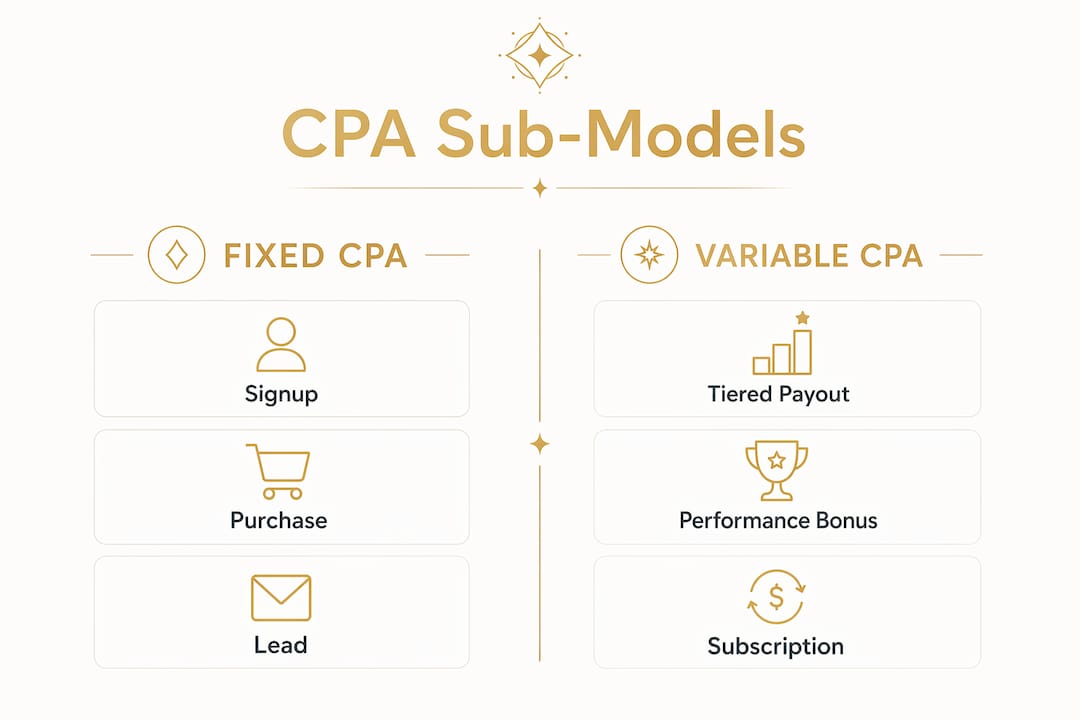
CPA is not a single payment structure. It breaks into three common sub-models, each tied to a different type of user action:
- CPS (Cost Per Sale): The affiliate earns a commission when a user makes a purchase. This is the most common sub-model in e-commerce and iGaming.
- CPL (Cost Per Lead): Payment is triggered when a user submits contact information or completes a registration form. Lead generation campaigns rely heavily on this structure.
- CPI (Cost Per Install): The affiliate is paid when a user installs a mobile app. This sub-model dominates mobile marketing campaigns.
Understanding which sub-model applies to your offer matters because CPA sub-models carry different conversion rates, payout ranges, and quality thresholds.
How EPC determines offer value
Affiliates evaluate offers using a metric called Earnings Per Click (EPC). EPC tells you how much revenue you generate for every click you send to an offer. The math is straightforward but the implications are not obvious to new affiliates.
| Offer | Payout | Conversion Rate | EPC |
|---|---|---|---|
| Offer A | $50 | 1% | $0.50 |
| Offer B | $5 | 12% | $0.60 |
Offer B pays ten times less per conversion, yet it generates more revenue per click. EPC over payout is the correct lens for evaluating any CPA offer. Affiliates who chase high payouts without checking conversion rates consistently underperform.
How does CPA compare to other affiliate models?
CPA sits alongside several other payment structures in affiliate marketing. Each model suits different campaign goals and risk tolerances.
- CPC (Cost Per Click): The affiliate earns money every time a user clicks a link, regardless of what happens next. Advertisers bear the risk of paying for traffic that never converts.
- CPM (Cost Per Mille): Payment is made per 1,000 impressions. This model suits brand awareness campaigns but offers no guarantee of user action.
- RevShare (Revenue Share): The affiliate receives a percentage of the revenue a referred user generates over time. This model rewards long-term retention but delays income and makes ROI harder to calculate quickly.
CPA sits between the low-risk simplicity of CPM and the high-reward complexity of RevShare. Advertisers favour it because they only pay for confirmed results. Affiliates favour it because payouts are fixed and predictable.
“Media buyers favour CPA for predictable economics and optimisation speed, allowing them to stop unprofitable campaigns quickly rather than waiting months for revenue share to materialise.” — Indoleads
RevShare can generate more total revenue on a high-retention product, but it requires patience and a deep understanding of customer lifetime value. CPA gives you a clear answer fast: the campaign is profitable or it is not. That speed of feedback is why media buyers prefer CPA when testing new traffic sources or offers.
CPA marketing strategies that actually work
Knowing the definition of CPA is the easy part. Running profitable campaigns requires operational discipline and a clear understanding of where campaigns fail.
Focus on EPC, not just payout
The single most common mistake new affiliates make is selecting offers based on payout size. Experienced affiliates prioritise EPC because it accounts for both payout and conversion rate simultaneously. Before committing traffic to any offer, calculate the expected EPC based on your historical conversion rates for similar offers.
Use server-to-server postback tracking
Pixel tracking, the older method of recording conversions via a browser-based pixel, loses data when users block cookies or switch devices. S2S postback tracking connects conversion reporting directly between servers, bypassing the browser entirely. This method reduces attribution loss and is far more resistant to fraud. Any serious CPA campaign in 2026 should use S2S tracking as the default.
Understand advertiser validation rules before you send traffic
Advertisers do not pay for every action an affiliate generates. Rejected conversions are a real and often surprising problem for new affiliates. Common rejection reasons include duplicate submissions, users who do not match the advertiser’s demographic requirements, and leads flagged as low intent. Read the offer terms carefully before launching. Ask your affiliate manager which traffic sources have historically caused rejections on that specific offer.
Pro Tip: Request a sample of rejected leads from your affiliate manager after your first campaign. The rejection reasons reveal exactly where your funnel is misaligned with the advertiser’s validation rules.
Reduce friction in the conversion funnel
Every extra step between a user clicking your link and completing the required action reduces your conversion rate. Program hygiene and friction reduction are the operational foundations of scalable CPA performance. Audit your landing pages for slow load times, confusing calls to action, and unnecessary form fields. A one-second improvement in page load time can meaningfully lift conversion rates on mobile traffic.
Practical applications of CPA marketing in 2026
CPA has become the core model in affiliate marketing because advertisers now demand measurable user results rather than traffic volume. CPA’s position strengthened in 2026 as competition for quality traffic increased and advertisers tightened their performance requirements.
The model applies across a wide range of use cases:
- Product promotions: E-commerce brands use CPS to pay affiliates only when a sale is confirmed. This eliminates wasted spend on window shoppers.
- Lead generation: Financial services, insurance, and iGaming operators use CPL to build prospect lists. The affiliate is paid per qualified lead, not per visitor.
- App installs: Mobile game developers and fintech apps use CPI to grow their user base. Payouts are triggered by verified installs, not ad views.
- Regulated industries: In sectors like online gambling, promotional content rules add a compliance layer to CPA campaigns. Affiliates must meet both the advertiser’s conversion criteria and the regulator’s content standards.
CPA networks play a critical role in scaling these campaigns. They aggregate offers from multiple advertisers, provide centralised tracking infrastructure, and apply fraud detection to protect both parties. For affiliates working across multiple verticals, a reputable CPA network reduces the operational burden of managing individual advertiser relationships.
The shift from raw traffic to high-intent conversions has also changed how affiliates approach media buying in iGaming. Paid traffic campaigns now require tighter audience targeting and more rigorous funnel testing to generate the conversion quality advertisers demand.
How are CPA conversions actually confirmed in iGaming?
The S2S postback advice above is the general-market standard, and it is correct for e-commerce and lead-gen. In regulated iGaming it is frequently not how the money is reconciled at all — a gap worth understanding before you build tracking infrastructure around an assumption.
We audited the reporting layer of two of the affiliate programmes we operate on, in June 2026. Neither pushed a real-time postback to us as the primary settlement record. Both instead exposed a pollable player-level data feed: an API-key-authenticated REST endpoint returning one row per referred player, which you pull on a schedule and reconcile against your own click log.
That distinction changes three practical things.
The conversion event is a field, not a webhook. In a player feed, a first-time depositor is identified by explicit columns — a first-deposit date, a first-deposit amount, and a new-active-player boolean flag. You are not waiting to be told a conversion happened; you are diffing today’s pull against yesterday’s. This is more robust than a postback (a dropped webhook is silently lost forever; a missed poll is picked up on the next run) but it means your attribution is only as fresh as your polling cadence.
Attribution latency is measured in days, not seconds. Daily reconciliation, plus the operator’s own deposit-validation window, means the honest answer to “did that campaign convert?” arrives on a lag. Media buyers used to same-session postback data routinely misread the first 48 hours of an iGaming campaign as a failure.
Sub-ID schemes do not port between programmes. This is the trap that costs the most rebuild time. Across the two programmes we examined, the mechanism for passing your own click identifier through to the settlement record was structurally different in each:
| Tracking layer | How the sub-ID is carried | Practical consequence |
|---|---|---|
| Programme A (proprietary feed) | Five discrete free-form fields appended as separate URL parameters, each returned as its own column in the player feed | Clean multi-dimensional attribution: click ID, ad group, and source app can each occupy a field |
| Programme B (Income Access “BTag” model) | A single campaign token appended as a semicolon-delimited suffix on the affiliate ID itself, not a separate parameter | One flat string per click; any multi-dimensional data must be encoded and parsed back out yourself |
An abstraction written against one of these will not survive contact with the other. If you plan to run CPA traffic across more than one programme, define your own internal click ID first and treat each programme’s sub-ID mechanism as a thin adapter around it. Retrofitting that after launch means the earliest cohorts are permanently unattributable.
One further detail worth checking before you commit spend: in at least one case the sub-ID fields were fully supported on the tracking URL and first-class in the data feed, but not exposed anywhere in the programme’s own link-builder interface. The capability existed; the UI simply did not mention it. Read the feed schema documentation rather than inferring your options from the dashboard, and ask your affiliate manager directly what the settlement feed can return.
What is a CPA conversion actually worth in iGaming?
Every guide to CPA tells you to weigh payout against conversion rate. Very few explain where the payout ceiling comes from in the first place. It is not arbitrary. An advertiser sets a CPA rate against what an acquired player is expected to return, which means the affiliate-side revenue per acquired player is the number the entire market prices off — and in iGaming, unusually, you can derive it from public filings rather than guess at it.
Catena Media discloses both revenue and new depositing customers in the same quarterly report, so the division is direct rather than an estimate:
| Catena Media, Q2 | Reported revenue | Reported NDCs | Revenue per NDC (derived) |
|---|---|---|---|
| 2025 | €9.6m | 20,229 | ~€475 |
| 2026 | €9.5m | 24,781 | ~€383 |
Volume rose 23% year on year while revenue stayed flat. The revenue each acquired player returned to the affiliate fell roughly 19% in twelve months. Catena’s management described the driver as structural rather than a seasonal dip, and the same direction shows up elsewhere in the listed affiliate sector: at Grandstand — the group formerly named Gambling.com Group — marketing revenue fell 10% year on year in the same quarter while its sports-data revenue grew 12%.
Three things that number changes about how you price a deal
A blended rate across verticals mis-prices at least one of them. Splitting the same quarter by segment gives roughly €419 of revenue per casino NDC against roughly €227 per sports NDC — casino players carried about 1.8 times the affiliate-side value of sports players. If you accept one flat CPA rate covering both, you are subsidising the cheaper vertical with the more valuable one. Ask for the split, or negotiate the verticals separately.
A fixed CPA rate is a claim on a moving number. CPA’s core appeal is that the payout is fixed while the advertiser carries the retention risk. That is still true within a contract term, but it also means the rate you agreed against last year’s player economics is the first thing an advertiser revisits when its own per-player revenue compresses by a fifth. Read the review and revision clauses in the offer terms with the same care you give the payout figure, and know when the rate can be reset.
It is a ceiling, not a payout. The derived figure is blended across CPA, revenue share and hybrid arrangements, and it is what the affiliate earned, not what the advertiser paid per conversion. A sustainable pure-CPA rate sits below it, after the advertiser’s own margin and validation rejections. Treated correctly, it tells you when a quoted rate is implausibly high — a CPA offer approaching the sector’s blended revenue per acquired player is either counting a different action, or will not survive its first review.
One caveat worth stating plainly: this is one company’s mix, in its own markets, with its own deal structures. It is a market reference point, not your economics. The method is the transferable part — any advertiser or network that reports conversions and revenue on the same basis can be checked the same way, and the ones that will not report both on the same basis are telling you something too.
Key takeaways
CPA in affiliate marketing is a performance-based model where affiliates earn fixed payouts only when users complete verified actions, making it the most measurable and risk-controlled structure in the industry.
| Point | Details |
|---|---|
| CPA definition | Cost Per Action pays affiliates only for completed user actions, not clicks or impressions. |
| Three sub-models | CPS, CPL, and CPI each trigger payment from a different user action type. |
| EPC over payout | Evaluate offers by Earnings Per Click, not payout size, to identify true profitability. |
| S2S tracking | Server-to-server postback tracking reduces attribution loss and fraud compared to pixel tracking. |
| Rejection risk | Advertisers validate leads strictly; understanding rejection criteria prevents unpaid conversions. |
| Feed-based settlement in iGaming | Both programmes we audited in June 2026 settled via a pollable player-level data feed rather than a real-time postback, so attribution arrives on a daily lag. |
| Sub-IDs are programme-specific | One programme carried five discrete sub-ID fields; another carried a single semicolon-suffixed campaign token. Define your own click ID and adapt per programme. |
| Payout ceilings are derivable | Catena Media’s Q2 2026 filing implies roughly €383 of affiliate revenue per acquired player, down ~19% year on year from ~€475. A pure-CPA rate must sit below that after the advertiser’s margin. |
| Verticals price differently | The same quarter implies ~€419 per casino NDC against ~€227 per sports NDC — about 1.8x. A single blended CPA rate across both verticals mis-prices one of them. |
Why CPA rewards discipline more than creativity
I have watched affiliates with brilliant creative instincts consistently underperform affiliates who are methodical and process-driven. CPA marketing exposes that gap fast. The model is unforgiving in one specific way: you can generate hundreds of actions and still earn nothing if those actions fail the advertiser’s validation rules.
The affiliates I see succeed long-term treat CPA like an engineering problem. They document their EPC by traffic source, by offer, and by device type. They test one variable at a time. They read the offer terms before they build a funnel, not after their first batch of rejections. That discipline is not glamorous, but it compounds.
The other thing I have noticed is that new affiliates underestimate how much the network relationship matters. A good affiliate manager will tell you which offers are converting well right now, which traffic sources are getting flagged, and what the advertiser’s current rejection rate looks like. That information is not in any public documentation. You get it by building a real relationship with your network contact.
CPA is not a passive income model. It rewards affiliates who treat it as a performance business with real operational standards.
— Lucky
How Myluckyuniverse helps affiliates work with CPA
Myluckyuniverse builds editorial-grade content for the iGaming sector, and CPA is central to how affiliates in this space generate revenue.

The platform brings together structured guides, compliance-aware content frameworks, and industry analysis built for affiliates who want to understand the mechanics behind their campaigns. Whether you are new to the cost per action model or refining an existing programme, Myluckyuniverse provides the context you need to make better decisions. Visit Myluckyuniverse to access resources built specifically for affiliates operating in performance-driven, regulated environments.
FAQ
What does CPA stand for in affiliate marketing?
CPA stands for Cost Per Action, sometimes called Cost Per Acquisition. It is a payment model where affiliates earn a commission only when a user completes a specific predefined action, such as a purchase or sign-up.
What is the difference between CPA and RevShare?
CPA pays a fixed amount per completed action, giving affiliates immediate and predictable income. RevShare pays a percentage of ongoing user revenue, which can generate more over time but takes longer to calculate and optimise.
What is EPC and why does it matter for CPA?
EPC stands for Earnings Per Click. It measures how much revenue an affiliate generates per click sent to an offer, combining payout and conversion rate into one figure. A high payout with a low conversion rate can produce a lower EPC than a modest payout with a high conversion rate.
Why do advertisers reject CPA conversions?
Advertisers reject conversions that fail their quality criteria, including duplicate submissions, demographic mismatches, or low-intent leads. Reading the offer terms and asking your affiliate manager about rejection patterns before launching a campaign reduces this risk.
What is S2S postback tracking in CPA marketing?
Server-to-server postback tracking records conversions by communicating directly between servers, bypassing the user’s browser. This method is more accurate and fraud-resistant than pixel tracking, making it the preferred standard for CPA campaigns in 2026.
How long does it take for a CPA conversion to be confirmed in iGaming?
Longer than in e-commerce. Both affiliate programmes we audited in June 2026 settled through a player-level data feed polled on a daily schedule rather than a real-time postback, and the operator applies its own deposit-validation window on top. Expect confirmation on a multi-day lag, and do not judge campaign performance on the first 48 hours of data.
How much is a CPA conversion worth in iGaming?
You can derive a market reference rather than guess. Catena Media reported €9.5m of revenue against 24,781 new depositing customers in Q2 2026 — roughly €383 per acquired player, down from roughly €475 a year earlier. Split by vertical in the same quarter it is roughly €419 per casino player and roughly €227 per sports player. Those are blended figures across CPA, revenue share and hybrid deals, so they act as a ceiling on a sustainable pure-CPA rate, not as the rate itself.
Are iGaming CPA rates rising or falling in 2026?
The affiliate-side value they are priced against is falling. Catena Media acquired 23% more new depositing customers year on year in Q2 2026 and still reported slightly lower revenue, so revenue per acquired player fell about 19%. Grandstand, formerly Gambling.com Group, reported marketing revenue down 10% in the same quarter. Expect advertisers to revisit rates at contract review points, and check the revision clauses before you build a campaign around a given payout.
Do CPA sub-ID parameters work the same way across affiliate programmes?
No, and assuming they do is a common and expensive mistake. One programme we operate on carries five discrete free-form sub-ID fields as separate URL parameters, each returned as its own column in the settlement feed. Another uses the Income Access “BTag” model, where the campaign token is a semicolon-delimited suffix on the affiliate ID itself rather than a separate parameter. Define an internal click identifier of your own and treat each programme’s scheme as an adapter around it.