Insights
What does multimodal content mean for marketers?

Multimodal content is defined as any communication that intentionally combines two or more distinct modes, such as linguistic, visual, aural, spatial, and gestural, to convey a richer and more complete message. The term comes from social semiotics and communication theory, where researchers like Gunther Kress established that meaning is never made through words alone. For content creators and marketers, understanding what multimodal content means is the difference between publishing material that gets skimmed and publishing material that gets remembered. Platforms like Myluckyuniverse build their entire editorial approach around this principle, structuring content so that text, visuals, and format all reinforce the same core message.
What does multimodal content mean, exactly?
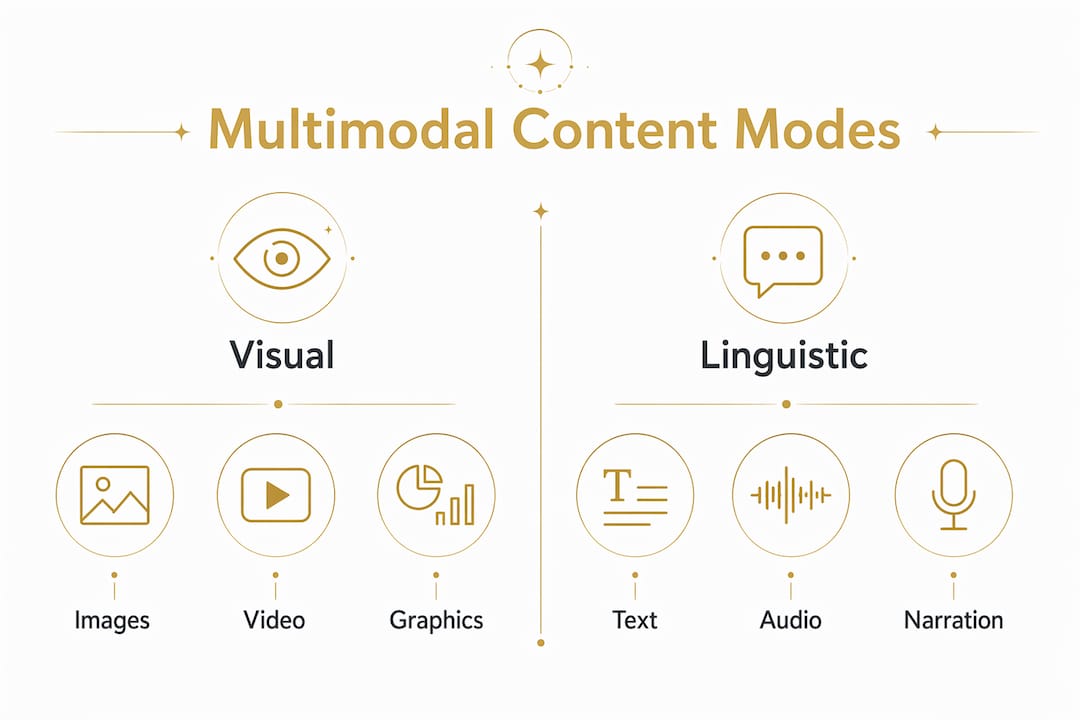
Multimodal content refers to communication that uses two or more modes, with the most common being linguistic, visual, aural, spatial, and gestural. Each mode carries its own layer of meaning, and combining them produces understanding that no single mode can achieve alone.

The WOVEN model, developed in academic communication frameworks, outlines five overlapping channels: written, oral, visual, electronic, and nonverbal. Marketers rarely use the WOVEN label, but the principle is identical to what drives modern content strategy. A blog post with embedded video, pull quotes, and a branded colour palette is a multimodal document, even if no one called it that during production.
Every design choice, from image placement to font size to page layout, carries semiotic significance beyond the words themselves. This is why two articles covering the same topic can produce completely different audience responses. The mode mix shapes perception as much as the message does.
What are the main modes in multimodal content?
The five core modes each serve a distinct function in communication:
- Linguistic mode: Written and spoken language. This includes body copy, headlines, captions, scripts, and transcripts. It is the most familiar mode for most content teams.
- Visual mode: Images, video, charts, infographics, and illustrations. Visuals communicate relationships and emotion faster than text in most contexts.
- Aural mode: Sound, music, narration, and ambient audio. Podcasts and video voiceovers rely almost entirely on this mode to carry tone and authority.
- Spatial mode: Layout, white space, hierarchy, and the physical or digital arrangement of elements. A cluttered layout undermines even strong copy.
- Gestural mode: Body language, facial expression, and movement. This mode is most active in video content and live presentations.
The real power comes from combining these modes so they reinforce each other. A product explainer video that pairs clear narration (aural) with annotated screen recordings (visual) and a well-structured transcript (linguistic) gives audiences three simultaneous entry points into the same idea.
Pro Tip: Design your content so that removing any single mode still leaves a coherent message. If your video only makes sense with sound, you have a single-mode asset wearing a multimodal costume.
How does multimodal content differ from multichannel strategies?
This is the most common point of confusion for marketing teams, and the distinction matters enormously for results.
A multichannel strategy distributes the same content across multiple platforms. The same blog post goes to LinkedIn, X, and an email newsletter with minimal adaptation. A multimodal strategy takes one core message and transforms it into genuinely different formats, each suited to how audiences consume that specific medium.
| Dimension | Multichannel approach | Multimodal approach |
|---|---|---|
| Core asset | Identical across platforms | Adapted into unique formats |
| Audience experience | Repetition | Reinforcement through variety |
| Retention impact | Low to moderate | Higher, through multiple entry points |
| Production effort | Lower | Higher upfront, lower over time |
| AI search visibility | Partial | Strong, across text, image, and video indexing |
A multimodal strategy transforms one core message into multiple unique formats, such as text, video, and audio, rather than reposting the same content across platforms. That distinction is what separates brands that build genuine audience depth from those that simply accumulate impressions.
A practical example: a casino content team produces a 2,000-word guide on bankroll management. The multimodal version turns that guide into a short explainer video, a downloadable infographic, a podcast segment, and a structured FAQ optimised for AI search. Each format serves a different audience behaviour. The multichannel version just posts the same article link on five platforms.
Pro Tip: Start every campaign with a single anchor piece designed for modular reuse. Write the long-form article first, then extract the video script, the infographic data points, and the podcast talking points from it. You will produce four assets in the time it used to take to produce two.
What role does multimodal AI play in content creation?
Multimodal AI systems process multiple data types simultaneously, including text, images, audio, and video, to deliver deeper context and more efficient production workflows. Models like GPT-4o and Gemini represent this capability at scale, handling tasks that previously required separate specialists for copy, design, and audio.
The practical impact for content teams is significant. Multimodal AI reduces the “handoff” friction that slows production when writers, designers, and audio producers work in isolated queues. When one system can draft copy, suggest image concepts, and flag audio-text misalignment in a single pass, revision cycles shrink.
Here is what multimodal AI changes in a typical content workflow:
- Asset alignment: AI reviews text and visuals together, catching cases where an image contradicts or weakens the written message.
- Format conversion: A written brief can generate a video storyboard, a social caption set, and a structured data outline without separate briefing rounds.
- Consistency checking: AI flags tone or terminology inconsistencies across formats before publication.
- Speed: Content production pace increases across industries as teams review and adjust content holistically rather than asset by asset.
For marketers working in fast-moving sectors like iGaming, this speed advantage is not trivial. Myluckyuniverse uses AI-assisted workflows to produce structured, multi-format editorial content that serves both human readers and AI search engines simultaneously. Creators who want to understand how AI tools fit into gambling content can read more about AI in gambling content.
Why is multimodal content important for modern marketers?
The importance of multimodal content comes down to three converging forces: audience cognition, search engine evolution, and competitive differentiation.
Human memory works through multiple encoding pathways. Integrating multiple literacy modes enhances message memorability and audience connection. A reader who watches a video, reads a summary, and sees a supporting infographic encodes the same message three times through different cognitive channels. That repetition through variety is what drives retention, not repetition through identical exposure.
Search engines have shifted to match this reality. Modern AI search engines pull information from text, images, and videos, making multimodal content necessary for visibility. Brands that publish only text risk being excluded from AI-generated summaries that draw on image alt text, video transcripts, and structured data alongside written copy.
The competitive argument is equally direct. Brands that confuse multimodal strategy with multichannel marketing miss the real value, which is creating unified, reinforcing content formats that build a consistent brand message across every touchpoint. A reader who encounters your brand through a podcast, then finds your infographic in a search result, then reads your long-form article has had three distinct but aligned experiences. That depth of exposure builds trust faster than any single format can.
Multimodal content also serves diverse learning preferences. Some readers absorb information through structured text. Others need a visual diagram. Others retain information best through audio. A multimodal approach reaches all three groups with the same campaign budget.
How to create multimodal content that actually works
Effective multimodal content creation follows a clear sequence. Skipping steps produces the most common failure mode: formats that look multimodal but carry misaligned messages.
- Start with an anchor piece. Write a comprehensive long-form asset first. This becomes the source of truth for every other format. Modular content design built around an anchor piece helps efficiently generate related formats without duplication.
- Map each mode to a specific audience behaviour. Video suits discovery and emotional connection. Infographics suit sharing and quick reference. Audio suits commuters and multitaskers. Match the format to the moment, not just the message.
- Align semantics across all modes. Semantic alignment means that AI and audiences perceive the same concept in text, images, and audio at equal depth. If your article discusses risk management but your accompanying image shows a generic stock photo of a laptop, you have broken the semantic chain.
- Build a shared asset library. Store approved visuals, audio clips, and copy blocks in one place. This prevents different team members from producing formats that contradict each other in tone or terminology.
- Measure by format, not just by campaign. Track which modes drive the most time on page, shares, and conversions separately. This tells you where to invest more production effort in the next cycle.
Pro Tip: Never finalise your visual assets before your copy is locked. Designers working from a rough brief produce images that fit the brief, not the final message. Mismatched visuals are the single most common cause of weak multimodal campaigns.
For a practical look at how this applies in iGaming, Myluckyuniverse covers casino content marketing best practices in detail.
Key takeaways
Multimodal content works because it encodes the same message through multiple cognitive pathways, making it more memorable, more findable by AI search, and more accessible to diverse audiences.
| Point | Details |
|---|---|
| Core definition | Multimodal content combines two or more modes: linguistic, visual, aural, spatial, and gestural. |
| Multimodal vs. multichannel | Multichannel repeats content; multimodal transforms it into genuinely different formats. |
| AI search visibility | Text-only content risks exclusion from AI-generated summaries that index images and video. |
| Anchor piece method | Build one comprehensive asset first, then extract each format from it to keep messaging aligned. |
| Semantic alignment | Visuals, audio, and text must convey the same concept or AI systems may misinterpret the content. |
Why I think most teams are still getting this wrong
The honest observation after watching content teams work across multiple industries is this: most organisations adopt multimodal content as a production checklist rather than a communication philosophy. They add a video to an article and call it multimodal. They record a podcast version of a blog post using the same script, word for word. Neither of those approaches captures what multimodal communication actually does.
The teams that see real results treat each mode as a distinct language with its own grammar. A video is not a blog post with pictures. An infographic is not a data table with colour. Each format requires its own structural logic, and the skill is in making all of those logics point at the same core idea without being identical.
The AI dimension makes this more urgent, not less. As GPT-4o, Gemini, and similar systems become the primary interface between audiences and information, content that fails the semantic alignment test simply will not surface. Creators who invest in genuine multimodal thinking now are building a structural advantage that will compound over the next several years.
The shift is not complicated, but it does require changing how teams brief, produce, and measure content. Start with the anchor piece. Lock the message before you touch the formats. Measure each mode separately. That sequence alone will put most teams ahead of the majority of their competitors.
— Lucky
Myluckyuniverse and multimodal content strategy
Myluckyuniverse was built from the ground up as an AI-native editorial platform, which means multimodal content is not an add-on. It is the foundation of how every piece of content is structured, produced, and distributed across the iGaming sector.
The platform produces editorial-grade content that works across text, structured data, and visual formats, all designed to perform in AI-powered search environments. Creators and marketers who want to see how this approach applies to real content strategy can explore AI-optimised casino content or visit Myluckyuniverse directly to see the full range of content formats in action.
FAQ
What does multimodal content mean in simple terms?
Multimodal content is any communication that combines two or more modes, such as text, images, sound, and layout, to convey a message more effectively than any single mode could alone.
What are the most common examples of multimodal content?
Common examples include explainer videos with narration and on-screen text, infographics that pair data with visuals, and podcast episodes accompanied by written transcripts and show notes.
How does multimodal content help with AI search visibility?
AI search engines index text, images, and video simultaneously, so content that uses multiple aligned modes appears in more search contexts than text-only content does.
What is the difference between multimodal and multichannel content?
Multichannel distributes the same content across multiple platforms; multimodal transforms one core message into genuinely different formats suited to each medium and audience behaviour.
How do I start building a multimodal content strategy?
Begin with a single comprehensive anchor piece, then extract each format, such as video, audio, and infographic, from that source document to keep all modes semantically aligned.