Insights
Grow iGaming organic traffic: the 2026 SEO guide

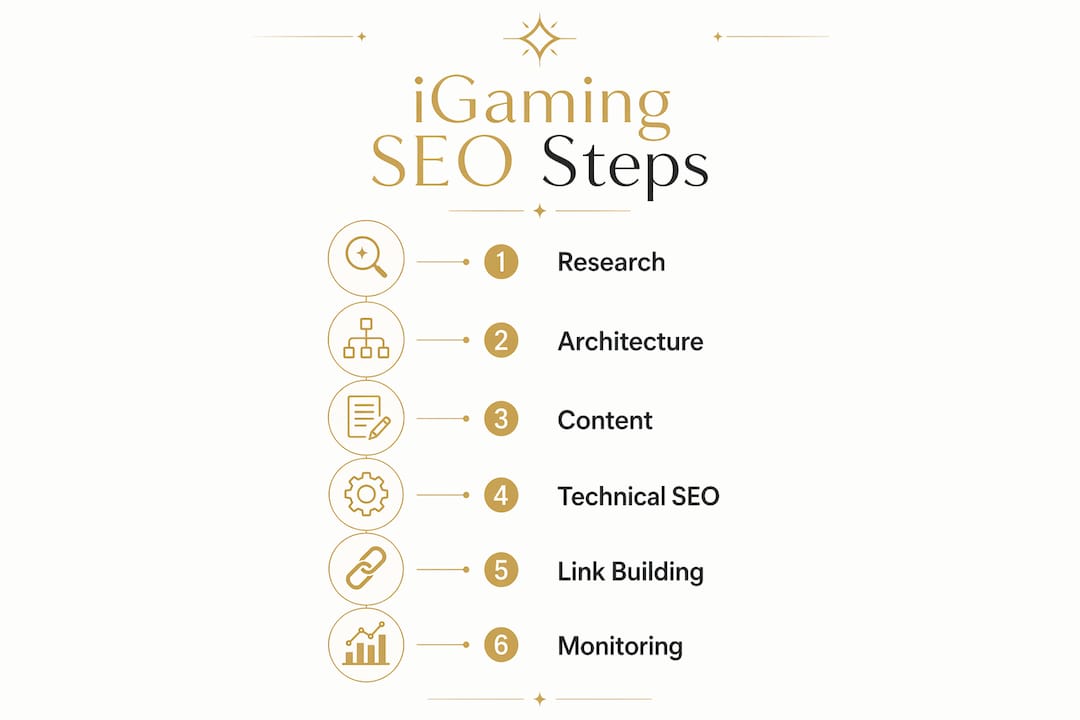
Organic search is the most cost-effective acquisition channel in iGaming, and the gap between it and paid media is widening fast. Paid CPAs have risen 15–25% year-on-year for three consecutive years in major regulated markets. That makes organic the only channel with near-zero marginal cost per first-time deposit. To grow iGaming organic traffic sustainably, you need three things working together: high-intent commercial content, technical SEO precision, and EEAT signals built around named human authors. This guide covers each layer in the order you should build them.
What foundations do you need to grow iGaming organic traffic?
The groundwork determines whether your SEO investment compounds or collapses. Skipping any of these foundations is the most common reason iGaming sites plateau after early gains.
Regulatory and geo-targeting setup

Every regulated market restricts what you can say and to whom. Your site architecture must reflect this from day one. Use geo-targeted subfolders or subdomains for each jurisdiction, and keep compliance-specific content separate from general editorial. Mixing them creates indexing problems and exposes you to regulatory risk.
Site architecture built around commercial intent
Your pillar pages must be high-intent commercial category pages, not blog posts. Operator review pages, game category pages, and offer landing pages should sit at the top of your internal link hierarchy. Informational content supports these pages; it does not replace them.
Named-author EEAT signals
Named-author EEAT is the strongest predictor of ranking resilience in iGaming. It outweighs domain authority and backlink volume. Every review and editorial piece needs a real person attached to it, with a bio, credentials, and schema markup confirming their identity. Generic “editorial team” attributions no longer hold up under Google’s quality assessments.
Technical SEO baseline
Mobile Core Web Vitals are non-negotiable. Largest Contentful Paint (LCP) must stay under 4.0 seconds, particularly on pages that load slot iframes. Failing this threshold risks silent deindexing, which means Google drops the page without any manual action notice.
Keyword segmentation
Split your keyword targets into three tiers:
- Head terms (e.g., “online casino Canada”): high volume, long time to rank, worth targeting with category pages
- Mid-tail terms (e.g., “best live dealer casinos 2026”): moderate competition, faster ranking windows
- High-intent long-tail terms (e.g., “no wagering bonus Canada”): lower volume, highest conversion rate, fastest to rank
Pro Tip: Build your content calendar around long-tail commercial terms first. They rank faster, convert better, and give you data to justify investment in head terms.
How do you create content that captures high-intent organic traffic?
Content strategy in iGaming is not about publishing volume. It is about matching content type to user intent at each stage of the decision process.
Prioritise commercial-intent pages
AI Overviews now capture 30–50% of informational search traffic in iGaming. That traffic is largely gone from traditional organic results. The pages that still drive registrations and deposits are commercial-intent pages: operator reviews, bonus comparison pages, and game category listings. Shift your content investment toward these page types.
Quarterly content refresh cadence
Static content decays. Refreshing roughly 30% of your evergreen content quarterly prevents algorithmic decay and keeps topical authority intact. A quarterly audit should update bonus terms, operator ratings, regulatory status, and any outdated statistics. Pages that have not been touched in six months are losing ground to fresher competitors.
Schema markup: what to use and what to avoid
Review schema with self-assigned star ratings triggers Google manual actions in iGaming. Use Article schema instead, with a named author, a publication date, and a last-modified date. This approach signals editorial credibility without the penalty risk. For schema markup implementation, the structured data must match the visible page content exactly.
Named author bios
Each author page should include a photo, a short professional biography, verifiable credentials, and links to external profiles where relevant. This is not optional decoration. Google’s quality raters use author pages as a primary signal when assessing EEAT for Your Money or Your Life (YMYL) content, and iGaming falls squarely in that category.
Key content types to prioritise:
- Operator review pages with structured comparison tables
- Bonus and promotion landing pages updated in real time
- Game category pages targeting mid-tail keywords
- Jurisdiction-specific guides addressing local regulations
- FAQ sections targeting long-tail question queries
Pro Tip: When refreshing content, update the last-modified date in both the page metadata and the Article schema. Google uses this signal to assess content freshness.
What technical SEO tactics boost organic traffic for iGaming sites?
Technical SEO in iGaming has one unique challenge that most other niches do not face: slot game iframes. These embedded game frames are among the heaviest page elements on the web, and they destroy LCP scores if loaded on page render.
Click-to-play iframe loading
The fix is a click-to-play mechanism. The page loads a static image of the game instead of the live iframe. When a visitor clicks the image, the iframe loads. This single change can bring LCP from well above 4.0 seconds down to under 2.5 seconds on mobile. It also improves conversion rates because the page feels faster to users who are browsing rather than immediately playing.
Mobile-first indexing requirements
Google indexes the mobile version of your site first. Any content, internal links, or schema markup that appears only on the desktop version is invisible to Google’s crawler. Audit your mobile pages separately and confirm that all structured data, canonical tags, and navigation elements are present on mobile.
Multilingual and multi-jurisdiction deployment
Each jurisdiction needs its own URL structure, hreflang tags, and localised content. A Canadian English page and a UK English page targeting the same keyword should not share a URL. Duplicate content across jurisdictions is a common cause of ranking cannibalisation in iGaming.
| Technical element | Requirement | Risk if ignored |
|---|---|---|
| Mobile LCP | Under 4.0 seconds | Silent page deindexing |
| Slot iframe loading | Click-to-play mechanism | Poor Core Web Vitals scores |
| Schema markup | Article schema with named author | Manual action for self-assigned stars |
| Hreflang tags | Per jurisdiction and language | Ranking cannibalisation |
| Core Web Vitals audit | Quarterly review | Gradual ranking erosion |
Pro Tip: Run a separate Core Web Vitals audit for your slot and game pages. They behave differently from editorial pages and often fail LCP thresholds that your other pages pass easily.
How does link building improve your iGaming organic traffic?
Link acquisition in iGaming is more expensive and more scrutinised than in almost any other niche. Spending budget on the wrong publishers wastes money and can attract algorithmic penalties.
Five criteria for publisher qualification
Evaluate every publisher against five criteria before committing to a placement:
- Niche acceptance: does the site publish iGaming content without restrictions?
- Domain authority: is the site’s authority score consistent with its age and traffic?
- Traffic health: does the site have real, consistent organic traffic from target markets?
- Outbound link density: does the page already link to too many external sites?
- GEO relevance: does the site’s audience match your target jurisdiction?
Evaluating link value
Link value depends on authority transfer, topical relevance, and editorial depth. A high-priced placement on a general news site often underperforms a lower-cost link from a niche gambling publication with genuine editorial standards. For a deeper look at how this works in practice, Myluckyuniverse covers iGaming link building strategy in detail.
Measuring link impact
Tie each link acquisition campaign to specific pages and keyword clusters. This makes attribution cleaner and helps you identify which publisher categories drive the most ranking movement. Track keyword position changes for target pages in the 30–90 days after a link goes live.
What are common pitfalls when growing iGaming organic traffic?
Most organic traffic failures in iGaming come from predictable mistakes. Knowing them in advance is cheaper than learning them through traffic drops.
- Templated affiliate content: copy-paste review templates with minimal original analysis trigger quality penalties. Operators using shortcuts risk losing 40–70% of domain-wide traffic from a single algorithm update.
- Ignoring named-author signals: Google’s 2026 helpful content updates continue to prioritise content with verifiable human authors. Anonymous content on YMYL pages ranks poorly and stays poor.
- Chasing informational traffic: with AI Overviews absorbing a large share of informational queries, investing heavily in top-of-funnel blog content produces diminishing returns. Commercial pages convert; informational pages increasingly do not.
- Measuring only traffic: SEO success in iGaming must be measured by cost-per-first-time-deposit and organic player lifetime value, not rankings or sessions alone. A site with 50,000 monthly visitors and no deposits is not performing.
- Expecting fast results: initial organic growth takes 3–6 months for competitive keywords, with compounding growth appearing between months 7 and 12. Pulling investment before that window closes is the most expensive mistake in iGaming SEO.
Key takeaways
Sustainable organic growth in iGaming requires named-author EEAT, commercial-intent content, technical precision on mobile, and measurement tied directly to first-time deposits and player lifetime value.
| Point | Details |
|---|---|
| EEAT over backlinks | Named human authors with verified credentials outperform domain authority as a ranking signal. |
| Commercial content first | Operator reviews and bonus pages drive deposits; informational content is losing ground to AI Overviews. |
| Fix slot page speed | Click-to-play iframe loading keeps LCP under 4.0 seconds and prevents silent deindexing. |
| Refresh content quarterly | Update at least 30% of evergreen pages each quarter to prevent algorithmic decay. |
| Measure business outcomes | Track cost-per-first-time-deposit and player lifetime value, not just traffic or keyword rankings. |
What I have learned about iGaming SEO the hard way
The iGaming SEO space rewards patience in a way that almost no other niche does. I have watched operators pour budget into link building and content production, then abandon the programme at month five because rankings had not moved enough. Every single time, they left just before the compounding phase began.
The shift I keep pushing for is measuring SEO from impressions all the way down to organic first-time deposits and player lifetime value. Most teams stop at traffic or keyword position. Those metrics feel good but they do not tell you whether the channel is actually profitable. When you tie SEO to business metrics like FTD and LTV, the conversation with stakeholders changes completely. You stop defending traffic numbers and start showing acquisition cost comparisons against paid channels.
The click-to-play iframe fix is the most underrated technical change I have seen move rankings on slot pages. It is not glamorous, but it solves a problem that is unique to iGaming and that most generic SEO guides never mention. If your game pages are loading full iframes on render, fix that before anything else.
My honest caution: do not chase every keyword in your market. Pick the commercial clusters where you can build genuine topical authority, invest in real editorial talent with named credentials, and let the compounding do its work. The operators who treat SEO as a long game consistently lower their marginal acquisition cost over time. The ones who chase shortcuts consistently end up rebuilding after penalties.
— Lucky
How Myluckyuniverse supports iGaming organic growth
Myluckyuniverse is built specifically for the iGaming sector, with over 20 years of industry experience behind its editorial and technical approach. The platform produces structured, compliance-aware content designed to rank in both traditional search and AI-powered answer engines like ChatGPT, Perplexity, and Claude.

For iGaming marketers and business owners who want to build organic traffic that compounds rather than collapses, Myluckyuniverse offers editorial-grade content frameworks, technical SEO guidance, and casino content marketing best practices grounded in 2026 algorithm realities. The platform’s AI-native approach means content is structured for both human readers and the answer engines that now shape discovery. Visit Myluckyuniverse to see how the platform approaches sustainable organic growth in regulated iGaming markets.
FAQ
How long does iGaming SEO take to show results?
Expect initial organic traffic movement within 3–6 months for competitive keywords. Compounding growth typically appears between months 7 and 12.
What is EEAT and why does it matter for iGaming?
EEAT stands for Experience, Expertise, Authoritativeness, and Trustworthiness. Named-author EEAT is the strongest predictor of ranking resilience in iGaming, outperforming domain authority and backlink volume.
Which schema type should iGaming sites use for reviews?
Use Article schema with a named author and update dates. Review schema with self-assigned star ratings triggers Google manual actions in iGaming.
How do AI Overviews affect iGaming organic traffic?
AI Overviews have captured 30–50% of informational search traffic in iGaming. Marketers should shift focus to high-intent commercial pages, which AI Overviews do not absorb as readily.
How should iGaming SEO success be measured?
Measure cost-per-first-time-deposit and organic player lifetime value rather than traffic volume or keyword rankings alone. These metrics connect SEO directly to business profitability.