Insights
What does EPC mean in affiliate marketing? The iGaming time problem
EPC, or earnings per click, is total affiliate earnings divided by total clicks over a reporting period. It is a sound efficiency metric for flat-fee offers. On iGaming revenue share it breaks, because the earnings in any window come from players acquired months or years earlier: in our own 87-day ledger, players acquired inside the window produced under 1% of earnings.

This guide covers the standard definition, then the part most EPC explainers skip: what happens to the metric when commission is a percentage of player revenue that accrues for years and can go negative. The second half is measured on a live revenue-share account rather than modelled.
What does EPC mean in affiliate marketing and how is it calculated?
EPC is calculated with one formula: total earnings divided by total clicks over a reporting period. If you earned $400 from 100 clicks, your EPC is $4.00. That number is the average value of each visitor you send to an offer.
One network convention changes the scale. CJ reports EPC per 100 clicks rather than per click, which, as AssociatePrograms.com notes, makes CJ’s EPCs look 100 times larger than a conventional EPC. Before comparing two EPC figures, confirm they use the same denominator.
The formula is simple; the inputs are where it goes wrong. A clean calculation needs four decisions:
- Fix the reporting period. Use a consistent window so comparisons are fair. The window matters far more on revenue share than on flat-fee deals, as the data below shows.
- Use net payout, not gross commission. Subtract refunds, chargebacks and voided conversions before dividing. If you only have gross data, label the result “gross EPC”.
- Count every click in the period, including clicks that did not convert. EPC is an average across all traffic, not across converters.
- Divide net earnings by total clicks. The result is net EPC for that period.
EPC is an average, not a payout per click. A $4.00 EPC does not mean every click pays $4.00; it means that across the whole traffic pool, each click contributed $4.00 on average.

How does the commission model change what EPC measures?
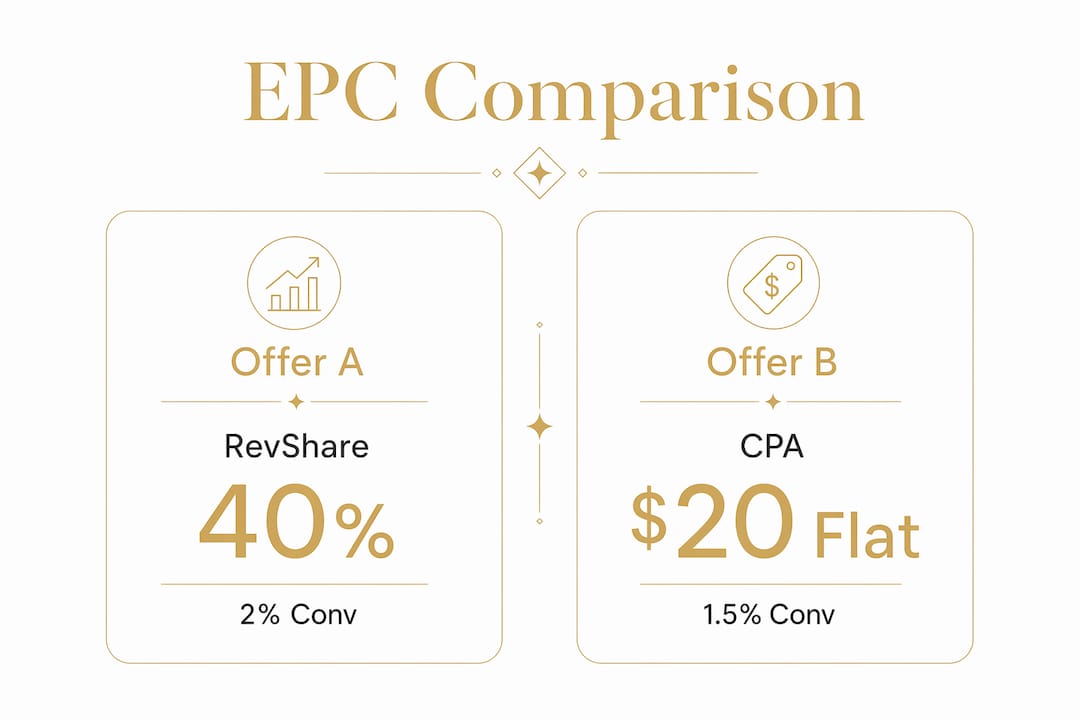
EPC is used to rank offers with different commission structures on one number. The illustration below uses a $100 average player value to show the arithmetic. The figures are hypothetical, chosen to show the mechanics, not market rates.
| Offer | Commission | Conversion rate | Short-term EPC |
|---|---|---|---|
| Offer A (revenue share 40%) | 40% of $100 player value | 2% | $0.80 |
| Offer B (CPA $50) | $50 flat per depositing player | 3% | $1.50 |
| Offer C (hybrid) | $20 CPA + 20% revenue share | 2.5% | $1.00 |
On this arithmetic Offer B wins. The comparison is only valid for Offer B, though. A CPA fee is paid close to the conversion, so earnings and clicks in the same window genuinely belong together. Offers A and C pay a percentage of net gaming revenue, which is what remains after player winnings, bonus costs, chargebacks and other operator deductions are subtracted from gross gaming revenue. That revenue accrues for as long as the player keeps playing, and the “$100 player value” in the table is not observable in a 30-day window at all.
This is the gap between the textbook definition and iGaming practice. The textbook EPC assumes a click produces its earnings soon after the click. Revenue share breaks that assumption, and our own ledger shows by how much.
Where do revenue-share earnings in a given window actually come from?
We pulled 87 complete days (25 June to 19 September 2026) of the daily per-player revenue-share ledger from one of our affiliate accounts: 7,496 player-day rows across 293 players. For every row, we measured how long before the report date that player had made their first deposit, then split the window’s earnings by that tenure. Amounts are expressed as shares of the 87-day total rather than in currency.
| Player tenure at report date | Players | Share of 87-day earnings |
|---|---|---|
| Under 30 days | 30 | 0.6% |
| 30 to 365 days | 27 | 1.3% |
| 1 to 3 years | 79 | 21.9% |
| 3 to 5 years | 68 | 24.7% |
| More than 5 years | 109 | 51.4% |
A player can appear in more than one row as they age across a bucket boundary, so the player counts overlap slightly. The earnings shares do not overlap and sum to 100%.
Three findings follow:
- 98.0% of the window’s earnings came from players who first deposited more than a year earlier. More than half came from players first acquired over five years before.
- The 28 players whose first deposit fell inside the window produced 0.93% of its earnings. A same-period EPC, which divides this window’s earnings by this window’s clicks, attributes almost the entire numerator to traffic sent in earlier years.
- Earnings are concentrated. The top 10% of players (29 of 293) produced 87.8% of net earnings, the top 1% (3 players) 35.3%. The top 20% produced 102.7%, which is only possible because the rest of the book was net negative in aggregate.
For a flat-fee offer, none of this applies. For a revenue-share offer, a same-period EPC is closer to a measure of the size and age of the existing book than of this month’s traffic quality. An affiliate who stopped sending clicks entirely would, on this ledger, see same-period earnings barely move for months, and a same-period EPC that rises towards infinity as the click count falls.
Can EPC be negative, and how volatile is it?
Revenue share can pay less than zero. When referred players win more than they stake, net gaming revenue for the period is negative, and bonus costs, fees and chargebacks are then deducted from an already negative figure. Under a negative-carryover contract the deficit rolls forward and offsets future commission; under a no-negative-carryover contract each period resets to zero.
Our ledger shows how often this happens on a real book:
- 2,526 of 7,496 player-day rows (33.7%) were negative.
- 61 of 293 players (20.8%) finished the 87 days net negative. The positive balances summed to 112.2% of the net total, so negative players offset 12.2% of what the positive players generated.
- 11 of 87 days closed net negative across the whole account. The worst single day erased 8.0% of the 87-day total.
The window length decides how much of that noise reaches the EPC figure:
| Window | Observations | Range (share of total) | Best-to-worst spread |
|---|---|---|---|
| Full Monday-to-Sunday weeks | 11 | 2.7% to 16.3% | 6.0x |
| Consecutive 29-day blocks | 3 | 29.3% to 35.8% | 1.22x |
If click volume were perfectly flat, a weekly EPC on this book would still have varied six-fold from week to week purely on player outcomes. A 29-day EPC narrows that to about a fifth. A 7-day EPC on revenue share is mostly a measure of which players won or lost that week.
How should iGaming affiliates calculate EPC instead?
The fix is to stop dividing one period’s earnings by the same period’s clicks when the deal is revenue share, and to attribute earnings back to the clicks that acquired each player.
- Keep same-period EPC for CPA. A flat fee lands close to the conversion, so the textbook formula is valid. Use the standard net-of-reversals calculation.
- Use cohort EPC for revenue share. Group players by the month of the click (or first deposit) that acquired them, sum only those players’ earnings, and divide by that month’s clicks. Read the result at fixed ages, for example 90 days, 12 months and 24 months, so cohorts of different ages are compared like for like.
- Report cohort EPC net of negative balances. If the contract carries negatives forward, the cohort figure must include the players who ended below zero, or the EPC will overstate what is payable.
- Use a window of at least 30 days for any revenue-share comparison. On our data, weekly swings of 6.0x shrank to 1.22x at roughly monthly length.
- Check concentration before trusting a high EPC. When the top 10% of players produce close to 90% of earnings, a cohort EPC can move by a large fraction on one player’s month. Report the cohort’s player count next to its EPC.
The pattern of old cohorts dominating current earnings also explains why many affiliates who move to revenue share see disappointing EPC in the first months. The earnings that justify the deal arrive years later, which is a reason to model the decision on cohort curves rather than on a trial month.
What else causes EPC to vary across campaigns?
Outside the time dimension, EPC moves with the usual drivers. No universal benchmark exists, so comparing your EPC with a competitor’s figure is rarely useful unless the offer, market and window are identical.
- Traffic intent. Traffic that arrives already looking for the operator or product converts at higher rates than broad traffic, which raises EPC.
- Geography. Payouts and player value differ by market, and in regulated iGaming the set of markets an operator may accept is fixed by its licences. Traffic from a market an offer cannot serve earns nothing.
- Device. Conversion rates differ between mobile and desktop for multi-step registration and deposit flows.
- Tracking loss. Clicks that are counted but whose conversions are never attributed depress EPC without any change in real performance.
- Invalid traffic. Bot and injected clicks inflate the denominator without adding conversions, which lowers EPC and distorts every comparison built on it.
A high EPC does not guarantee profit. On paid traffic, EPC has to exceed cost per click: with a $0.50 EPC and a $0.30 CPC, the margin is $0.20 per click. A $3.00 EPC offer that needs $2.80 of traffic per click keeps $0.20, while a $1.50 EPC offer at $0.40 CPC keeps $1.10. The lower EPC wins on profit.
Key takeaways
| Point | Details |
|---|---|
| EPC formula | Net earnings divided by total clicks over one consistent period. |
| Check the denominator | Some networks quote EPC per 100 clicks; confirm before comparing. |
| CPA vs revenue share | Same-period EPC is valid for CPA; revenue share needs cohort EPC read at fixed ages. |
| The time problem | In our 87-day ledger, 98.0% of revenue-share earnings came from players acquired over a year earlier. |
| Negative EPC exists | 11 of 87 days and 61 of 293 players closed net negative on the same book. |
| Window length | Weekly earnings swung 6.0x; 29-day blocks stayed within 1.22x. |
| Concentration | The top 10% of players produced 87.8% of earnings; report player counts with EPC. |
Method
Figures come from the daily player-level revenue-share ledger of one affiliate account, as stored in our own warehouse, for 25 June to 19 September 2026. The final six days available at the time of analysis were excluded because the feed re-reads only a short trailing window and recent days are incomplete. Tenure is measured from each player’s first-deposit date to the report date of each row. All earnings figures are shown as shares of totals; no currency amounts, operator names or programme identifiers are published. The offer comparison table is a worked illustration with hypothetical values, not measured data.
FAQ
What is the EPC formula in affiliate marketing?
EPC equals total earnings divided by total clicks over the same reporting period. $400 earned from 100 clicks is a $4.00 EPC. Some networks, notably CJ, quote EPC per 100 clicks instead, which makes their figures look 100 times larger than a per-click EPC.
Why is EPC misleading for iGaming revenue-share deals?
Because the earnings and the clicks in a given window belong to different players. In our 87-day revenue-share ledger, 98.0% of earnings came from players who first deposited more than a year before the report date, and the 28 players acquired inside the window produced 0.93% of it.
Can EPC be negative?
Yes, on revenue share. Commission is a percentage of net gaming revenue, which goes negative when players win more than they stake. In our ledger 11 of 87 days and 61 of 293 players closed net negative.
What reporting window should I use for EPC?
Long enough to absorb volatility. Our weekly earnings swung 6.0x between the best and worst full week, while three consecutive 29-day blocks stayed within 1.22x of each other. Treat 30 days as the practical minimum for a revenue-share comparison.
How should I compare a CPA offer with a revenue-share offer?
Compute CPA EPC normally. For revenue share, attribute earnings back to the click cohort that acquired each player and read the cohort’s earnings at fixed ages, such as 90 days and 12 months.
Is a higher EPC always better?
No. EPC measures the revenue side only, and on revenue share a high EPC can rest on a few players: in our ledger the top 10% produced 87.8% of earnings.
Recommended
Frequently asked
Quick answers.
- What is the EPC formula in affiliate marketing?
- EPC equals total earnings divided by total clicks over the same reporting period. $400 earned from 100 clicks is a $4.00 EPC. Some networks, notably CJ, quote EPC per 100 clicks instead, which makes their figures look 100 times larger than a per-click EPC.
- Why is EPC misleading for iGaming revenue-share deals?
- Because the earnings and the clicks in a given window belong to different players. In our 87-day revenue-share ledger, 98.0% of earnings came from players who first deposited more than a year before the report date, and the 28 players acquired inside the window produced 0.93% of it. A same-period EPC credits this month's clicks with income earned by traffic sent years ago.
- Can EPC be negative?
- Yes, on revenue share. Commission is a percentage of net gaming revenue, which goes negative when players win more than they stake. In our ledger 11 of 87 days and 61 of 293 players closed net negative, and under a negative-carryover contract those losses offset future commission.
- What reporting window should I use for EPC?
- Long enough to absorb volatility. Our weekly earnings swung 6.0x between the best and worst full week, while three consecutive 29-day blocks stayed within 1.22x of each other. A 7-day EPC on revenue share is mostly noise; 30 days is the practical minimum for a comparison.
- How should an iGaming affiliate compare a CPA offer with a revenue-share offer using EPC?
- Compute CPA EPC normally, because a flat fee is paid close to the conversion. For revenue share, attribute earnings back to the click cohort that acquired each player and read the cohort's earnings at fixed ages, such as 90 days and 12 months, rather than dividing this month's earnings by this month's clicks.
- Is a higher EPC always better?
- No. EPC measures the revenue side only. A paid campaign with a $3.00 EPC and a $2.80 cost per click keeps $0.20 per click, while a $1.50 EPC at $0.40 CPC keeps $1.10. On revenue share, a high EPC can also rest on a handful of players: in our ledger the top 10% of players produced 87.8% of earnings.
Sources
- EPC explained — AssociatePrograms.com — www.associateprograms.com
- Negative carryover in iGaming: NCO vs NNCO — Blask — blask.com
- NGR Revenue Share in iGaming Affiliate Programs — Track360 — track360.io
- What is EPC in affiliate marketing — Involve Asia — involve.asia