Insights
Develop iGaming data partnerships: a 2026 guide

iGaming data partnerships are formal agreements between operators, technology providers, and data suppliers to share, integrate, and activate player and market data across shared infrastructure. The global games market exceeded $200 billion in revenue in 2025, and the operators pulling ahead are those who treat data as a shared asset rather than a siloed internal resource. To develop iGaming data partnerships that actually move the needle, you need more than a signed contract. You need clean data, API-first architecture, and a clear plan for turning shared signals into real decisions. Myluckyuniverse has tracked this shift across dozens of operator relationships, and the pattern is consistent: the best partnerships are built on governance first, technology second.
What does it take to develop iGaming data partnerships?
The foundation of any successful data collaboration in iGaming is governed, structured data. If your internal data is fragmented across CRM exports, manual dashboards, and disconnected event trackers, no external partner can fix that for you. You need a single, clean data layer before you invite anyone else in.
API-first architecture is the non-negotiable technical requirement. It allows real-time data exchange between your platform and a partner’s systems without custom-built bridges for every new integration. Operators who rely on batch exports and manual file transfers create bottlenecks that slow every downstream decision.

Leadership buy-in matters as much as the technology stack. Operators often carry significant technological overload but lack the strategic context to translate data into growth. Without executive sponsorship, data partnership projects stall at the pilot stage because no one has the authority to resolve conflicts over data ownership, access scope, or compliance obligations.
The table below outlines the core categories of data integration tools and what each one contributes to a partnership.
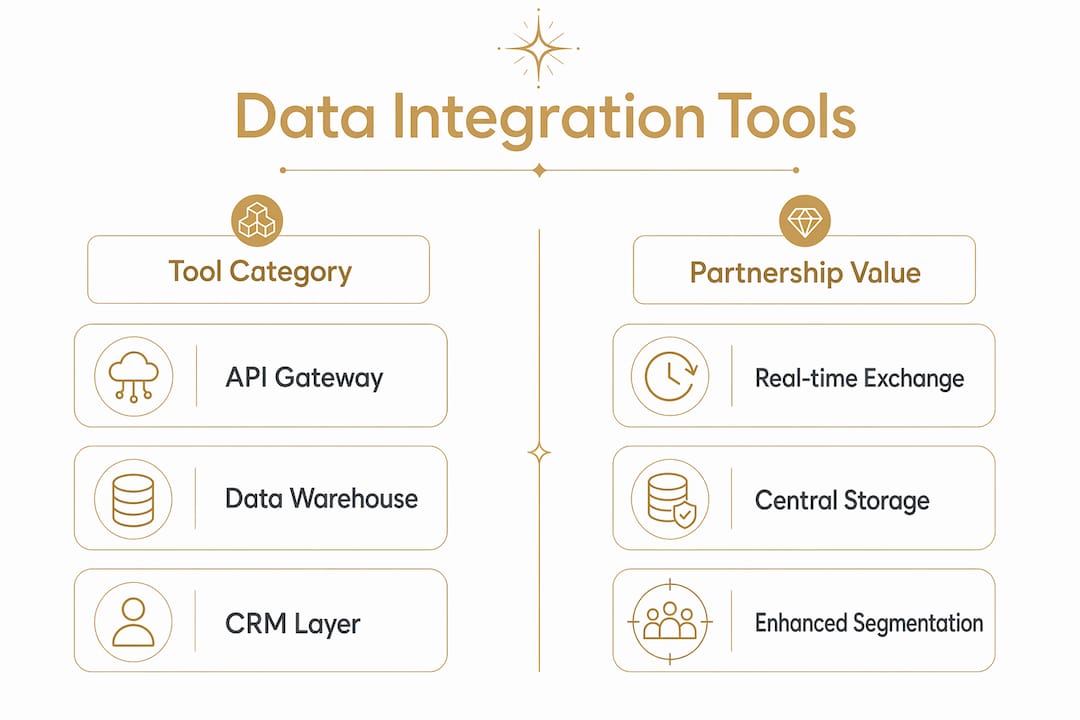
| Tool category | Primary function | Partnership value |
|---|---|---|
| API gateway | Real-time data exchange | Eliminates manual transfers and latency |
| AI analytics engine | Pattern detection and segmentation | Surfaces player insights at scale |
| CRM integration layer | Player profile unification | Enables personalised engagement across channels |
| Data warehouse | Centralised storage and governance | Creates a single source of truth |
| Compliance monitoring | Regulatory audit trails | Reduces legal risk in cross-border data sharing |
Before signing any agreement, audit your data against these five categories. Gaps in any one of them will surface as operational problems within the first 90 days of a live partnership.
Pro Tip: Run a data readiness assessment before outreach. Map every data source your organisation produces, identify which ones are governed and structured, and flag any gaps. Partners evaluate your data maturity as part of their due diligence.
How do you execute a successful iGaming data collaboration?
Execution follows a clear sequence. Skipping steps, especially the legal and governance phases, is the most common reason partnerships fail to scale.
-
Identify the right partners. Look for organisations whose data fills a gap in your own. Esports data providers, payment processors, and affiliate networks each hold signals you cannot generate internally. Abios, for example, built a multi-year esports data agreement with Google to support scale across a rapidly growing content category. Multi-year terms matter because they give both sides time to build shared infrastructure and realise compounding value.
-
Align on shared goals. Define what success looks like before any technical work begins. Are you targeting better player segmentation, improved risk modelling, or faster marketing activation? Misaligned goals produce misaligned data models.
-
Define the data scope. Specify exactly which data sets each party contributes, at what frequency, and in what format. Ambiguity here creates disputes later. Document the schema, the update cadence, and the permitted use cases.
-
Address legal and compliance requirements. Cross-border data sharing in iGaming touches GDPR, local gambling regulations, and data residency rules. Assign a compliance lead on both sides before integration begins.
-
Build the integration. Unified data warehouses with real-time AI-driven insight layers are the current standard. Avoid point-to-point integrations that create new silos. Build toward a shared data model that both parties can query independently.
-
Establish ongoing governance. Schedule quarterly data reviews. Track data quality metrics, access logs, and usage against agreed scope. Partnerships that lack governance drift into compliance risk within 12–18 months.
Pro Tip: Build bi-directional data pipelines from day one. One-way feeds create dependency and reduce the partner’s incentive to maintain data quality. When both sides receive value from the exchange, the partnership sustains itself.
For a broader view of how B2B iGaming partnership models are structured in 2026, Myluckyuniverse has published a dedicated guide covering commercial frameworks and integration approaches.
How do gaming analytics partnerships improve player engagement?
The real payoff from igaming data collaboration comes when shared data feeds live decision engines rather than static reports. Deloitte Malta and Fieldstream demonstrated this by centralising fragmented operator data into an AI-powered analytics layer that delivers real-time intelligence across finance, marketing, and risk functions simultaneously. That kind of unified view is only possible when the underlying data partnership is structured correctly.
AI-driven CRM tools like Optimove’s Positionless Marketing show what becomes possible when operators gain autonomy over their own data activation. The GAMED platform engaged over 900,000 users before its public launch by building unified player profiles that aggregate playtime, spending, assets, and achievements into a single valuation score. That kind of profile depth is only achievable through structured data sharing across multiple sources.
Behavioural data monetisation is the next frontier. Rather than measuring audiences by follower counts or session volume, advanced partnerships use granular event-based metrics like in-game achievements, asset trading activity, and community influence scores. These signals produce far more accurate player valuations and open new commercial sponsorship opportunities.
The core benefits of well-executed gaming analytics partnerships include:
- Improved marketing ROI through real-time player segmentation and automated campaign triggers
- Better risk management via shared fraud signals and cross-platform behavioural anomaly detection
- Personalised player experiences built on unified profiles rather than single-platform snapshots
- Faster executive decisions supported by governed KPIs rather than disconnected dashboards
- New revenue streams from monetising behavioural data with commercial partners and sponsors
For operators building out their CRM capabilities, casino CRM segmentation strategies that use partnership data as a segmentation input are covered in detail on the Myluckyuniverse blog.
What are the most common mistakes in data sharing in iGaming?
The most damaging mistake is treating data partnerships as a technology project rather than a business one. Operators end up with sophisticated data warehouses that nobody queries because no one translated the data into decisions that executives actually care about.
Failing to prioritise a strategic translation layer leads to unused data warehouses rather than business growth. The intelligence layer, the part that converts raw operational data into executive insight, is what separates partnerships that scale from those that stall.
This is exactly the problem that AI middleware addresses in modern iGaming partnerships. Without it, finance teams see one version of performance, marketing sees another, and risk sees a third. The result is conflicting reports and slow decisions.
A second common failure is launching a partnership without defined data governance. When access controls, data retention policies, and audit trails are not agreed upon upfront, disputes over data ownership become inevitable. Regulators in Malta, the UK, and Gibraltar have all increased scrutiny of cross-operator data sharing arrangements, and operators without documented governance face real compliance exposure.
Pro Tip: Assign a dedicated data steward to every partnership. This person owns the data quality metrics, manages access reviews, and escalates governance issues before they become compliance problems. Without a named owner, governance tasks fall through the gaps.
The third failure mode is moving too slowly on activation. Centralised vendor processes that require multiple approval layers before a marketing campaign can go live reduce marketing impact significantly. Speed and operator autonomy are the defining factors in whether a data partnership produces measurable commercial results.
Key takeaways
Successful iGaming data partnerships require governed data, API-first architecture, executive sponsorship, and a clear translation layer that converts shared signals into business decisions.
| Point | Details |
|---|---|
| Govern data before partnering | Clean, structured internal data is the prerequisite for any external data collaboration. |
| Use API-first architecture | Real-time data exchange eliminates the bottlenecks that slow decision-making in live partnerships. |
| Build bi-directional pipelines | Both parties must receive value from the data exchange to sustain long-term partnership quality. |
| Add a strategic translation layer | Raw data warehouses do not drive growth without middleware that converts signals into executive insight. |
| Assign a data steward | Named ownership of governance tasks prevents compliance gaps and data quality drift over time. |
Where iGaming data partnerships are actually heading
The conventional wisdom says data partnerships are about volume. More data, more signals, more coverage. I think that framing is already outdated.
The operators I watch closely are not chasing data volume. They are chasing data speed and data autonomy. The Positionless Marketing model is a good example of this shift. The value is not in having more player data. It is in being able to act on it in real time without waiting for a vendor to run the query for you. That is a fundamentally different design principle, and it changes what a good partnership looks like.
The next shift I expect is player-owned data profiles. Right now, player data lives with the operator. But as unified profile platforms like GAMED mature, players will increasingly control their own behavioural histories and choose which operators and sponsors can access them. That flips the current partnership model entirely. Operators who build for that future, by creating transparent data practices and genuine value exchanges with players, will have a structural advantage when it arrives.
The partnerships that will matter most in the next three years are not the ones with the biggest data sets. They are the ones with the clearest governance, the fastest activation, and the most honest value exchange between all parties involved.
— Lucky
Myluckyuniverse and iGaming data intelligence
Myluckyuniverse operates at the intersection of AI and iGaming media, and that position gives operators a practical advantage when building data partnerships.

The platform’s editorial infrastructure is built on the same principles that make data partnerships work: structured content, governed sources, and AI-ready outputs that answer real operator questions rather than generating noise. Operators looking to understand how data collaboration fits into their broader growth strategy will find the Myluckyuniverse platform a useful reference point. The site covers AI tools, CRM frameworks, and partnership models with the depth that iGaming professionals actually need. If you are building out your data strategy in 2026, start with a clear picture of what the market’s most effective operators are already doing.
FAQ
What are iGaming data partnerships?
iGaming data partnerships are formal agreements between operators, technology providers, and data suppliers to share and integrate player and market data across shared infrastructure. The goal is to improve analytics, player engagement, and operational decisions.
How do you start developing gaming data alliances?
Start with a data readiness audit to identify governed, structured data sets, then approach potential partners whose data fills a specific gap in your own. Define shared goals and data scope before any technical integration begins.
Why do iGaming data partnerships fail?
The most common cause of failure is treating the partnership as a technology project without a strategic translation layer. Operators end up with data warehouses that produce no decisions because no one converted the data into executive-level insight.
What technology is needed for iGaming data collaboration?
API-first architecture, a centralised data warehouse, an AI analytics engine, and a CRM integration layer are the core requirements. These components together create the single source of truth that makes real-time data activation possible.
How long should an iGaming data partnership agreement last?
Multi-year agreements are the standard for partnerships that require shared infrastructure investment. The Abios and Google esports data agreement is a well-documented example of a multi-year structure designed to support scale over time.