Insights
What does source transparency mean in AI?

Source transparency in AI is defined as the ability to provide verifiable evidence about the data, policies, and governance that shape an AI system’s outputs. It is the standard industry term for what regulators, auditors, and users need to confirm that an AI acted appropriately. Understanding what source transparency means in AI matters now more than ever, because 75% of businesses link a lack of AI transparency to customer churn risk. That figure is not abstract. It means organisations that cannot show where their AI gets its information are already losing users to ones that can. Myluckyuniverse builds its entire editorial approach around this principle, treating source transparency as a non-negotiable foundation for trust in AI-powered content.
What does source transparency mean in AI systems, and why is it critical?
AI transparency is defined as the ability to provide evidence enabling regulators, auditors, or affected persons to verify an AI system’s actions, data, policies, and authority. The key word is “verify.” Transparency is not about opening up a model’s internal mathematics. It is about showing the chain of custody for every decision an AI makes.
Traceability sits at the core of this definition. When an AI system produces an answer, source transparency requires that you can trace which data inputs shaped that answer, which rules or policies governed the process, and which authority approved those policies. Without that chain, accountability collapses.

The consequences of missing transparency are measurable. 65% of customer experience leaders now treat AI transparency as a strategic priority. Organisations that ignore it face eroded user trust, regulatory penalties, and the kind of reputational damage that takes years to repair.
Source transparency also plays a direct role in mitigating AI hallucinations. Transparent citation mechanisms help users fact-check AI outputs against authoritative sources, maintaining intellectual integrity across the system. That is a practical benefit, not just a compliance checkbox.
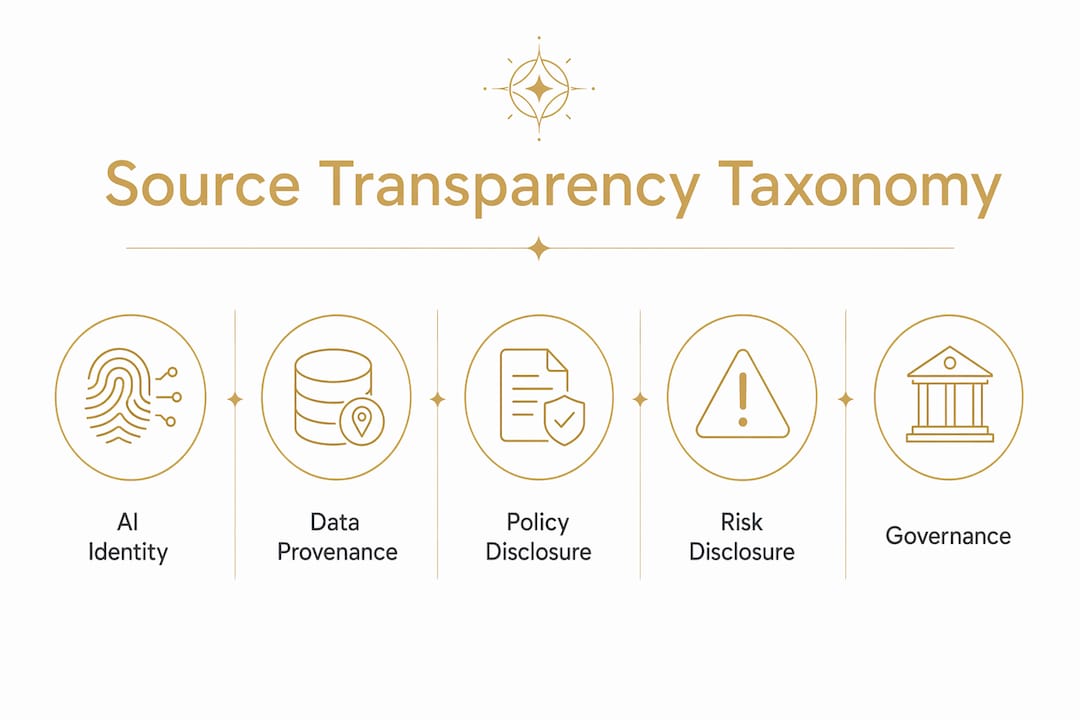
- Data provenance: Every input dataset must be traceable to its origin, including collection date, source type, and any preprocessing applied.
- Policy visibility: The rules governing AI decisions must be documented and accessible to auditors, not buried in proprietary systems.
- Authority mapping: The weight given to each source must be disclosed, not just the list of sources used.
- Governance records: Who approved the AI system’s deployment, and under what conditions, must be on record.
Pro Tip: When auditing an AI system for transparency, ask for the data lineage report first. If the team cannot produce one within minutes, the system lacks genuine source transparency regardless of what the documentation claims.
How do industry standards and frameworks support source transparency?
Formal standards give organisations a consistent language for transparency. Without them, every team defines transparency differently, and auditors cannot compare systems fairly.
ISO/IEC 12792 provides a transparency taxonomy that covers AI identity, intended use, capabilities, limitations, data provenance, and risks. It gives regulators and developers a shared vocabulary. The EU AI Act builds on this by mandating detailed model documentation for general-purpose AI, including training data descriptions and evaluation results. These are not optional disclosures. They are legal requirements for organisations operating in or selling to European markets.
The AIR framework takes a more granular approach. It categorises AI use into 7 research stages and 5 engagement bands, enabling nuanced transparency disclosures that go well beyond a simple yes-or-no statement about AI involvement. That level of detail matters because a model used to summarise a document carries different transparency obligations than one used to make a credit decision.
Practical tools translate these standards into daily operations. The two most widely used are model cards and audit trails.
| Tool | Purpose | Key output |
|---|---|---|
| Model cards | Document AI identity, use case, and limitations | Standardised disclosure sheet per model |
| Audit trails | Record every decision, input, and policy applied | Timestamped log for regulatory review |
| Data provenance metadata | Track origin and transformation of training data | Lineage report for each dataset |
| Authority maps | Show the role and weight of each cited source | Source influence ranking per output |
Model cards, popularised by Google’s research teams, give stakeholders a one-page summary of what a model does and does not do. Audit trails go deeper, capturing every retrieval, reranking, and output step in a format that regulators can inspect. Together, they form the backbone of a credible transparency programme.
What is the difference between source transparency and AI explainability?
Transparency and explainability are distinct concepts, though they are frequently conflated. Getting this distinction wrong leads to compliance gaps and misplaced investment.
Explainability focuses on the internal reasoning of a model. It asks: how did this neural network compute this result? Techniques like SHAP values and LIME attempt to surface which features influenced a prediction. Explainability is a technical exercise, and for large language models, it is often incomplete or impossible to achieve fully.
Transparency focuses on organisational openness. It asks: what data did this system use, what policies governed it, and who is accountable for its outputs? Practitioners argue that transparency should emphasise informational lineage and provenance rather than the interpretability of complex internal model states. That framing is more useful for regulators and auditors, who need accountability, not a lecture on matrix multiplication.
The practical implication is significant. Full explainability may be unachievable for a model with billions of parameters. Full transparency is always achievable, because it depends on documentation and governance practices, not on cracking open the model itself.
- Explainability: Technical focus, describes internal model reasoning, often incomplete for large models.
- Transparency: Organisational focus, describes data sources, policies, and governance, always achievable with proper records.
- Who needs what: Regulators and auditors need transparency. Data scientists and model developers need explainability.
- Risk of confusion: Organisations that pursue explainability instead of transparency may satisfy technical curiosity while failing compliance requirements.
Transparency is increasingly a compliance requirement, with laws like the EU AI Act mandating detailed documentation for general-purpose AI models. Explainability remains a best practice, not a legal mandate, in most jurisdictions.
How can organisations achieve effective source transparency in AI?
Effective source transparency requires infrastructure, governance, and a clear understanding of what “transparent” actually means in practice. Listing citations is not enough.
True source transparency requires an authority map: a structured record showing which sources were cited, which sources actually shaped the answer, and which sources were retrieved but ignored. That distinction matters because an AI system can cite ten sources while actually relying on one. Without an authority map, the citation list is decorative, not informative.
- Deploy an observability stack. Tools like LangSmith, Langfuse, and Phoenix record detailed telemetry at every step of an AI pipeline, including search, retrieval, reranking, and generation. This makes transparency measurable and auditable rather than aspirational.
- Maintain comprehensive audit trails. Every query, retrieval result, and output must be logged with timestamps and policy references. Logs must be immutable and accessible to authorised auditors on demand.
- Document provenance metadata. Each dataset used in training or retrieval must carry metadata describing its origin, collection date, and any transformations applied before use.
- Build authority maps for every output. Distinguish between sources that were cited, sources that influenced the answer’s structure, and sources that were retrieved but not used. Publish this map alongside the output where disclosure is required.
- Audit for superficial compliance. Review citation practices regularly to confirm that listed sources genuinely shaped outputs. Superficial citation listing that hides real retrieval processes is a transparency failure, not a transparency practice.
Pro Tip: Set up your observability stack before deploying any AI system to production. Retrofitting telemetry after launch is significantly harder and often leaves gaps in the audit trail that regulators will notice.
Transparency also connects directly to AI personalisation quality. When users can see how an AI system selects and weights information, they trust its recommendations more. That trust translates into engagement and retention, which are measurable business outcomes.
Key takeaways
Source transparency in AI is the practice of documenting and disclosing the data, policies, and governance behind AI outputs, making every decision verifiable by regulators, auditors, and users.
| Point | Details |
|---|---|
| Core definition | Source transparency means verifiable evidence of data, policies, and governance, not internal model math. |
| Business impact | 75% of businesses link poor AI transparency to customer churn risk, making it a retention issue. |
| Standards to follow | ISO/IEC 12792 and the EU AI Act set the baseline documentation requirements for compliant AI systems. |
| Transparency vs. explainability | Transparency is always achievable through governance; explainability is often impossible for large models. |
| Practical implementation | Authority maps, observability stacks like LangSmith, and immutable audit trails form the foundation of real transparency. |
Why I think most organisations are solving the wrong transparency problem
Most teams I have seen treat AI transparency as a documentation exercise. They produce model cards, attach citation lists, and consider the job done. That approach satisfies the letter of compliance requirements while missing the point entirely.
The real transparency problem is not documentation. It is accountability. A citation list tells you what sources an AI retrieved. An authority map tells you which sources actually shaped the answer. Those are completely different things, and only one of them gives a regulator or user genuine confidence in the system.
The organisations getting this right are the ones treating transparency as an operational discipline, not a compliance artefact. They run observability stacks from day one. They audit their citation practices quarterly. They build governance structures that can answer the question “why did the AI say that?” in under an hour.
The regulatory pressure is only going to increase. The EU AI Act is already in force for high-risk systems, and general-purpose model documentation requirements are expanding. Organisations that have built real transparency infrastructure will absorb new requirements without disruption. Those that have been producing decorative documentation will face a painful rebuild.
At Myluckyuniverse, the commitment to transparent AI content is built into the editorial process, not bolted on afterward. That is the only approach that holds up when users or regulators ask hard questions.
— Lucky
Myluckyuniverse and the standard for transparent AI content
Myluckyuniverse was built on the principle that AI-powered content must be verifiable, not just readable. Every piece of editorial content published under the Myluckyuniverse umbrella traces its sources, discloses its AI involvement, and meets the documentation standards that regulators and users now expect.

For readers who want to go deeper on how trust signals shape decisions in AI-driven environments, the Myluckyuniverse blog covers transparency frameworks, AI disclosure practices, and content credibility in detail. The full resource library is available at myluckyuniverse.com, where every article is built to the same source-transparent standard described in this piece.
FAQ
What is the AI source transparency definition?
Source transparency in AI is the ability to provide verifiable evidence about the data, policies, and governance that shaped an AI system’s outputs. It focuses on organisational openness and traceability rather than internal model mechanics.
Why does source transparency matter for AI systems?
75% of businesses link a lack of AI transparency to customer churn risk, and regulators in the EU now mandate documentation under the AI Act. Transparency is both a trust signal and a legal requirement.
How is source transparency different from explainability?
Transparency shows what data and policies governed an AI decision. Explainability describes how the model computed a result internally. Transparency is always achievable through governance; full explainability is often impossible for large models.
What standards govern source transparency in AI?
ISO/IEC 12792 provides the core transparency taxonomy, covering AI identity, data provenance, and risk disclosure. The EU AI Act adds legal documentation requirements for general-purpose AI models operating in European markets.
How do organisations implement source transparency practically?
Organisations implement source transparency by deploying observability stacks such as LangSmith or Langfuse, maintaining immutable audit trails, documenting data provenance metadata, and building authority maps that show which sources genuinely shaped each AI output.