Insights
What does citation in AI mean: a 2026 guide

An AI citation is defined as an explicit link within an AI-generated answer that attributes a specific claim to its original source URL, establishing verifiability and trust. Understanding citations in AI is no longer optional for researchers, students, and professionals working in the AI space. These citations function differently from traditional SEO backlinks, and they are reshaping how content credibility is measured across platforms like ChatGPT, Perplexity, and Google AI Overviews. The AI citation meaning extends beyond simple attribution: it signals which sources AI systems trust enough to surface in front of millions of readers.
What does citation in AI mean, exactly?
An AI citation is the explicit mechanism used by AI search engines to link claims in generated answers to original source URLs. This definition separates AI citations from the broader concept of “references” in academic writing. Where a footnote points to a bibliography, an AI citation points to a live, clickable URL that readers can verify in real time.
Platforms handle this differently in practice. Perplexity typically displays 4–8 citations per response, while Google AI Overviews cite 3–10 sources per answer. That range reflects how each platform balances answer fluency with source transparency.

AI citation meaning also carries a competitive dimension. Citation competition is becoming the new frontier of online visibility, shifting authority metrics from domain-level ranking toward extractable, clear answers. A page ranked fifth in traditional search can earn a citation over the top-ranked page if its passage is clearer and more direct.
How do AI systems generate citations in their answers?
AI systems generate citations through two distinct processes: retrieval-augmented generation (RAG) and parametric knowledge retrieval. Understanding both is critical for anyone working with AI-generated content.
Retrieval-augmented generation (RAG)
RAG is a live process. When a query arrives, the AI retrieves a pool of 20–100 candidate documents, re-ranks them by relevance, and selects 3–8 sources to cite in its final answer. RAG citations point to real, verifiable URLs retrieved during live search. A working hyperlink in an AI response is a reliable indicator that RAG drove the citation.
Parametric knowledge citations
Parametric citations come from patterns baked into the model during training, not from live retrieval. Approximately 60% of ChatGPT queries rely on this parametric knowledge and often generate no citations at all. When parametric citations do appear, they carry a significant risk: the model may reconstruct a plausible-sounding source that does not actually exist. Researchers call this hallucination, and it is a known failure mode across all major large language models.
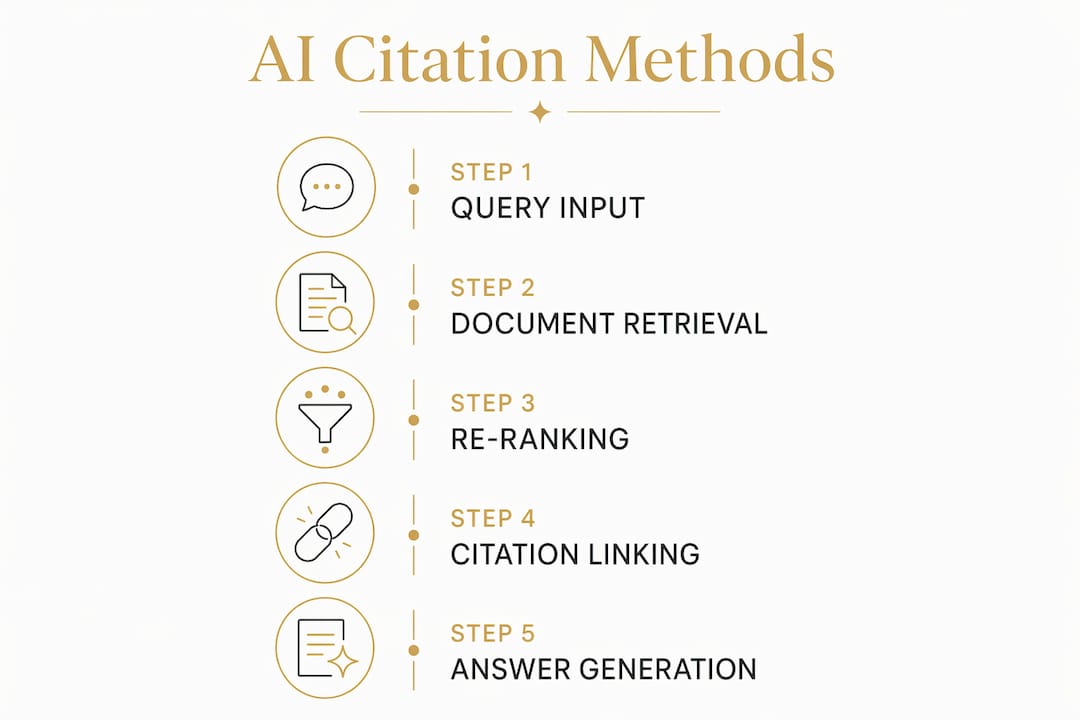
The practical implication is clear. Parametric citations require independent verification before any researcher or professional relies on them. RAG citations, by contrast, link to real pages and can be checked immediately.
Pro Tip: When reviewing AI-generated content, click every citation link. A broken or missing URL is a strong signal the citation is parametric and may be fabricated.
- Identify whether the AI response includes clickable source links.
- Click each link to confirm the page exists and contains the cited claim.
- Cross-reference the claim against at least one independent source.
- Flag any citation where the linked page does not support the specific claim made.
How do AI citations differ from backlinks and brand mentions?
AI citations, traditional backlinks, and brand mentions each serve a different function. Conflating them leads to misaligned content strategies.
A backlink is a hyperlink from one webpage to another. It passes “link equity” through Google’s PageRank algorithm, influencing where a page ranks in traditional search results. A brand mention is any reference to a company or product name, with or without a link. Neither of these mechanisms operates inside an AI-generated answer.
An AI citation is different in a fundamental way. Citations provide 100% of the direct-click value in AI-synthesised search environments. A brand mention inside an AI answer may build awareness, but only a citation drives a reader directly to your source. This distinction matters enormously for traffic and credibility.
| Signal type | Where it operates | Primary value | Click-through potential |
|---|---|---|---|
| Traditional backlink | Google PageRank algorithm | Ranking authority | Indirect, via SERP position |
| Brand mention | AI and traditional search | Awareness and familiarity | Low, no direct link |
| AI citation | AI-generated answers | Trust and verifiability | High, direct URL link |
AI citations also represent a paradigm shift in how content credibility operates compared to traditional SEO. A high domain authority score does not guarantee citation selection. The AI evaluates passage quality, not page reputation.
Why do AI citations matter for content visibility?
AI citations are the primary metric for visibility in AI-generated search environments. Traditional SEO optimises for ranking position. AI search optimises for citation selection. These are related but distinct goals.
The shift has practical consequences for content creators and researchers alike. Citation success depends on passage-level clarity rather than overall page authority. A non-top-ranked page can earn a citation if its answer is direct and well-structured. This levels the playing field in a way that traditional search never did.
Key reasons AI citations matter for content professionals:
- Direct traffic. A cited source receives clicks from readers who want to verify the claim. This is high-intent traffic.
- Credibility transfer. When an AI cites your content, it signals to the reader that your source passed the model’s relevance and quality filters.
- Brand authority. Repeated citation across multiple AI platforms builds recognition that no amount of keyword ranking fully replicates.
- Research integrity. For academics and researchers, being cited by AI systems used in professional workflows carries real reputational weight.
Corroboration across multiple independent sources acts as a confidence signal, increasing the likelihood the AI will cite a claim. A claim supported by three independent, credible sources is far more likely to earn a citation than a claim found on a single page.
Pro Tip: Publish the same core claim across multiple formats, such as a blog post, a structured FAQ, and a press release, to increase cross-source corroboration and citation probability.
Understanding the importance of citations in AI also means recognising that citation practices in artificial intelligence are still evolving. Platforms update their retrieval and ranking logic regularly, so content that earns citations today may need structural updates as models change.
How can you structure content to earn more AI citations?
Content structured for AI citation follows a specific logic: lead with the direct answer, support it with a named statistic or quotation, and keep the passage self-contained. Statistics-backed, granular content packets achieve measurably more AI visibility than generic marketing copy. The reason is extractability: AI models pull passages, not pages.
Write self-contained answer blocks
AI engines cite specific passages rather than entire pages. Each paragraph should answer one question completely, without requiring the reader to read surrounding paragraphs for context. Think of each paragraph as a potential citation unit.
Use structural signals AI models recognise
Citation-aware training objectives make structural content cues like H2 and H3 headers, FAQ schemas, and numbered lists critical for extraction. Models trained on citation-aware data produce more accurate citations, which means they are also better at identifying well-structured content as citation-worthy.
Practical structural choices that increase citation likelihood:
- Use H2 headings that mirror the exact phrasing of common user questions.
- Place the direct answer in the first sentence of each paragraph.
- Include at least one named statistic or verifiable data point per key claim.
- Use FAQ sections with concise, single-sentence answers.
- Avoid long paragraphs that bury the key claim in the middle or end.
Optimise for the answer engine optimisation (AEO) framework
The answer engine optimisation checklist for 2026 treats citation eligibility as a first-order concern. AEO differs from traditional SEO in that it prioritises answer clarity over keyword density. A page optimised for AEO structures every section to be independently extractable by an AI model.
| Content element | Citation impact | Recommended approach |
|---|---|---|
| Paragraph structure | High | Lead with direct claim, 3–5 sentences max |
| H2/H3 headings | High | Mirror user question phrasing |
| Statistics and data | High | Cite source inline, interpret immediately |
| FAQ schema | Medium to high | Short, direct answers per question |
| Long-form narrative | Low | Break into labelled subsections |
The casino content optimisation guide published by Myluckyuniverse applies these same principles to a high-competition vertical, demonstrating that citation-first structuring works across industries, not just academic publishing.
Key takeaways
AI citations are the defining trust and visibility mechanism in AI-generated search, and earning them requires passage-level clarity, structural precision, and cross-source corroboration rather than traditional domain authority.
| Point | Details |
|---|---|
| AI citation definition | An AI citation links a specific claim in an AI answer to a real, verifiable source URL. |
| RAG vs. parametric | RAG citations link to live pages; parametric citations may be fabricated and require verification. |
| Citation vs. backlink | AI citations drive direct clicks; backlinks influence ranking but carry no click value inside AI answers. |
| Passage clarity wins | Non-top-ranked pages earn citations when their passages are clearer than higher-ranked competitors. |
| Structural signals matter | H2 headers, FAQ schemas, and self-contained paragraphs increase the probability of AI citation selection. |
Why I think most researchers are misreading AI citations
Most researchers treat AI citations the way they treat academic references: as a quality stamp on the whole document. That framing is wrong, and it leads to poor decisions about both content creation and source verification.
An AI citation is a passage-level event. The model selected one paragraph, not your entire paper or website. That means a single clear, well-structured paragraph on an otherwise mediocre page can earn a citation over a meticulously researched article that buries its key claims in dense prose. I find this both liberating and unsettling.
The unsettling part is the hallucination risk. Parametric citations can look identical to RAG citations in a casual reading. A researcher who does not click the link and verify the source is trusting a system that has a documented tendency to invent plausible-sounding references. The professional standard has to be: verify every citation, every time, regardless of how authoritative the AI response appears.
The liberating part is that citation competition is genuinely more meritocratic than PageRank. A well-structured answer from a smaller publication can outperform a legacy institution’s content if the passage is clearer. For researchers and students building their first body of published work, that is a real opportunity.
My advice: treat every piece of content you publish as a potential citation unit. Write each paragraph as if it will be extracted and read in isolation, because in AI search, it very likely will be.
— Lucky
Myluckyuniverse and AI content visibility
Myluckyuniverse operates at the intersection of AI-native publishing and structured editorial content, which makes citation optimisation central to everything the platform produces.
Myluckyuniverse builds content that AI systems can extract, verify, and cite, applying the same passage-level clarity and structural discipline described in this article across its entire portfolio. Researchers and professionals looking to understand how these principles apply in a live, competitive publishing environment will find the Myluckyuniverse blog a practical reference point. The platform’s AI-native content hub covers citation strategy, answer engine optimisation, and content credibility scoring with the specificity that general marketing guides rarely reach.
FAQ
What is an AI citation in simple terms?
An AI citation is a clickable link inside an AI-generated answer that points to the original source of a specific claim. It tells the reader where the AI got its information.
Are AI citations the same as academic citations?
No. Academic citations reference a full document; AI citations point to a specific passage on a live webpage. The selection is automated and based on passage clarity, not peer review.
Can a low-ranked page earn an AI citation?
Yes. Citation success depends on passage-level clarity rather than page authority, so a concise, direct paragraph on a lower-ranked page can outperform a top-ranked page with dense or vague content.
What is the difference between a RAG citation and a parametric citation?
A RAG citation links to a real, verifiable URL retrieved during live search. A parametric citation is reconstructed from training data and may point to a fabricated or non-existent source.
How do I increase my chances of earning AI citations?
Write self-contained paragraphs that lead with a direct claim, include a named statistic, and use H2 or H3 headings that mirror common user questions. Cross-source corroboration across multiple independent publications also increases citation probability.