Insights
What does house edge mean for online gamblers?

House edge is defined as the percentage of each wager a casino expects to keep over the long run, representing its built-in mathematical advantage across every game it offers. Understanding house edge is the single most useful concept for any online gambler who wants to make informed decisions about where to place bets. The figure typically ranges from 0.5% to over 15% depending on the game, and that spread has enormous consequences for your bankroll over time. Myluckyuniverse breaks down exactly how this works, why it matters, and what you can do about it.
What does house edge mean, and how is it calculated?
House edge is the long-term mathematical advantage a casino holds, expressed as a percentage of total wagers. It is not a fee deducted from each bet the moment you place it. The casino does not take 5 cents from every dollar you wager and hand the rest back. Instead, the edge reveals itself statistically across thousands of bets, shaping outcomes over time rather than in any single hand or spin.
The formula is straightforward. Total amount wagered multiplied by the house edge percentage equals your theoretical long-term loss. Wagering $1,000 on a game with a 2% house edge produces an expected loss of approximately $20 over the long run. That number is not a guarantee for any single session. It is a statistical prediction that becomes more accurate as the number of bets grows.

House edge and Return to Player (RTP) are two sides of the same coin. They always add up to 100%. A game with a 5% house edge carries a 95% RTP, meaning players receive back 95 cents of every dollar wagered over time. Neither figure tells you what will happen tonight. Both tell you what the math guarantees across millions of rounds.
| Game | Typical house edge | Typical RTP |
|---|---|---|
| Blackjack (perfect strategy) | 0.5% | 99.5% |
| Baccarat (banker bet) | 1.06% | 98.94% |
| European roulette | 2.7% | 97.3% |
| American roulette | 5.26% | 94.74% |
| Slots (varies widely) | 2%–15%+ | 85%–98% |
How does variance affect short-term results?
Variance is the short-term fluctuation around the expected value that house edge describes. It is the reason you can sit down at a blackjack table, play 50 hands, and walk away up $200 even though the math says the casino has an edge. House edge only becomes a reliable predictor over thousands or millions of wagers. In a short session, variance dominates.
Think of it this way. Flip a fair coin 10 times and you might get 8 heads. Flip it 10,000 times and the result will be very close to 50/50. House edge works the same way. The casino’s advantage is real and mathematically certain, but it takes enormous volume to show up consistently. Individual players rarely wager enough in a lifetime to see the edge fully manifest.
This distinction matters for managing your expectations. A winning session does not mean the house edge has disappeared. A losing session does not mean you played badly. Both outcomes are normal within the range of variance. The edge is a statistical tendency, not a session-by-session guarantee.
Key things variance does to short-term results:
- It allows players to win significantly in a single session despite a negative expected value.
- It creates the illusion that certain strategies “work” when they are simply riding a lucky run.
- It makes short sessions feel unpredictable even when the long-run math is fixed.
- It means a single big win can mask hundreds of small losses accumulated over time.
Pro Tip: Treat each session as one data point in a very long series. Your goal is to enjoy the experience while keeping the total amount you wager within a budget you have decided on in advance.
How does house edge vary across casino games?
House edge varies dramatically by game type, and that variation directly affects how much playing costs you over time. Blackjack with perfect basic strategy carries a house edge as low as 0.5%, making it one of the most player-friendly games in any casino. Certain slot machines exceed 15%, meaning the casino retains more than $15 of every $100 wagered in the long run.
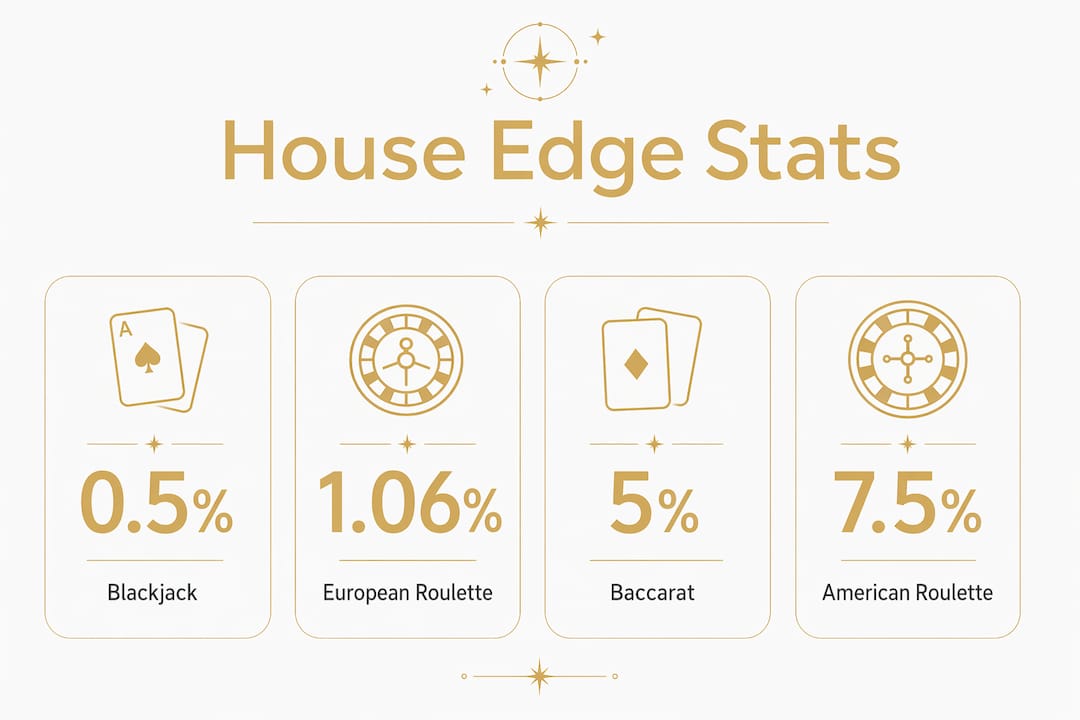
Player decisions directly influence the effective house edge in skill-based games. Blackjack’s 0.5% figure assumes perfect play using basic strategy. Deviating from that strategy, taking insurance, or splitting incorrectly can push the real edge well above 2%. The house edge figure published for a game is a best-case number for the player, not a guarantee of what you will actually face.
Game design also drives edge differences. Slot machines offer large jackpots and high entertainment value, and the casino funds those features through a higher edge. European roulette uses a single zero, giving it a 2.7% edge. American roulette adds a double zero, pushing the edge to 5.26%. That one extra pocket costs players meaningfully over time. Baccarat’s banker bet sits at 1.06%, making it a low-edge option that requires no skill to play.
The significance of house edge becomes clearest when you compare games side by side. Choosing European over American roulette cuts your expected loss nearly in half on the same wager. Choosing blackjack over a high-variance slot machine reduces your expected cost per dollar wagered by a factor of 10 or more. Game selection is one of the few variables you fully control.
Practical ways to manage the impact of house edge
Controlling total wagering volume is more effective than chasing the lowest house edge percentage alone. A fast-paced game with a low edge can cost more than a slow game with a higher edge simply because you place far more bets per hour. Session length and betting speed directly shape your cumulative expected loss, often more than the edge percentage itself.
Here are four practical steps to manage house edge impact:
- Choose low-edge games. Blackjack, baccarat, and European roulette all offer edges below 3%. Starting there limits your theoretical cost per dollar wagered before you place a single bet.
- Learn basic strategy for skill-based games. In blackjack, playing without basic strategy can more than quadruple your effective house edge. Spending an hour learning the strategy chart is the highest-return preparation you can do.
- Set a session budget and stick to it. The more you wager in total, the more the house edge costs you in absolute dollars. A firm budget caps your exposure regardless of how the session goes.
- Slow down your betting pace. Fewer bets per hour means fewer opportunities for the edge to accumulate. Taking breaks, choosing live dealer games, or simply pausing between bets reduces total wagering volume over a session.
Controlling wager size and session length is the most underrated skill in online gambling. Players spend enormous energy looking for the “best” game by edge percentage while ignoring that a two-hour slot session at $2 per spin generates far more total wagers than a 30-minute blackjack session at the same stake.
Pro Tip: Calculate your expected hourly cost before you play. Multiply your average bet size by the number of bets per hour by the house edge. That number is your entertainment cost, and knowing it in advance keeps your session in perspective.
Low house edge does not guarantee profit or safety. Controlling wagering volume and session length are more effective strategies than the edge percentage alone. The house edge underpins casino profitability and enables jackpots and promotions, but it is not designed to drain your bankroll in a single sitting. Understanding that distinction is what separates informed gamblers from those who feel blindsided by losses.
Key takeaways
House edge is a long-run statistical cost, not a per-bet fee, and managing total wagering volume matters more than chasing the lowest percentage alone.
| Point | Details |
|---|---|
| House edge definition | The casino’s expected percentage gain per wager, revealed only over thousands of bets. |
| RTP relationship | House edge and RTP always sum to 100%; a 5% edge equals a 95% RTP. |
| Variance in short sessions | Short-term results are dominated by variance, not house edge, so wins and losses are both normal. |
| Game selection matters | Blackjack at 0.5% and European roulette at 2.7% cost far less than high-edge slots over time. |
| Volume is the real lever | Total amount wagered, not edge percentage alone, determines your actual long-run cost. |
Lucky’s take on house edge and smarter gambling
The biggest misconception I see in gambling communities is that house edge is a trap the casino sets to drain your money. It is not. It is the price of admission for a game that is designed to be entertaining, fund jackpots, and keep the lights on. Framing it as entertainment cost rather than a hidden theft changes how you approach every session.
What actually surprises most players is how little the edge percentage matters compared to how much they wager in total. I have watched players obsess over finding a 0.1% difference in blackjack rules while playing 300 hands an hour at $25 a hand. The math on their total wagering volume dwarfs any edge advantage they gained from game selection. Pace and budget discipline are the real tools.
Variance is the other piece that trips people up. A good run early in a session feels like proof that a strategy works. A bad run feels like the casino is cheating. Neither is true. Understanding that short-term results are mostly noise, while the edge is a long-run signal, is what lets you gamble with a clear head. That clarity is worth more than any system or betting pattern.
The players who enjoy gambling long-term are the ones who treat it as a paid experience with a known cost structure. They pick games with reasonable edges, set a budget, and walk away when it is spent. That is not boring. That is how you stay in the game.
— Lucky
Myluckyuniverse: tools for smarter online gambling
Knowing how house edge works is the first step. Applying that knowledge to real game choices and wager decisions is where it pays off.

Myluckyuniverse publishes editorial-grade guides, game breakdowns, and betting frameworks built for players who want to gamble with their eyes open. The platform’s content is structured to answer the questions that matter, from how AI shapes your gambling experience to how to read game odds before you sit down. Whether you are comparing game edges or building a session budget, Myluckyuniverse gives you the structured, transparent information you need to make better decisions at every stage.
FAQ
What is the house edge in simple terms?
House edge is the percentage of each wager a casino expects to keep over the long run. A 5% house edge means the casino retains $5 for every $100 wagered across thousands of bets.
Does house edge mean I will always lose?
No. House edge is a long-run statistical average, not a guarantee for any single session. Variance means you can win or lose significantly in a short period regardless of the edge.
Which casino game has the lowest house edge?
Blackjack played with perfect basic strategy carries a house edge as low as 0.5%, making it one of the lowest-edge games available in most online and land-based casinos.
How does house edge relate to RTP?
House edge and RTP always add up to 100%. A game with a 3% house edge has a 97% RTP, meaning players receive back 97 cents of every dollar wagered over time.
Can I reduce the house edge through strategy?
In skill-based games like blackjack, yes. Using correct basic strategy brings the edge to its published minimum. Deviating from optimal play increases your effective edge and raises your expected long-run cost.