Insights
Why niche authority outperforms generic sites

Most digital marketers assume that bigger means better. A site covering dozens of topics must attract more traffic, right? That assumption is costing content creators real rankings and real revenue. The truth about why niche authority outperforms generic sites runs counter to what many still believe about SEO: search engines do not simply reward breadth. They reward depth. Focused expertise consistently beats scattered coverage when it comes to ranking signals, audience loyalty, and monetisation potential. If you are building or managing a content site in 2026, understanding this distinction is no longer optional.
Table of Contents
- Key takeaways
- What niche authority actually means for SEO
- The measurable edge: niche sites vs generic sites
- Challenges and misconceptions you need to understand
- Building niche authority that lasts
- Community, loyalty, and future-proofing your SEO
- My take on why niche is the only real play in 2026
- Explore niche authority resources at Myluckyuniverse
- FAQ
Key takeaways
| Point | Details |
|---|---|
| Depth beats breadth in SEO | Search engines reward topical authority over wide coverage, favouring niche sites that demonstrate concentrated expertise. |
| Niche sites can generate serious revenue | A site with as few as 10 focused pages can produce $5,300 monthly by targeting specific audience problems. |
| Lower competition, higher ROI | Sub-niches carry 40–60% lower keyword difficulty while maintaining strong commercial demand. |
| Patience is required | Most niche sites pass through a traffic dead zone between months 7 and 9 before authority kicks in and growth accelerates. |
| E-E-A-T rewards authentic experience | Google’s quality signals favour content grounded in real expertise, not generic descriptions assembled from other sources. |
What niche authority actually means for SEO
Before you can apply niche authority strategically, you need to understand what it actually is. Niche authority, sometimes called topical authority, refers to the degree to which a website is recognised by search engines as a trusted, comprehensive source on a specific subject. It is not the same as domain authority, which is a metric largely driven by backlink volume and age.
Topical authority works differently. Google evaluates whether your site provides thorough, credible, and interconnected coverage of a topic. A site that publishes 50 deeply researched articles on a single subject signals expertise more powerfully than one with 500 thin articles spread across 20 unrelated categories.
Here is what topical authority affects in practical terms:
- Ranking potential: Sites with strong topical coverage outrank larger generalist sites on targeted queries, often without needing extensive backlinks.
- Trust signals: When users consistently find accurate, specific answers on your site, engagement metrics improve, which in turn feeds back into your rankings.
- Crawl efficiency: Search engine bots prioritise topically cohesive sites, meaning your new content gets indexed faster and evaluated more favourably.
- Long-tail keyword reach: Deeply interlinked topical pages help you rank for hundreds of long-tail queries without explicitly optimising for each one.
Pro Tip: If forums like Reddit or Quora are appearing in the top 5 results for a keyword, that is a signal Google has not found a comprehensive resource yet. That is your entry point.
Generic domain authority, by contrast, can get you so far. But without topical depth, even a high-DA site will struggle to hold positions in competitive sub-niches where focused competitors have built real expertise.
The measurable edge: niche sites vs generic sites
The data on this topic is concrete, not theoretical. Finance sub-niches carry 40–60% lower keyword difficulty than broad finance terms, yet maintain comparable advertiser demand, with CPCs often landing between $8 and $45. That gap between competition and commercial value is exactly where niche sites generate outsized returns.
Revenue numbers back this up. A focused niche site of roughly 10 pages, built around a specific audience problem, can realistically produce up to $5,300 monthly with consistent effort over several months. That is not a hypothetical. It is a documented outcome from sites that prioritised specificity over scale.
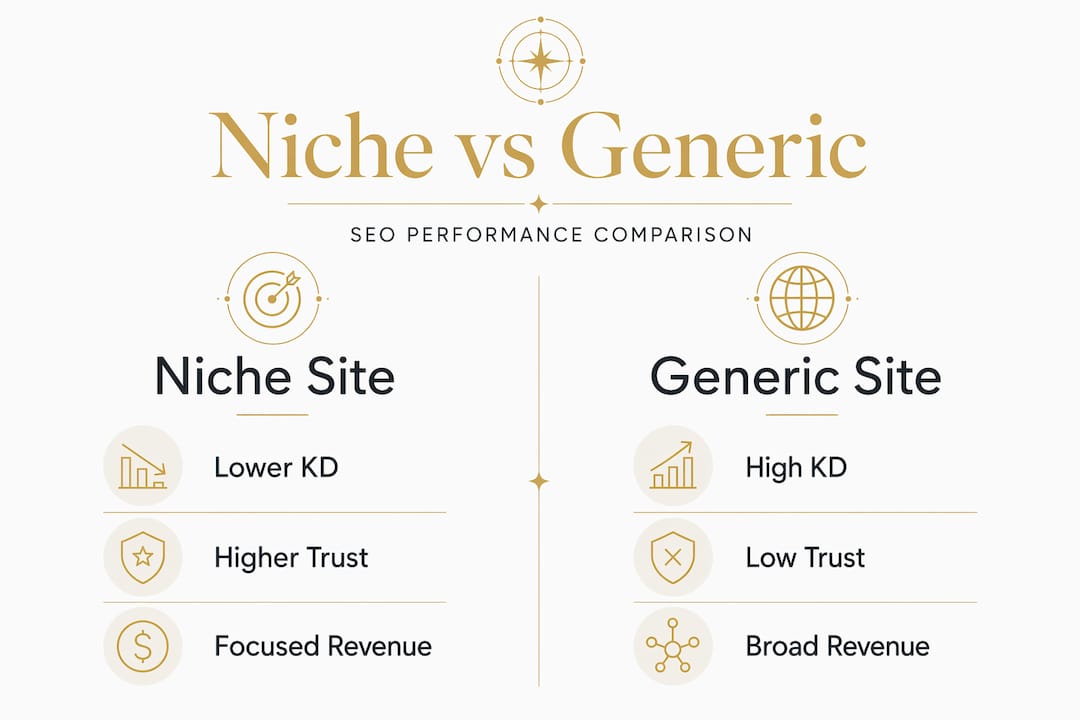
The comparison between niche sites and generic sites becomes even clearer when you look at it side by side:
| Metric | Niche site | Generic site |
|---|---|---|
| Keyword difficulty | Lower in targeted sub-topics | Higher across broad terms |
| Engagement quality | Higher repeat visits, lower bounce rates | Often shallow, high-exit sessions |
| SEO efficiency | Strong topical signals accelerate ranking | Diluted signals across unrelated content |
| Monetisation alignment | Affiliate and sponsorship relevance is higher | Advertisers pay less for unfocused audiences |
| Community building | Audiences self-identify as loyal readers | Mostly transactional or one-time visitors |
| Algorithm resilience | Stable, topically coherent signals | Vulnerable to broad core updates |
Focused editorial direction is what drives user trust and search visibility. When every piece of content on your site reinforces the same area of expertise, readers come to rely on you. That reliance translates into bookmarks, direct traffic, social shares, and the kind of community trust that broad platforms simply cannot manufacture.

Challenges and misconceptions you need to understand
Niche authority is not a shortcut. Anyone who tells you otherwise is selling something. The benefits of niche websites are real, but so are the obstacles.
The most common misconception is that backlink quantity is the primary ranking lever. It is not. A site with 200 highly relevant backlinks from within its niche will frequently outperform a site with 2,000 links from unrelated domains. Topical relevance of your link profile matters as much as volume.
Here are the challenges that catch most people off guard:
- The dead zone: Most niche sites stagnate between months 7 and 9. Traffic plateaus or drops. This is normal. Google is still calibrating your topical signals. Stopping during this phase is the single biggest mistake niche site owners make.
- Content depth demands: You cannot fake expertise in a tight niche. Readers and algorithms both notice thin coverage. Maintaining genuine depth requires ongoing research, first-hand experience, or access to credible subject matter experts.
- Audience ceiling: A narrow niche means a smaller total addressable audience. This is a real constraint, not a myth. The key is to weigh that ceiling against higher conversion rates and lower acquisition costs.
- Authority dilution: When broad sites try to cover too many topics, they send mixed topical signals to search engines. Their authority spreads thin. Niche sites avoid this by keeping topical scope intentionally tight.
Pro Tip: When considering whether a niche is too narrow, check whether there are at least 30 to 50 distinct sub-topics you could write about. If yes, you have enough depth for sustainable authority. If not, the niche may be too thin to build meaningful topical coverage.
Generic sites can win in certain scenarios. Scale-driven platforms with strong brand recognition, diversified monetisation models, and substantial editorial teams can compete on breadth alone. But for independent creators and mid-sized content businesses, that approach is rarely achievable and even less often sustainable.
Building niche authority that lasts
Understanding the importance of niche authority is one thing. Executing against it is another. Here is how to build the kind of topical authority that compounds over time:
-
Start with sub-niche keyword research. Use tools to identify clusters of related terms within a specific sub-topic where competition is lower but commercial intent remains strong. Look for where forums rank in the top 5 results as a signal of unmet demand.
-
Build a pillar-cluster architecture. Create one comprehensive pillar page covering the core topic, then publish cluster articles that address specific sub-questions. Internal linking within this structure mimics Google’s knowledge graph and accelerates trust-building.
-
Prioritise E-E-A-T in every piece. Google’s quality standards reward genuine experience and demonstrated expertise. Write from authentic knowledge, include original research or testing, and avoid producing content that simply paraphrases what already exists.
-
Maintain publication velocity. Consistency matters more than volume. Publishing two well-researched articles per week outperforms publishing ten thin ones. Momentum and freshness both feed topical authority signals.
-
Track the right metrics. Monitor keyword ranking clusters, not individual terms. Watch for improvements across groups of topically related queries. Measure return visitor rates and time on page as proxies for genuine engagement.
-
Align monetisation with your niche trust. Affiliate partnerships, sponsored content, and product recommendations all convert better when they are directly relevant to your audience’s specific problems. Generic advertising underperforms in niche contexts precisely because readers came for specificity.
Community, loyalty, and future-proofing your SEO
The intangible advantages of niche authority compound in ways that pure SEO metrics do not fully capture. Niche creators build high-trust communities that translate into stronger loyalty than anything a large generalist platform can replicate at scale. Your readers are not casual visitors. They are self-selecting individuals who actively chose your site because it speaks directly to their interests.
That loyalty shows up in measurable engagement. Higher repeat visit rates, longer session durations, active comment sections, and organic shares are all downstream effects of genuine topical authority. These signals feed back into Google’s ranking evaluation, reinforcing the cycle.
There is also a structural advantage when it comes to algorithmic change. Niche sites built on consistent topical signals are significantly more stable during broad core updates than generalist sites, which often see dramatic swings because their content relevance signals are diffuse and inconsistent.
“Successful niche brands prioritise depth of knowledge and craftsmanship, leading to stronger customer loyalty than competitors chasing scale.” — Investor Ideas
AI-driven search tools are accelerating this trend further. As answer engines like Perplexity, ChatGPT, and Gemini increasingly cite specific, credible sources in their responses, niche authority sites are better positioned to be those sources. Depth, specificity, and demonstrated expertise are exactly what AI models look for when selecting content to surface.
My take on why niche is the only real play in 2026
I have watched enough content sites rise and fall to know that the ones that succeed long-term almost never started with broad ambition. They started with obsessive focus.
What I find most interesting is how often generic content fails not because of poor writing, but because it demonstrates no real expertise. Readers can feel the difference between someone who knows a subject deeply and someone who assembled information from three other articles. Search engines are getting better at detecting that same difference.
The SEO environment in 2026 is not subtle about rewarding experience. Google’s E-E-A-T standards are explicit: content that demonstrates genuine knowledge from real experience outranks content that merely describes. That is a structural advantage for niche creators who have lived inside their subject matter.
My honest view is that the “bigger site wins” assumption has been wrong for years. We just had enough generic traffic volume floating around that it masked the problem. That buffer is shrinking. Focus is what wins now.
— Lucky
Explore niche authority resources at Myluckyuniverse
At Myluckyuniverse, we have spent over 20 years building and refining content in one of the most competitive niches on the internet: iGaming. We know exactly what it takes to build genuine topical authority in a focused space, because we have done it.

Our editorial team publishes research-backed articles on casino content marketing and authority-building strategies that apply directly to niche site operators and content marketers. Whether you are managing a gambling-adjacent site or working in a completely different vertical, the principles are the same. Visit the Myluckyuniverse insights blog to explore expert guidance on trust signals, content strategy, and what is actually working in specialised content markets right now.
FAQ
What makes niche authority stronger than domain authority?
Niche authority measures how thoroughly a site covers a specific topic, which is a stronger ranking signal than general domain authority driven by backlinks alone. Sites with deep topical coverage regularly outrank larger sites on targeted queries.
Are niche websites better for affiliate marketing?
Yes. Niche websites convert affiliate offers at higher rates because the audience is self-selected and specifically interested in the subject. Relevance between content and offer is what drives conversion, not raw traffic volume.
How long does it take to build niche authority?
Most niche sites experience a traffic plateau between months 7 and 9 before Google’s recognition of topical authority accelerates growth. Consistent publishing and a clear topical focus are required throughout that period.
Can a generic site compete with a niche authority site?
On broad, high-volume queries, large generic sites can compete due to brand recognition and domain age. On specific, intent-driven queries within a sub-niche, a focused niche site with concentrated topical coverage will typically outrank even well-established generalist competitors.
How do I measure topical authority progress?
Track ranking improvements across clusters of related keywords rather than single terms. Rising positions across an entire topical cluster, combined with improving return visitor rates and session durations, are reliable indicators that authority is building.